Starship · 2002–2026
The rocket nobody would sell him
In 2002 Elon Musk went to Moscow to buy a used missile and came home with a spreadsheet. On 28 September 2026 Starship reached orbit for the first time and set loose 26 Starlink satellites.
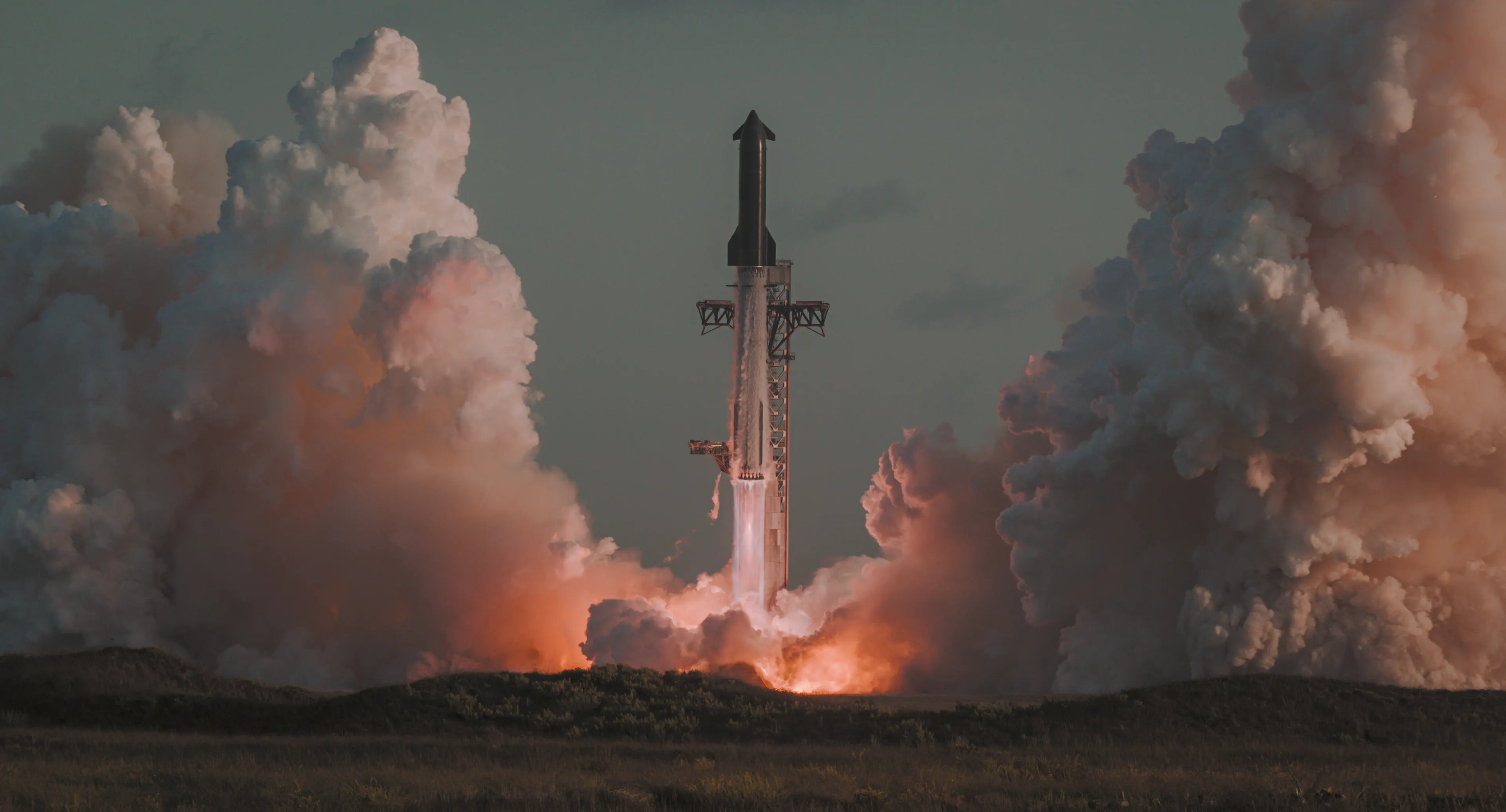
Starship lifting off from Starbase, on the Texas coast near the Mexican border. Photo: SpaceX
At 7.46 on the morning of 28 September 2026, Starship lifted off from Pad 2 at Starbase, Texas. Not long after, a voice in mission control said “Starship is orbital”, and for the first time in 14 flights it was.1 The ship then released 26 Starlink V3 satellites, each about two tonnes, and SpaceX made contact with all of them.2
“First orbital flight of Starship successful!” Elon Musk wrote on X, which by his standards was restrained.3
The flight nearly stopped short. One of the ship’s three vacuum engines failed on the way up, and at first SpaceX told its webcast audience that it had “made the call not to commit to orbit”. After more checks, about 22 minutes into the flight, controllers changed their minds and lit the engines for the orbital insertion burn.4 The mission was cut from about ten hours to three. The ship came down in the North Pacific, north of Hawaii, tipped over and burned up as planned; the booster splashed into the Gulf of Mexico and exploded, also more or less as planned.5
A missile, slightly used
In 2002 eBay bought PayPal for $1.5bn in stock. Musk, its largest shareholder, came away with about $180m after tax.6 His friends had suggestions for the money, and none of them involved rockets.
Musk wanted to land a small greenhouse on Mars, a stunt he called Mars Oasis, and he needed something to throw it there. American launches cost tens of millions of dollars. Russia had decommissioned intercontinental ballistic missiles going spare. In October 2001 and again in February 2002 he flew to Moscow with Jim Cantrell, a launch consultant, to buy some. Mike Griffin, who would later run NASA, came on the second trip, and Adeo Ressi, Musk’s friend from university, came on the first.7

The meetings went the way most bargaining goes in a Guy Ritchie film. The Russians, according to Cantrell, quoted $8m per missile, and the Americans wanted three. At one point “the chief designer got tired of listening to him and he spit on our shoes,” Cantrell later recalled.8 The price, after the spitting, did not come down.

On the flight home Musk sat with a laptop, building a spreadsheet of what a rocket is made of and what each part would cost to buy or make. Then he turned round and said, “Hey guys, I think we can build this rocket ourselves.”9
Ressi’s response was to send Musk video montages of rockets exploding, Russian, European and American, and to stage interventions with friends.10 Musk incorporated Space Exploration Technologies on 14 March 2002 and moved into a 3,000-square-foot warehouse at 1310 East Grand Avenue in El Segundo, California.11
Three bangs and a fourth try
The opposition was large and comfortable. American government launches belonged to the old aerospace primes: Boeing, Lockheed Martin and Northrop Grumman, with their decades of contracts and cost-plus accounting. In December 2006 Boeing and Lockheed merged their rocket businesses into the United Launch Alliance, which had the Pentagon’s launch business largely to itself until SpaceX was certified in 2015.12 A Delta IV Heavy cost about $350m a launch.13
SpaceX’s first rocket, the small Falcon 1, launched from Kwajalein Atoll in the Marshall Islands, and it failed three times.
The first, on 24 March 2006, caught fire within a minute: salt spray from the sea had corroded a fuel line. The second, on 21 March 2007, reached space but wobbled out of control because of propellant sloshing in its upper stage. The third, on 2 August 2008, lost its second stage when the spent first stage bumped into it after separation.14
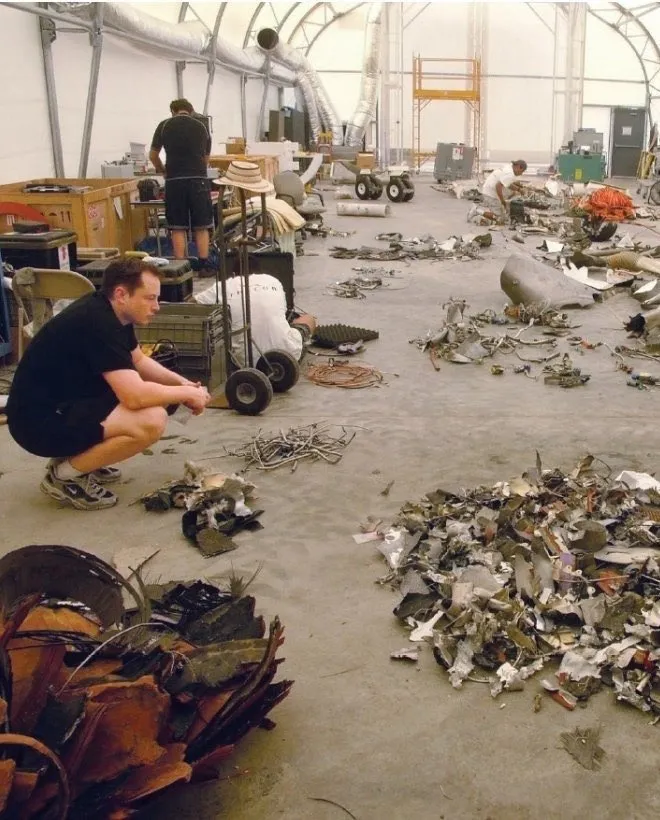
By then 2008 was going badly for everyone. Tesla was close to running out of money too, and SpaceX had enough parts and cash for one more Falcon 1. On 28 September 2008 the fourth flight reached orbit carrying a dummy payload, the first privately developed liquid-fuelled rocket to do so.15 Musk later told 60 Minutes that the fourth launch used “the last money that we had for Falcon 1”, and that if it had failed, “that would have been it for SpaceX.”16
“That would have been it for SpaceX.”
Three months later, on 23 December 2008, NASA gave SpaceX a $1.6bn contract to fly 12 cargo missions to the International Space Station.17
Falcons that come home
Falcon 9 first flew on 4 June 2010. A Dragon capsule reached the space station on 25 May 2012, the first commercial spacecraft to do so. On 21 December 2015 a Falcon 9 first stage flew back to Cape Canaveral and landed upright, and on 30 March 2017 a used booster flew again.18 On 30 May 2020 Crew Dragon took two NASA astronauts to the station, the first crew launched from American soil since the Space Shuttle retired in 2011.19
Reusable boosters changed the arithmetic. Falcon 9 lists at about $70m a launch, a fifth of the Delta IV Heavy’s price.13 In 2025 SpaceX flew 165 orbital launches, half of all the orbital launches in the world that year.20 One booster, B1067, flew for the 37th time on 25 August 2026.21
The incumbents had a harder decade. Boeing’s Starliner capsule took two astronauts to the space station in June 2024 for what was meant to be an eight-day visit. Helium leaks and thruster failures meant it came home without them, and Butch Wilmore and Suni Williams rode back on a SpaceX Dragon in March 2025, 286 days after they left.22
A rocket the weight of 880 elephants
Starship is what Musk built once the money stopped being the problem. It is a two-stage steel rocket, both stages designed to be caught or landed and flown again. The current version, V3, stands 124.4 metres tall and 9 metres across, and on the pad it holds about 5,250 tonnes of liquid methane and liquid oxygen.23
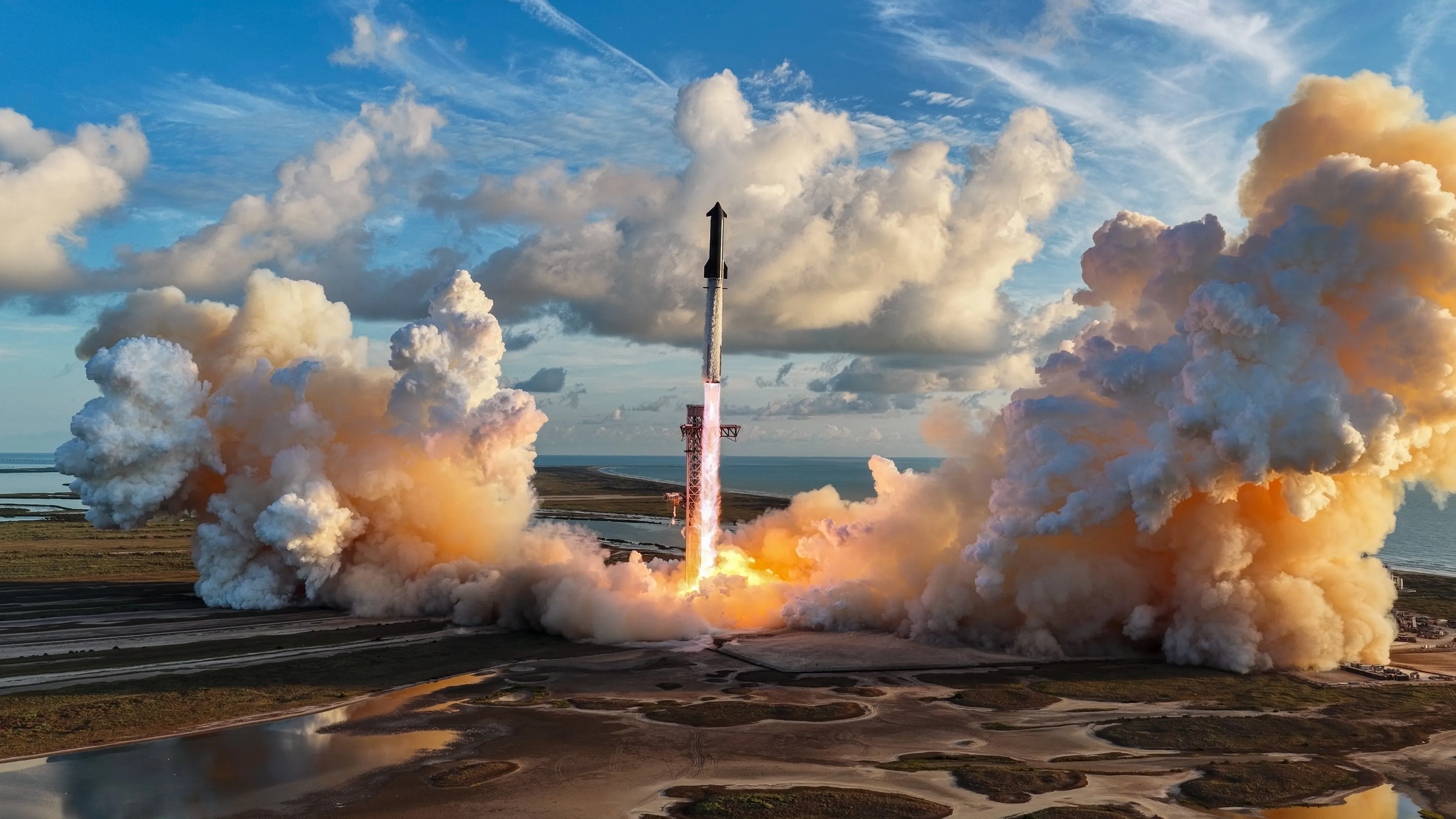
Big numbers are hard to picture, so the desk did the sums in elephants. A large African bull weighs about six tonnes and stands about 3.2 metres at the shoulder.24
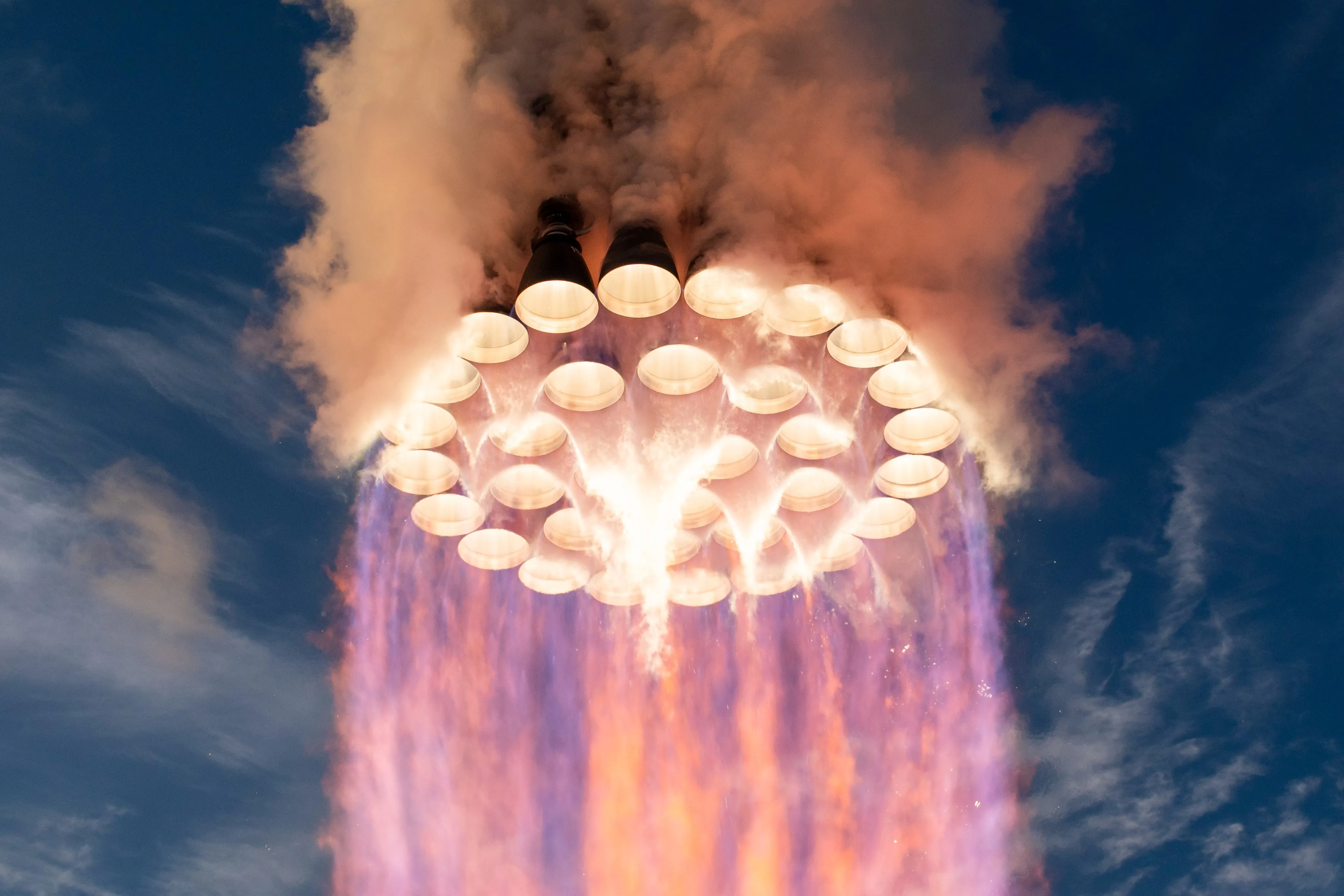
The booster, Super Heavy, has 33 Raptor 3 engines at its base. The ship on top has six more, three for use in the atmosphere and three with large nozzles for the vacuum of space. Each Raptor 3 makes about 250 tonnes of thrust; SpaceX has quoted 280 tonnes as a target.23
Fourteen flights to orbit
SpaceX tests by flying, and the early flights ended in fireballs. On the first, on 20 April 2023, the stages never separated and the rocket was blown up four minutes in. The second, that November, separated and then lost both stages. The third reached space and broke up on the way back.25
Each flight returned data, and the next one went further. Flight 4, in June 2024, brought both stages down under control. On Flight 5, on 13 October 2024, the launch tower caught the returning booster in a pair of mechanical arms nicknamed the chopsticks.25
The year 2025 opened badly. The ships on Flights 7, 8 and 9 were all lost, one of them scattering debris over the Caribbean, and in June a ship exploded on a test stand before it ever flew. Flights 10 and 11, in August and October, flew cleanly.25 The bigger V3 debuted on Flight 12 in May 2026 and lost its booster. On Flight 13, in July, it carried 20 real Starlink V3 satellites on a path that brought them back down on purpose, and the ship made its softest splashdown yet.26 Flight 14 went to orbit.
Twenty-six satellites, room for sixty
Starlink is why SpaceX needs a rocket this big. The network had about 11,000 working satellites in orbit by the end of August 2026, and SpaceX told investors it had 10.3m subscribers at the end of March.27 The older V2 Mini satellites, about 740 kilograms each, ride on Falcon 9.
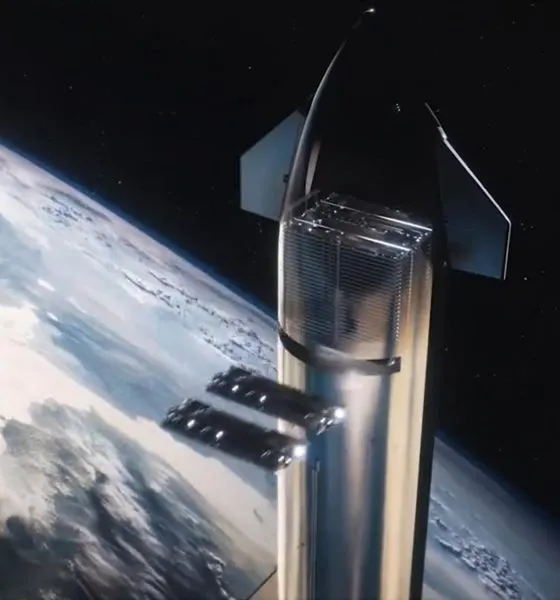
The V3 satellites weigh about two tonnes each and are too big for Falcon 9. Each one can send about 1 terabit a second down to Earth, ten times a V2’s downlink, and receive 160 gigabits a second, 22 times as much.2 A fully loaded Starship can carry 60 of them, adding about 60 terabits a second to the network in one launch, more than 20 times what a Falcon 9 load of V2 Minis adds.28
Flight 14 carried 26, and SpaceX expects them to start serving customers within weeks.4 “All 26 Starlink V3 operational satellites deployed and operating nominally,” Musk posted.3 Jared Isaacman, the NASA administrator, praised SpaceX for “managing every step in a safe, responsible and especially inspirational way.”5 SpaceX had planned to catch both stages on this flight and dropped the idea; the next flight may try a tower catch.5
Footnotes
-
Space.com, “SpaceX Starship Flight 14”, 28 September 2026; NBC News, “SpaceX Starship rocket launches to orbit for the first time”, 28 September 2026. Liftoff time is US Central Daylight Time; in UTC the flight began at about 12.46 on 28 September. Some outlets date it 29 September. Confidence: reported. ↩
-
Light Reading, “Starship reaches orbit, releases 26 high-capacity V3 Starlink satellites”, 28 September 2026. Confidence: reported. ↩ ↩2
-
Elon Musk on X, 28 September 2026, as quoted by 24/7 Wall St, 29 September 2026. Confidence: reported. ↩ ↩2
-
Light Reading, as above, quoting SpaceX spokesman Dan Huot on the webcast. Confidence: reported. ↩ ↩2
-
NBC News, as above; Interesting Engineering, 28 September 2026. Confidence: reported. ↩ ↩2 ↩3
-
Musk, “My proceeds from the PayPal acquisition were $180 million”, widely quoted; Fox Business. Confidence: reported. ↩
-
“History of SpaceX”, Wikipedia; Inverse, “Elon Musk tried to buy ICBM rockets from Russia”. Confidence: reported. ↩
-
Jim Cantrell, as quoted by Futurism, “A Russian engineer spat on Elon Musk’s shoes”. The spitting is Cantrell’s recollection; nobody on the Russian side has confirmed it. Confidence: reported. ↩
-
Cantrell’s account, retold by Jump Associates, “Elon Musk, SpaceX and the earth-shattering spreadsheet”, Medium. Confidence: reported. ↩
-
Ashlee Vance, Elon Musk (2015), excerpted in Bloomberg Businessweek. Ressi told a similar story to Esquire in 2012; Musk has said that profile “had high fiction content”. Confidence: reported. ↩
-
“History of SpaceX”, Wikipedia. Some sources give the founding date as 6 May 2002. Confidence: reported. ↩
-
United Launch Alliance, “United Launch Alliance begins operations”, 1 December 2006. Confidence: verified. ↩
-
“Delta IV Heavy” and “Falcon 9”, Wikipedia. Some estimates put a Delta IV Heavy launch as high as $450m. Confidence: reported. ↩ ↩2
-
“Falcon 1”, Wikipedia. Flight 3 was 3 August 2008 in UTC. Confidence: reported. ↩
-
As above. Confidence: reported. ↩
-
CBS, 60 Minutes, March 2014, as transcribed by Space.com. Confidence: verified. ↩
-
SpaceNews, “NASA awards space station commercial resupply services contracts to SpaceX and Orbital”, December 2008. Confidence: verified. ↩
-
“History of SpaceX” and “Falcon 9”, Wikipedia. The 2015 landing was on the evening of 21 December in Florida, 22 December in UTC. Confidence: reported. ↩
-
“History of SpaceX”, Wikipedia. Confidence: reported. ↩
-
Space.com, “SpaceX shatters its rocket launch record yet again”, January 2026. The 165 counts Falcon launches; the headline figure of 167 appears to include Starship. Confidence: reported. ↩
-
Space.com, 25 August 2026. B1067 may have flown again since. Confidence: reported. ↩
-
“Boeing Crew Flight Test”, Wikipedia; Spaceflight Now, 29 September 2026. Confidence: reported. ↩
-
“SpaceX Starship”, Wikipedia; SatNews, “SpaceX debuts Starship V3”, 14 May 2026. Thrust figures for V3 vary between sources. Confidence: reported. ↩ ↩2
-
The elephant is the desk’s own yardstick: a large African bull of 6 tonnes and 3.2 metres. Thrust in elephants divides 80.8 MN by the weight of a 6-tonne animal. Confidence: estimated. ↩
-
“List of Starship launches”, Wikipedia. The June 2025 test-stand explosion destroyed Ship 36. Confidence: reported. ↩ ↩2 ↩3
-
“Starship flight test 12”, Wikipedia; CNN, 22 May 2026; Space.com live coverage of Flight 13, 24 July 2026. Confidence: reported. ↩
-
“Starlink”, Wikipedia, satellite count as of 27 August 2026; Statista, citing SpaceX’s S-1 filing. Confidence: reported. ↩
-
Light Reading, as above; Tom’s Hardware on the V3 design. Confidence: reported. ↩