America.gov · 2000–2026
Hello, America
On 29 September 2026 the White House opened America.gov, one front door to the whole federal government. On the first day it was a chatbot that knew 29,000 government websites, and it answered some questions the White House wished it had not.
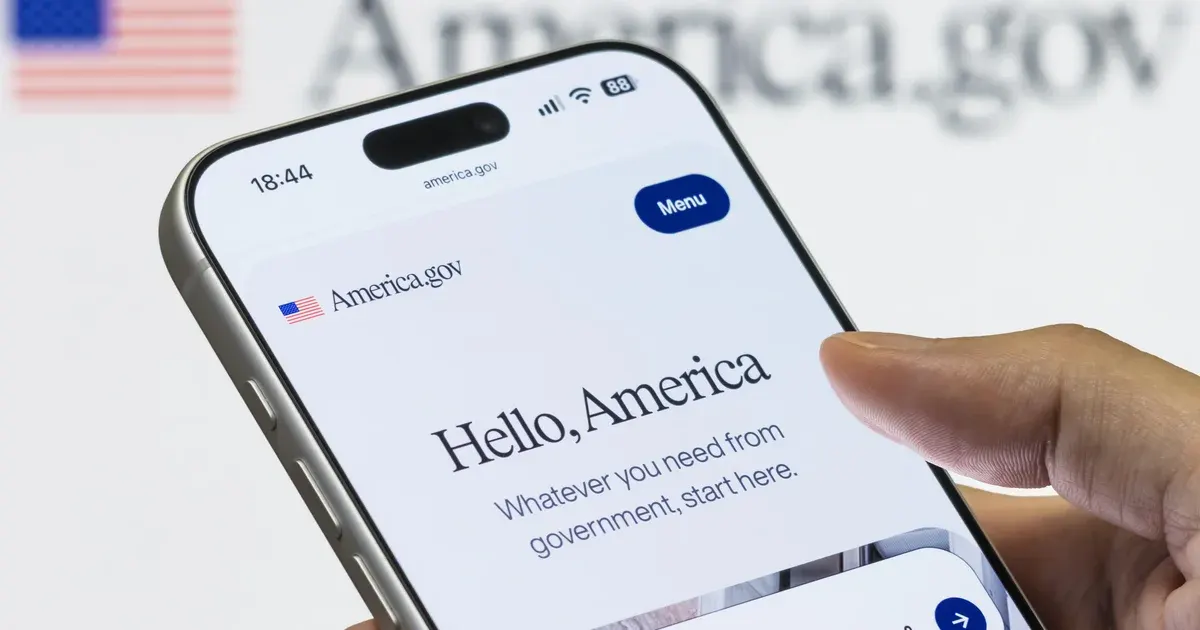
The America.gov home page on a phone. The site asks visitors what they need and answers in plain language.
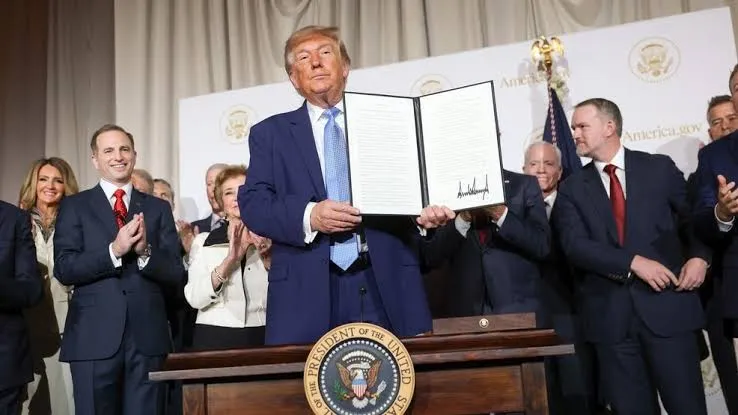
On Tuesday 29 September 2026, in the Andrew W. Mellon Auditorium a few blocks from the White House, Joe Gebbia unveiled a website. Gebbia co-founded Airbnb and is now the United States’ Chief Design Officer, and the site was America.gov, which the White House calls “the unified digital front door to the Federal Government”.1 The event was called “Hello, America”, and so is the home page.2
A citizen types what they need, in their own words, and the site answers from official sources, instead of sending them to hunt across the government’s websites, of which Gebbia’s team counts about 29,000.3 “Every day, 40 million people interact with a government website trying to get something done,” Gebbia said.4
President Donald Trump called it “one of the most revolutionary product launches of all time”, signed an executive order on stage, and told the audience that for their whole lives the government had been so big “it makes the citizen feel very, very small”. The new site, he said, is “held in the palm of your hand.”5
What works on the first day
At launch America.gov is a chatbot. Anyone can ask it a question without creating an account, and it replies with an answer and a pointer to the agency page that handles the matter.6 The White House fact sheet puts it plainly: “Right now, Americans can ask any question on America.gov and get an up-to-date answer.”7
Under the hood are two commercial models. Gebbia told CNBC the site runs on Google’s Gemini and on Grok, from Elon Musk’s xAI. Google confirmed its part in a blog post the same day; xAI did not respond to CNBC.8 “Anyone who’s used Grok or Gemini or ChatGPT will understand instantly how to use america.gov,” Trump said.5
Gebbia called the site “private by design”. The site’s privacy notice says chats are not saved and the AI companies do not keep prompts, though answers may be cached for up to two hours and, according to HuffPost, Cloudflare security logs that can include a visitor’s IP address are kept for 12 months.9
The parts that would let people actually get things done come later. Trump described a woman changing her name after marriage: she would ask America.gov, and it would “fill out the forms, track the progress, and send her a new Social Security card, passport, and insurance card in the mail.”5 According to a slide Gebbia showed, uploading a marriage certificate to the agencies of your choice belongs to “phase two”, set for early 2027.10
A passport without the drugstore
The demonstration that drew laughs was Marco Rubio’s. The Secretary of State walked through applying for a first passport on America.gov, signed in with Login.gov, which showed him “the information that the government already has about me in its system.”11
The photograph can be taken on the applicant’s own phone and previewed as it will look in the finished passport. “You’re not going any longer to some drugstore to get your picture taken behind a white screen,” Rubio said. He paid, called it “the most beautiful government checkout I’ve ever seen”, and got an estimated delivery date.11
“No printing forms, no drugstore hostage photo, no appointment, no line.”
“No printing forms, no drugstore hostage photo, no appointment, no line, no middleman that you’re paying to do something that should be available to you,” he said.11 Rubio said first-time applications would open online “starting next year”, and that by the end of 2027 the goal is for “the vast majority of Americans” to apply this way. In 2028 the department will issue a redesigned passport, made with Gebbia’s studio.12
The State Department issued 27.3m passports in the 2025 financial year, the most since its records begin in 1996.13 Renewals have been possible online since September 2024, and 1.5m people had used that service by January 2025.14 What is new is the first passport, which until now has meant a paper form, a photo shop and an appointment in person.
The order behind it
The order Trump signed, “Streamlining Access to Government Services Through America.gov”, is Executive Order 14432.15 It promises that the site “will not be merely another website, search engine, or directory of Government links”, and that it “will enable the Federal Government to do its own paperwork so that the American people may get on with their lives.”1
It covers every public-facing federal service used by more than 100,000 people a year that can be reached online, except tax filing with the Internal Revenue Service and services of the Department of War and the intelligence agencies. The General Services Administration runs the site with the National Design Studio and the Office of Management and Budget, and Login.gov is the sign-in. Agencies must open their existing application programming interfaces, dashboards and digital forms to it.1
The order keeps the old routes open. In-person, telephone, mail and agency websites stay, so that America.gov “provides a better option but does not become the only option”. It also says joining up access must not create “a centralized Federal system of records concerning the American people.”1
Trump signed a second order that day, EO 14434, “Inaugurating the Era of Super Intelligence”. It tells the government to say “Super Intelligence” in place of AI where it can.16 “We’re changing the name to superintelligence,” Trump said.5
Who built it
America.gov was designed and built by the National Design Studio, which Trump created by executive order on 21 August 2025 along with the post of Chief Design Officer, and which includes former members of DOGE, Musk’s cost-cutting team.17 The General Services Administration operates it.18 Trump thanked Musk as “the man who initially envisioned the transformation of government through technology”, and named Edward Coristine, a DOGE engineer known online as “Big Balls”, as lead engineer.19
Gebbia’s Airbnb went through Y Combinator, the startup programme, in its winter 2009 batch.20 Balaji Srinivasan saw the launch as the kind of event the tech industry throws for itself. It had “the unmistakable feel of an Apple launch event,” he wrote on X. “They’re rebooting the federal government as a tech startup.”21
What it cost has not been said. The White House, the General Services Administration and xAI did not answer FedScoop’s questions about the contracts, and Google did not answer questions on cost.22
The first day
The chatbot answered from official sources, and the official sources sometimes disagreed with the president. Asked about the 2020 election, it said official records showed Joe Biden won. On climate it said “recent warming is largely from human greenhouse-gas emissions.” It named George Washington, Herbert Hoover and John F. Kennedy as presidents who gave up their salaries, after Trump had told the audience that, as he understood it, no other president had served without pay.23
Elizabeth Warren posted its one-word answer to whether the Iran war had raised fuel prices: “Yes.”24 “Finally, a straight answer from someone in the Trump administration,” Adam Schiff wrote.25 By the next day, according to AFP, it replied: “I do not provide political commentary or analysis of past elections.” AP reported the change starting during the launch itself.25
The chat also went down for a while. Gizmodo found it unavailable on the afternoon of the launch, and on Wednesday morning it showed “Chat is unavailable right now”.26 No cause was given. Visitors found two easter eggs: asking about Minecraft returns a rewritten version of the game’s “End Poem”, and typing “hotdog” brings up a hot dog, which for a while multiplied with every keystroke.27
The front doors before it
America.gov is not Washington’s first one-stop shop. FirstGov opened on 22 September 2000, launched in a webcast from the Oval Office, and was renamed USA.gov in 2007.28 NBC News found that the new chatbot often sends people there.29
The best-known failure came on 1 October 2013, when HealthCare.gov opened and, according to notes released by the House Oversight Committee, six people managed to enrol on the first day.30 In August 2014 the government set up the United States Digital Service, whose first head, Mikey Dickerson, had worked on the HealthCare.gov rescue. Trump renamed it the DOGE Service on 20 January 2025, and on 1 March 2025 the General Services Administration shut 18F, a digital team of about 90 to 100 people that built services for other agencies.31
Britain went down this road earlier. GOV.UK replaced the old Directgov site on 17 October 2012, putting the government’s services under one domain, and it added a phone app in July 2025.32
The verdicts
Dickerson was unmoved. “You announced a demo which solved like the easiest 5% of the problem,” he told FedScoop, “and I’m not going to get impressed until you solve some of the actual hard parts.” Amanda Renteria, who runs Code for America, said success would be measured by the technology’s impact on people “often experiencing one of the hardest moments of their lives.”22
Philip Fields, a security researcher, told HuffPost he would advise against submitting sensitive information once applications open. An unnamed White House official replied: “These researchers are idiots.”9
Srinivasan was rooting for it. “As a tech startup, there will no doubt be bugs and user issues and so on,” he wrote, “but unlike with paper laws those issues will be visible and the code fixes will be verifiable.”21 Under the order, the Office of Management and Budget has 90 days to tell agencies how to plug in, which runs to 28 December 2026.1
Footnotes
-
White House, “Streamlining Access to Government Services Through America.gov”, executive order, 29 September 2026, Secs. 1–5. The 90-day deadline is counted by the desk from 29 September. Confidence: verified. ↩ ↩2 ↩3 ↩4 ↩5
-
FedScoop, “Trump launches AI-fueled America.gov in bid to tie government services together”, 29 September 2026. Gebbia’s title is from @RapidResponse47 on X, 29 September 2026. Confidence: reported. ↩
-
FedScoop and CNBC give “roughly 29,000” websites; the General Services Administration’s release says “more than 29,000”. Confidence: reported. ↩
-
CNBC, “New AI-powered government website uses Gemini, Grok, Trump official Gebbia says”, 29 September 2026. Confidence: reported. ↩
-
Trump’s remarks, from a third-party transcript (The Singju Post, 30 September 2026). No official White House transcript was found. The transcript reads “the entire US government will fit in the plan”, probably a mishearing of “palm”; the text quotes only the words that are clear. Confidence: reported. ↩ ↩2 ↩3 ↩4
-
FedScoop, as above; Nextgov/FCW, “White House launches AI-powered ‘America.gov’ digital front door”, 29 September 2026; CNET, 30 September 2026. The desk could not load America.gov itself. Confidence: reported. ↩
-
White House, “Fact Sheet: President Donald J. Trump Streamlines Access to Government Services Through America.gov”, 29 September 2026. Confidence: verified. ↩
-
CNBC, as above, which says xAI has been renamed SpaceXAI; Google, “Google is a technology partner for the launch of America.gov”, 29 September 2026. xAI has not confirmed its role. Confidence: reported. ↩
-
FedScoop, as above, quoting the privacy notice; HuffPost, “White House Responds To Security Concerns About New AI Tool: ‘These Researchers Are Idiots’”, 30 September 2026. Nextgov reads the same notice as saying the site does not use location; FedScoop and The Register say it uses approximate location. Confidence: reported. ↩ ↩2
-
Nextgov/FCW, as above, from Gebbia’s presentation. Confidence: reported. ↩
-
US Department of State, “Secretary of State Marco Rubio at President Trump’s America.gov Event”, transcript, 29 September 2026; @StateDept on X, 29 September 2026. Confidence: verified. ↩ ↩2 ↩3
-
State Department transcript, as above. Nextgov and Spectrum News, citing a slide at the event, say December 2026; the White House fact sheet says passport renewal arrives “later this year”. The text follows Rubio’s spoken words. Confidence: reported. ↩
-
USAFacts, “How many US passports are issued each year?”, updated 28 August 2026, from State Department data. Confidence: reported. ↩
-
US Department of State, “Setting Records in U.S. Passport and Visa Services”, January 2025. Confidence: verified. ↩
-
Federal Register, public inspection document 2026-20319, filed 1 October 2026, to be published 2 October 2026. Confidence: verified. ↩
-
Federal Register, public inspection document 2026-20321; FedScoop, as above. Confidence: reported. ↩
-
White House, “Improving Our Nation Through Better Design”, executive order 14338, 21 August 2025; Nextgov/FCW, as above, for the former DOGE staff. Confidence: verified. ↩
-
General Services Administration, “GSA Joins the White House’s National Design Studio in Unveiling America.gov”, 29 September 2026. Confidence: verified. ↩
-
Trump’s remarks, Singju Post transcript, as above; FedScoop, as above, for Coristine’s nickname. Confidence: reported. ↩
-
Y Combinator, company page for Airbnb (“Batch: Winter 2009”). Confidence: verified. ↩
-
Balaji Srinivasan on X, 29 September 2026. Confidence: verified. ↩ ↩2
-
AP, as published by Fortune, 29 September 2026; IBTimes UK, 1 October 2026; Business Today, 30 September 2026. Confidence: reported. ↩
-
Benzinga, September 2026, reporting Warren’s post. Confidence: reported. ↩
-
AFP, as published by RTÉ, 1 October 2026; AP, as above. AP says the answers began changing during the launch; AFP says within 24 hours. Confidence: reported. ↩ ↩2
-
Gizmodo, 29 September 2026; IBTimes UK, as above. Confidence: reported. ↩
-
TechCrunch, 29 September 2026, which says the Minecraft answer is deliberate; The Register, 30 September 2026; CNET, as above. Confidence: reported. ↩
-
“USA.gov”, Wikipedia. Confidence: reported. ↩
-
NBC News, “Trump’s new America.gov AI chatbot often links to a site launched under Clinton 26 years ago”, 30 September 2026. Confidence: reported. ↩
-
House Oversight Committee, release of HealthCare.gov meeting notes from 2 October 2013 (“6 enrollments have occurred so far”); NBC News, November 2013. Confidence: reported. ↩
-
“United States Digital Service”, Wikipedia; FedScoop, “GSA shutters 18F, possibly leaving agencies in the lurch”, March 2025. Confidence: reported. ↩
-
“GOV.UK”, Wikipedia; Government Digital Service blog, “GOV.UK app: One year of easier, faster services in your pocket”, 1 July 2026. Confidence: reported. ↩