Sridhar Vembu and Zoho · 1968–2026
The billionaire who moved to the village
Sridhar Vembu left a clerk's household in Chennai for IIT and Princeton, spent three decades building Zoho abroad without a rupee of outside money, then took his desk to a village in Tenkasi.
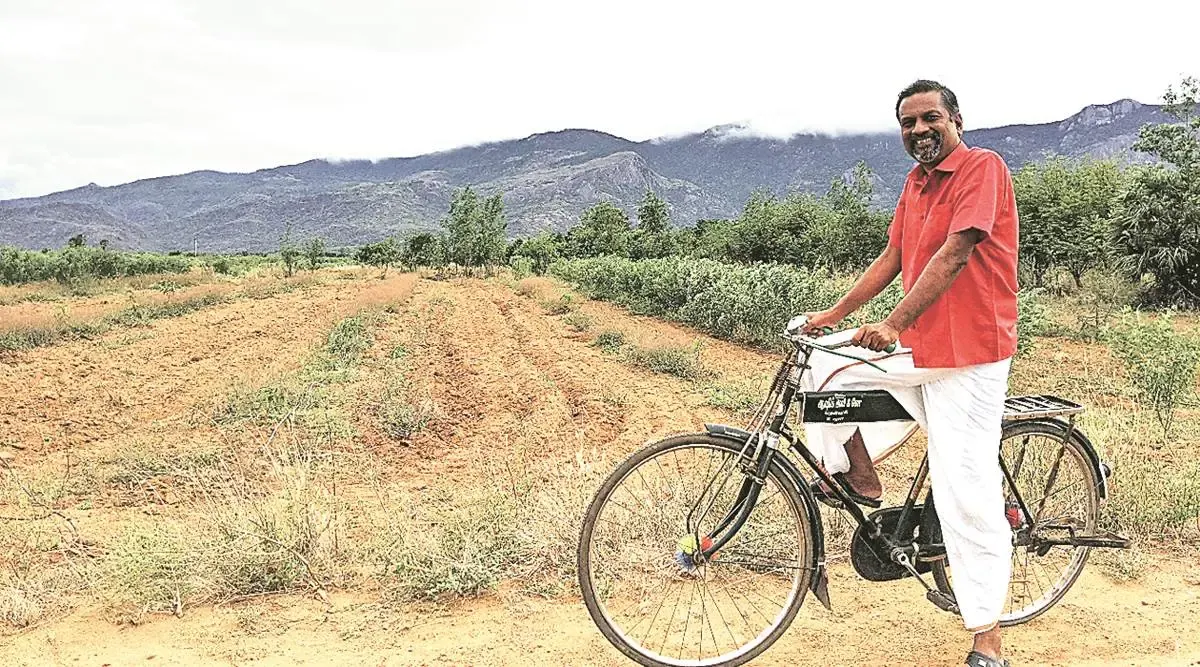
Sridhar Vembu on a bicycle beside farmland, with hills behind.
In October 2019 one of India’s richest men moved to Mathalamparai, a village in Tenkasi district about 650 km south of Chennai. Sridhar Vembu, co-founder of the software company Zoho, had lived abroad for most of three decades.1 In the village he took calls with America from four in the morning, walked at six, swam now and then in the village well and spent afternoons growing paddy, vegetables and fruit. He was in bed by eight. A Forbes India reporter who visited in 2020 added that he spotted snakes, and a few times caught them.2
“I always thought that people migrating from villages to cities is not a good idea,” he told the magazine.3
Forbes puts the fortune of Vembu and his siblings at $5.8bn.4 He has never sold Zoho to investors or the stock market. The company has never taken outside money, and Vembu and his family hold most of it.5
A stenographer’s son
Vembu was born in 1968, the eldest of five children of Sambamurthy and Janaki Vembu. His parents came from villages in Thanjavur district and had moved to Chennai, where he grew up. A family of seven lived on Sambamurthy’s pay as a stenographer at the Madras High Court; Janaki kept the house.6 “We noticed that Sridhar was from a low-income family,” T T Narendran, who taught him at IIT Madras, later said.7
He went to a Tamil-medium school in Chennai, aided by the government and paid for by a philanthropist, Jaigopal Garodia, to whom Vembu has said he owes a great deal. He came fourth in the state in the Class 10 board exams.8 In Class 11 a classmate mentioned IIT, which he had never heard of. He joined coaching classes. “We had never heard of it,” his youngest brother, Mani, said. “He prepared for the exam without telling our parents.”9
He placed 27th in the entrance exam and entered IIT Madras in 1985. “Sridhar outshone the rest when it came to academics,” Professor Narendran said.10 He graduated in electrical engineering in 1989 and went to Princeton, where in 1994 he finished a PhD in information theory and wrote papers with Sergio Verdú, a professor there.11 He never put “Dr” in front of his name, and, by one account, later burnt his thesis.12
“I moved to silicon valley in April 1996… I was miserably unprepared and blew my life savings.”
Silicon Valley, with nothing in the bank
After Princeton he spent two years as a wireless engineer at Qualcomm in San Diego.13 His own account of what came next is less tidy than the usual founding story. In 1995 and 1996 his brothers Kumar and Sekar and their friend Shailesh Kumar started a small software business from home in East Tambaram, a suburb of Chennai, while Tony Thomas ran another from a bedroom in New Jersey. Vembu moved to Silicon Valley in April 1996 and tried to build hardware. “I was miserably unprepared and blew my life savings,” he wrote. He paid his bills with contract programming, including a stint as a bug fixer for an ATM software company, and “joined” the brothers’ business in May 1997. “I put ‘join’ in quotes because there was no job to join.”14
The company, AdventNet, sold about $350,000 of software in 1997 and put all of it back into the business. It passed $1m in sales in 1998.15 It launched ManageEngine, its IT management line, in 2002, and its first Zoho office app, Zoho Writer, in 2005. In 2009 it renamed itself Zoho Corporation.16
What Zoho became
Zoho now sells more than 55 apps: email, spreadsheets, accounting, customer records, a browser, an AI model, a messaging app. In February 2026, its 30th year, it said it had more than a million paying customers, 150 million users and about 19,000 staff in 28 countries, with its headquarters in Chennai.17 In the year to March 2025 it made operating revenue of ₹12,313 crore and a profit of ₹3,191 crore.18
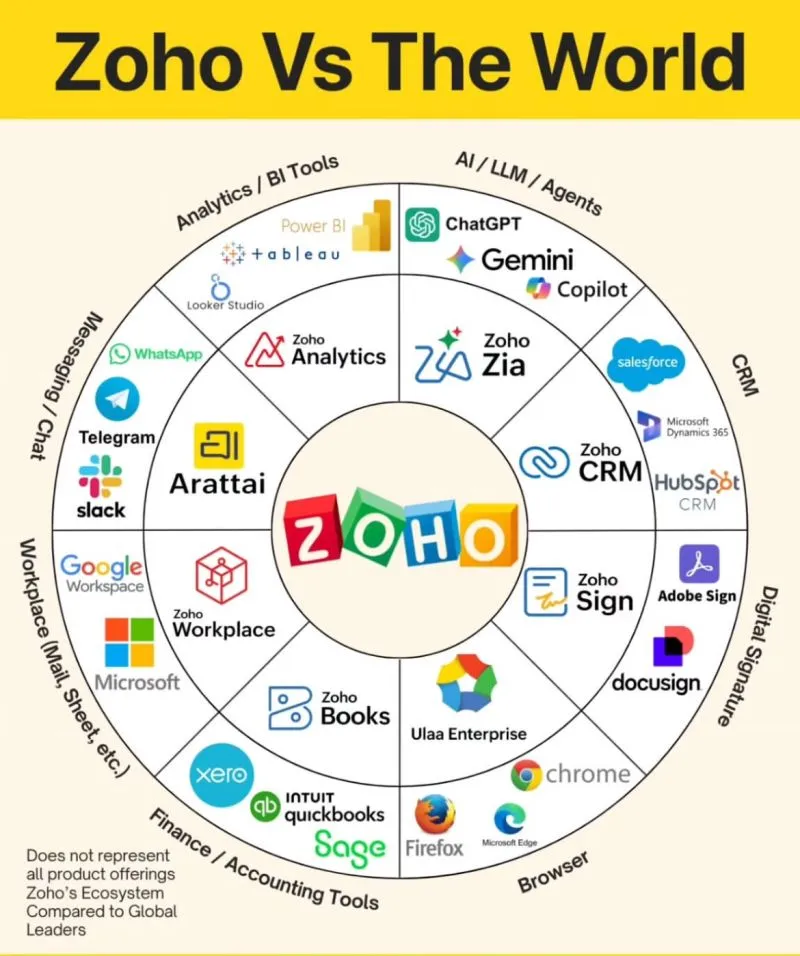
Vembu has turned down every suggestion to list it. When Arattai took off in 2025, he answered calls for a share sale by saying the app “would very likely not have been built by a public company that faces quarter to quarter financial pressure”. He added: “We have a culture of founders and senior executives living frugally, like how good scientists and engineers in ISRO would live.”19
Zoho also hires people without degrees. Zoho Schools of Learning began in 2005 with six students and two teachers. It charges no fees and pays its students a stipend, ₹10,000 a month in 2020. It now gets about 20,000 applications a year and has turned out more than 2,000 graduates; Zoho says more than a tenth of its staff came through it.20
Offices among the fields
Zoho’s first rural office opened in Tenkasi in 2011, eight years before Vembu followed it, with a team of six.21 By about 2021 the Tenkasi office had 750 staff, close to 600 of them from the district.22 In October 2025 The Week counted 1,200 people at the Mathalamparai campus, and more than 3,000 working in about 100 Zoho offices in small cities and villages.23 There are campuses at Tharuvai near Tirunelveli and at Kappalur near Madurai, “about 1 hour from where I live in Tenkasi”, as Vembu put it, and since July 2025 an AI and robotics centre at Kottarakkara in Kerala.24
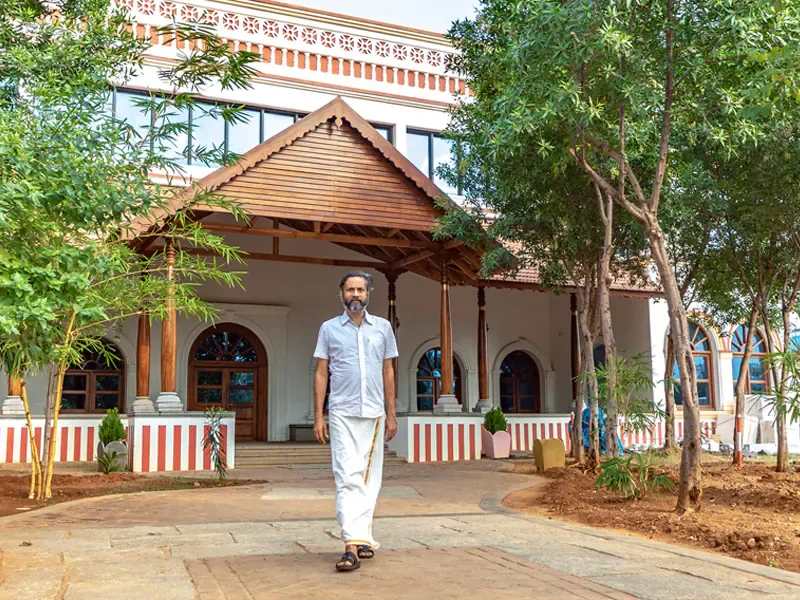
The model is hub and spoke. Hubs of 500 to 1,000 people do the training; small spoke offices of 10 to 20 sit in villages around them. “We cannot train talent remotely,” Vembu said.25 He has described the aim as “distributing growth and income across Tier 2/3 communities”.26 A study Zoho cites puts the local multiplier at ten jobs for every one it brings.27 In the company’s own survey of its Tenkasi staff, 58 per cent were paying for a family member’s education and 67 per cent were sending money to family or friends.28 A local vegetable supplier earns about ₹20,000 a day feeding the campus.29
For short trips Vembu uses an electric autorickshaw. “I am excited that my brand new electric auto Montra from the Murugappa Group is here,” he wrote in April 2024. “Fast pick up and nice suspension. I am loving it!”30
A free school in Govindaperi
When the schools shut in the 2020 lockdown, Vembu began teaching village children. That grew into Kalaivani Kalvi Maiyam, a free school in Govindaperi, near Mathalamparai.31 By April 2023 it had 130 pupils, 19 full-time and five part-time teachers, Montessori classes for the youngest and the national open-schooling (NIOS) curriculum for the older ones. A building for 750 pupils was going up, and a second school was planned at Cumbum in Theni district.32 Vembu calls it “our rural school Kalaivani Kalvi Maiyam, which provides completely free education to rural children”.33 Forbes lists among his works that he “funds a rural school in southern Tamil Nadu”.34
Zoho spends well past what the law asks of it. In 2020–21 its spending on corporate social responsibility was ₹54.07 crore, against a legal minimum of ₹12.74 crore, and more than half went on the environment, mostly in Tamil Nadu.35 In the second Covid wave of April 2021, Vembu announced kitchens in Guduvanchery, Mathalamparai and Gudalur serving 6,000 free meals a day.36 In 2022 Zoho put about $2.5m into Genrobotics, a Kerala start-up building robots to clean sewers so that people no longer have to go down them.37
The government gave him the Padma Shri in 2021. “It is a huge honor and I feel humbled,” he said. “I dedicate this to our employees, my extended family, for keeping the faith.”38
Arattai and the swadeshi rush
Arattai, Tamil for “chat”, is Zoho’s messaging app. It soft-launched in January 2021 and sat quietly for four years.39 In September 2025 ministers took up the government’s call to use Indian software. Ashwini Vaishnaw, the IT minister, gave a Cabinet briefing from Zoho’s presentation app: “It was not Microsoft PowerPoint, it was Zoho.” Dharmendra Pradhan, the education minister, asked everyone to “switch to India-made apps for staying connected with friends and family”.40
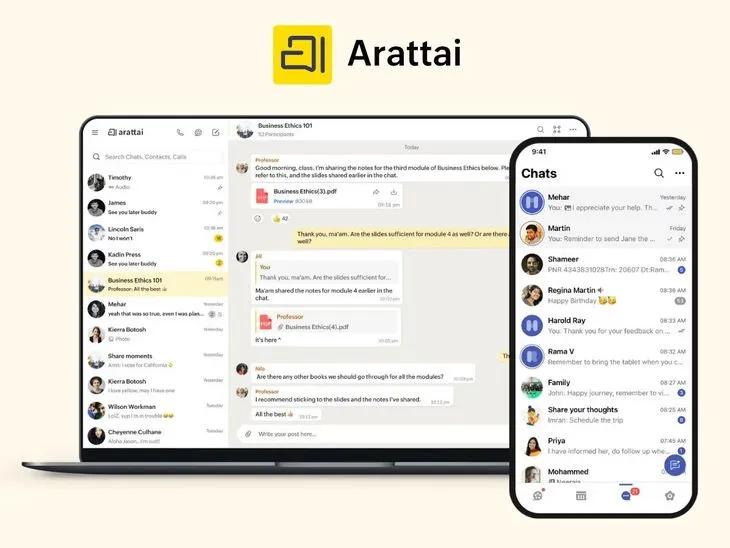
“We have faced a 100x increase in Arattai traffic in 3 days,” Vembu wrote on 28 September 2025. “New sign-ups went vertical from 3K/day to 350K/day.”41 About two million people signed up in a single day in early October, and the app topped the App Store’s social networking chart in India. It was downloaded 13.8 million times that month.42 Then the rush faded. By 4 November Arattai ranked 105th on Google Play.43 In January 2026 Shailesh Kumar Davey, Zoho’s chief executive, put it at about 25 million downloads and about four million monthly users.44
The surge also exposed a gap. Arattai encrypted calls end to end, but not text chats.45 Zoho added end-to-end encryption to one-to-one chats on 18 November 2025 and to group chats in the last week of September 2026. “This took time because we had to redo a lot of the app,” Vembu wrote, “but finally it is here!”46
Zoho Mail had a bigger year. The central government had picked Zoho in 2023 to replace its own email system, and by 1 April 2026 it had moved 16.68 lakh official accounts there, at a cost of ₹180.10 crore.47 On 8 October 2025 the home minister, Amit Shah, wrote on X: “Hello everyone, I have switched to Zoho Mail.”48 Ulaa, Zoho’s web browser, won the IT ministry’s challenge for an Indian browser in March 2025.49
Catalyst, and the machines underneath
Zoho runs its software on its own servers in its own data centres. “All our services run on hardware we own and software frameworks we developed, on top of open source like Linux OS and Postgres,” Vembu wrote this week.50
Catalyst opens that stack to outside developers. It went into early access in October 2019 as a platform for serverless functions and microservices, and became generally available in October 2023, with functions, a data store, file storage, scheduled jobs, machine learning and data centres in the United States, Europe and India.51 Version 2.0 added QuickML, for building machine-learning models without code, and AppSail, for hosting whole applications.52 Catalyst 3.0, released on 2 September 2026, is aimed at AI coding agents: it connects to tools such as Claude Code and Codex and can take an app from a prompt to production.53 Vembu says students will get it free.54
In July 2025 Zoho released Zia LLM, its own family of language models with 1.3, 2.6 and 7 billion parameters, trained on Nvidia chips in its own data centres in India, the United States and Europe.55 Forbes India put the cost at about $20m.56
Not every project went ahead. Zoho planned a $700m compound-semiconductor plant in Mysuru, and dropped it in May 2025. “Since this business is so capital intensive it requires government backing, we wanted to be absolutely sure of the technology path before we take taxpayer money,” Vembu said. “We did not have that confidence in the tech.”57
Chief scientist
On 27 January 2025 Vembu handed the chief executive’s job to Shailesh Kumar Davey, a co-founder, and became Zoho’s chief scientist. “It has been decided that it is best that I should focus full time on R&D initiatives, along with pursuing my personal rural development mission,” he wrote. He said he was “very happy to get back to hands on technical work”.58
In April 2026 he wrote an open letter to Indians in America. “America was good to us,” it began. “For that we must remain grateful.” India, he wrote, had exported too much of its talent. “Please come back home.”59
| Year | Sridhar Vembu |
|---|---|
| 1968 | Born, eldest of five; grows up in Chennai |
| 1985 | Enters IIT Madras, 27th in the entrance exam |
| 1989 | Graduates in electrical engineering; leaves for Princeton |
| 1994 | PhD, Princeton; joins Qualcomm in San Diego |
| April 1996 | Moves to Silicon Valley; loses his savings on a hardware venture |
| May 1997 | Joins his brothers’ software business, AdventNet |
| 2005 | Zoho Writer launches; Zoho Schools of Learning opens with six students |
| 2009 | AdventNet becomes Zoho Corporation |
| 2011 | Zoho opens its Tenkasi office with six people |
| October 2019 | Moves to Mathalamparai, Tenkasi district; Catalyst enters early access |
| 2020 | Free school opens in Govindaperi |
| 2021 | Padma Shri; Arattai soft-launches |
| 27 January 2025 | Steps down as chief executive to become chief scientist |
| September 2025 | Arattai sign-ups jump from 3,000 to 350,000 a day |
| 2 September 2026 | Catalyst 3.0 released |
| September 2026 | Arattai group chats get end-to-end encryption |
Footnotes
-
Forbes India, Naandika Tripathi, “Sridhar Vembu’s vision from the village”, 3 June 2020, gives October 2019; The News Minute says late 2019; some later reports say early 2020. “Three decades” is the desk’s count from his 1989 departure for Princeton. Confidence: reported. ↩
-
Forbes India, 3 June 2020. Confidence: reported. ↩
-
Forbes India, 3 June 2020. Confidence: reported. ↩
-
Forbes real-time billionaires, “Sridhar Vembu & siblings”, read 1 October 2026. The figure is for Vembu and his siblings together, not for him alone. Forbes India’s 2025 rich list gave $6.0bn, 47th in India. Confidence: verified. ↩
-
Zoho, “About us”; Forbes profile: “Vembu and his two siblings own a majority stake in the company”. Confidence: verified. ↩
-
The News Minute, Indulekha Aravind, profile of Sridhar Vembu, 9 January 2026; Founding Fuel, N S Ramnath, “The Contrarian”, 18 June 2022. Most reports give his birthplace as Thanjavur district; Founding Fuel says his parents moved to Chennai a few years before he was born. Forbes India (2020) describes “a family of farmers”, which fits the family’s roots rather than his father’s job. Confidence: reported. ↩
-
The News Minute, 9 January 2026. Confidence: reported. ↩
-
Business Today, 12 January 2026; Open, V Shoba, “Sridhar Vembu: The Code Breaker”, 30 July 2015. Confidence: reported. ↩
-
Founding Fuel, 18 June 2022; Mani Vembu quoted in Open, 30 July 2015. Confidence: reported. ↩
-
The News Minute, 9 January 2026. The rank appears in that source only. Confidence: reported. ↩
-
IIT Madras on X, January 2021 (“B. Tech Electrical Engineering, 1989”); Princeton University Library catalogue, “Information theory without ergodicity assumptions: some new results”, 1994; papers co-written with Sergio Verdú in IEEE Transactions on Information Theory. Confidence: reported. ↩
-
Founding Fuel, 18 June 2022. Confidence: reported. ↩
-
Forbes profile (“began his career at Qualcomm in 1994”); Forbes India, 3 June 2020 (“for two years”). Confidence: reported. ↩
-
Sridhar Vembu, “25 years of Zoho”, Zoho blog, 16 March 2021. Zoho’s About page gives 1996 and New Jersey as the founding year and place. Confidence: verified. ↩
-
Sridhar Vembu, “25 years of Zoho”, 16 March 2021. Confidence: verified. ↩
-
Same; Zoho, “About us”; TechCrunch, 16 October 2019. Confidence: verified. ↩
-
Zoho press release, “Zoho Corporation Surpasses One Million Customers”, 18 February 2026; Forbes India, Naini Thaker, 11 December 2025, for the 55 products. Confidence: verified. ↩
-
Entrackr, 8 April 2026, and Indian Startup News, 10 April 2026, from Zoho Corporation’s filings with the Registrar of Companies. Total income, including other income, was ₹13,544 crore, which some outlets report as revenue. Figures for the year to March 2026 had not been published by 1 October 2026. Confidence: reported. ↩
-
Vembu on X, 28–29 September 2025, as quoted by Business Today, 29 September 2025. Confidence: reported. ↩
-
Zoho press release on the school’s 20th anniversary, 22 April 2025; Forbes India, 3 June 2020, for the stipend. Some biographies give 2004 as the founding year. Zoho’s estimates of the share of staff vary from “over 10%” to about 15 per cent; Forbes India (December 2025) says about 20 per cent. Confidence: verified. ↩
-
Outlook Business, “Zoho beyond the bustling city”, c. 2021; The Week, 11 October 2025. Confidence: reported. ↩
-
Outlook Business, c. 2021. Confidence: reported. ↩
-
The Week, “Sridhar Vembu’s vision: How Zoho transformed Tenkasi into rural tech hub”, 11 October 2025. Confidence: reported. ↩
-
Vembu on X, September 2024; Zoho press release, 2 July 2025. Confidence: verified. ↩
-
Entrepreneur India, S Shanthi, 19 May 2022; Forbes India, 3 June 2020, for the 10-to-20-person centres. Confidence: reported. ↩
-
Zoho release on its rural hubs, April 2023. Confidence: verified. ↩
-
Outlook Business, c. 2021, citing a study by Economix Consulting Group. Confidence: reported. ↩
-
Zoho, “Rural Revival” page, read 1 October 2026. This is the company’s own survey. Confidence: reported. ↩
-
The Week, 11 October 2025. Confidence: reported. ↩
-
Vembu on X, April 2024. Confidence: verified. ↩
-
Zoho release, April 2023, for the school’s founding in 2020. That Vembu taught the first children himself comes from smaller outlets only. Confidence: reported. ↩
-
Zoho release, April 2023, as carried by CXOToday and Business Standard. Confidence: verified. ↩
-
Vembu on X, June 2026. Confidence: verified. ↩
-
Forbes profile, read 1 October 2026. Zoho’s 2023 release says the school is operated by Zoho; Business Today (June 2026) calls it Vembu’s trust. Confidence: reported. ↩
-
The CSR Universe, 1 May 2023, from Zoho’s filings for 2020–21. Confidence: reported. ↩
-
Vembu’s posts on X, April 2021, as reported by Curly Tales and others. Later reports put the figure at up to 30,000 meals a day. Confidence: reported. ↩
-
Forbes profile; press reports, May 2022, name Zoho Corporation as the investor. Confidence: reported. ↩
-
Ministry of Home Affairs, Padma Awards 2021, 25 January 2021; Vembu quoted by The News Minute, 26 January 2021. Confidence: verified. ↩
-
The Economic Times, 12 January 2021, as cited by Wikipedia. Confidence: reported. ↩
-
The Sunday Guardian, 24 September 2025; Dharmendra Pradhan on X, 24 September 2025, as quoted by Organiser. Confidence: reported. ↩
-
Vembu on X, 28 September 2025. Confidence: verified. ↩
-
Gulf News, updated 18 October 2025; The Economic Times, 29 September 2025; Moneycontrol figures, 4 November 2025. Confidence: reported. ↩
-
Moneycontrol figures, as posted by Chandra R Srikanth, 4 November 2025. Confidence: reported. ↩
-
The Edge Malaysia, January 2026. Confidence: reported. ↩
-
Storyboard18, 6 October 2025; Business Today, 13 November 2025. Confidence: reported. ↩
-
Arattai on X, 18 November 2025; Vembu on X, quoted by Storyboard18, 25 September 2026. Confidence: reported. ↩
-
Jitin Prasada, minister of state for electronics and IT, in Parliament on 1 April 2026, as reported by The News Mill and Deccan Herald. About 12 lakh accounts had moved by October 2025. Confidence: reported. ↩
-
Amit Shah on X, 8 October 2025. Confidence: verified. ↩
-
CXOToday, March 2025. Confidence: reported. ↩
-
Vembu on X, about 30 September 2026, as quoted by News Karnataka, 1 October 2026. Confidence: reported. ↩
-
TechCrunch, Frederic Lardinois, 16 October 2019; Catalyst blog, 10 October 2023. A later Catalyst post says the platform “originally launched in 2021”. Confidence: verified. ↩
-
Catalyst blog, “Catalyst 2.0”, 2023. Confidence: verified. ↩
-
Zoho announcement, 2 September 2026, as carried by Republic World. Confidence: reported. ↩
-
Vembu on X, as quoted by News Karnataka, 1 October 2026. Confidence: reported. ↩
-
Zoho press release, 17 July 2025. Confidence: verified. ↩
-
Forbes India, 11 December 2025. Confidence: reported. ↩
-
eeNews Europe, 5 May 2025, after a Reuters report. Confidence: reported. ↩
-
Vembu on X, 27 January 2025; Moneylife, 27 January 2025. Confidence: verified. ↩
-
Vembu on X, 27 April 2026, as quoted by India Blooms. Confidence: reported. ↩