AP liquor · Part 2 · 1790–2026
The abkari raj
In 1907 the Imperial Gazetteer of India explained how the Raj sold liquor: the Collector fixed the number and place of the shops, and the right to sell was auctioned. Andhra Pradesh still fixes the shops and sells the right, now by lottery at a set fee, with the tax on top. A California liquor store pays $1,009 a year for its licence. At Andhra's rate, measured against income, it would pay up to $3.6m.
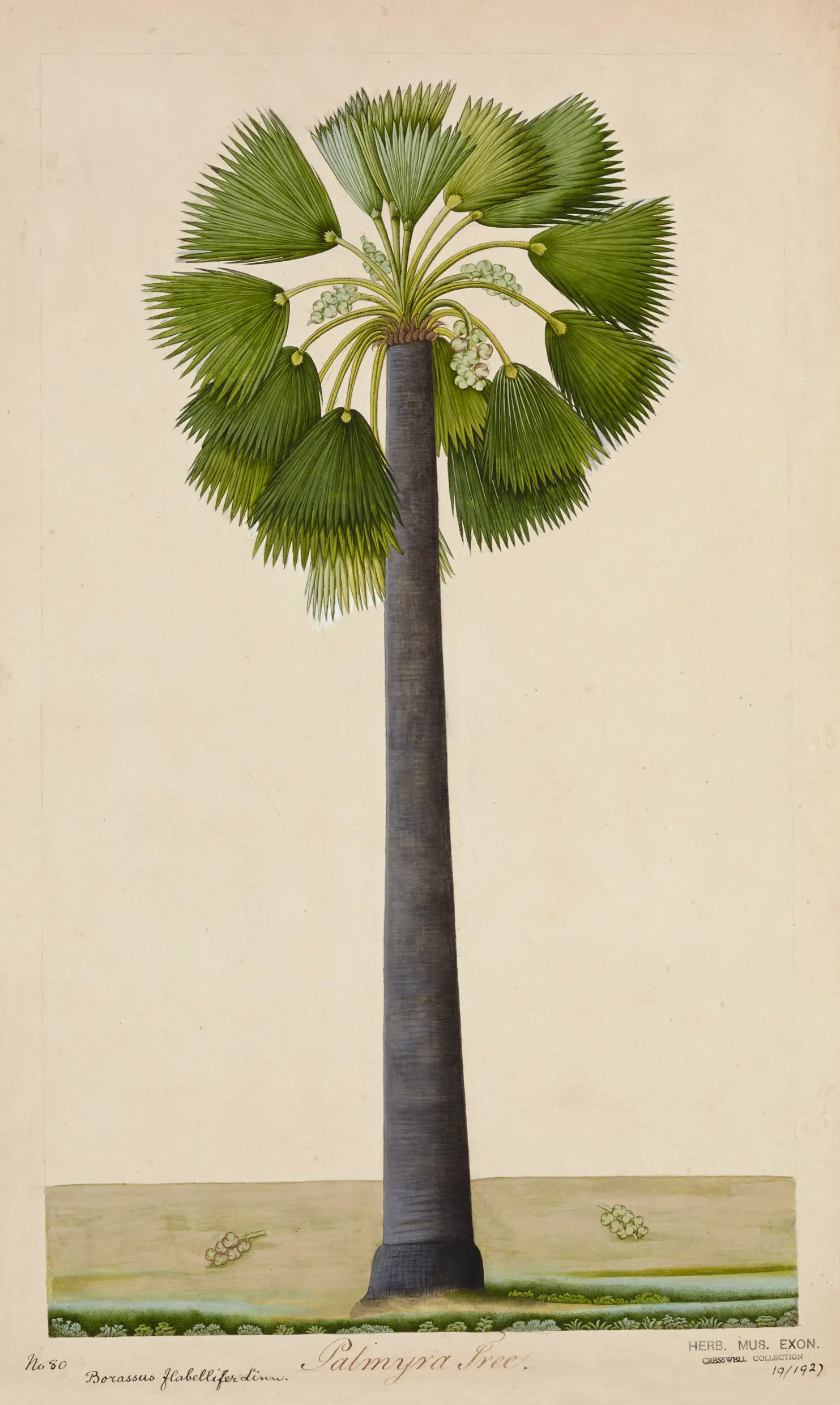
Sugar palm (Borassus flabellifer), Company School, early 1800s. The museum's catalogue notes that its flower clusters can be tapped for a sap drunk fresh or fermented into toddy. In 1902-3 the Madras Presidency raised about 72 per cent of British India's toddy revenue.Royal Albert Memorial Museum, Exeter. Public domain, via Wikimedia Commons
“The number and position of the shops is fixed by the Collector, and single shops, or sale-rights in a defined area, are sold (as a rule annually) by auction.”1
That is the Imperial Gazetteer of India, the Raj’s own reference work, describing its liquor trade in 1907. On 30 September 2024 the Government of Andhra Pradesh fixed the number of liquor shops in the state at 3,736, set the fee for each by the population of its town, and sold the right to run them by lottery.2 The first report in this series showed what that costs a shopkeeper and a drinker in Tadipatri. This one traces where the system came from, and compares it with the United States, which banned the liquor trade nationally for nearly 14 years and then left it to the states.
Inherited, then expanded
The British did not invent the liquor licence in India. The Gazetteer says so: under Indian rulers “the system in general force was one of farming, the right of manufacture and sale being given to the highest bidder. The British administration inherited this farming system, but soon began to modify it.”1
The East India Company wrote it into law in Bengal. Regulation XXXIII of 1790 required anyone who wished to make or sell spirits to hold a licence. Its 1793 re-enactment gave two reasons in one sentence: “to prevent the perpetration of crimes, and at the same time to augment the public revenue”.3 Toddy was brought into the tax in 1800, and official distilleries were ordered at each Collector’s station in 1813. By the historian Erica Wald’s account, abkari, the excise on liquor and drugs, became the Company’s second-largest source of income after land revenue.3
By 1907 the Raj ran three methods side by side. Under farming, one contractor bought a monopoly over an area. Under the out-still system, the right to make and sell at a single shop was “as a rule, sold annually by auction”. Under the central distillery system, the government supervised the still and charged duty on every gallon before it left.4 The Gazetteer liked the annual shop auction for two reasons, and it stated them plainly: it “prevents the growth of vested interests, which might hamper the Government in introducing improvements and reforms”, and it gave “valuable evidence as to the sufficiency or otherwise of the rate of still-head duty”.5 The auction told the state how much more it could charge.
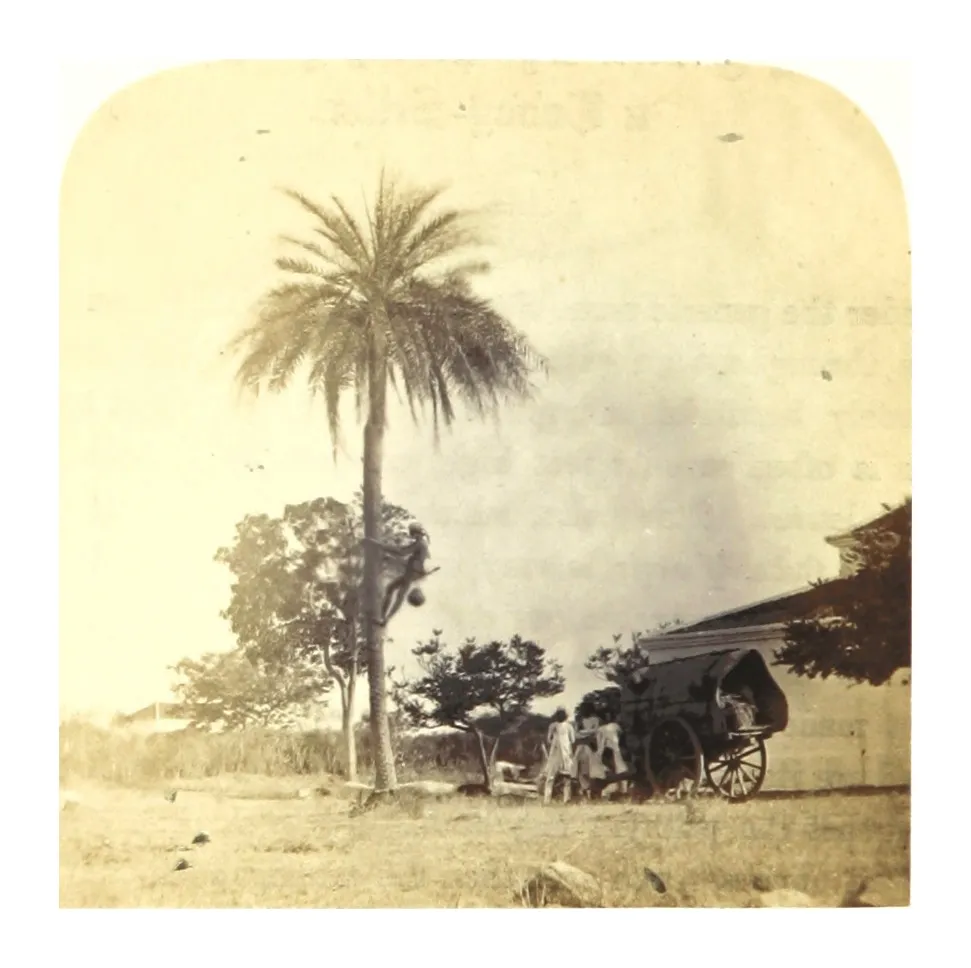
In Madras, the presidency that included almost all of today’s Andhra Pradesh, the government sold the monopoly of supply in each area by tender, charged duty on every gallon, and auctioned the right of retail sale “annually by auction, usually by single shops”. It taxed toddy by a fixed fee on every tree tapped, on top of the shop auction. Madras alone raised about 72 per cent of British India’s toddy revenue, which came to more than a crore of rupees in 1902-3.6
Licences for the chosen
In most of the Bombay Presidency there was no auction at all. “The contract is not offered to competition, but the monopolist is selected at the discretion of the Excise Commissioner and the Local Government,” the Gazetteer says. The chosen contractor had to “guarantee a minimum return to the Government: in other words, he must pay duty on a certain quantity of liquor whether he sells that quantity or not.”7
Officials picked the seller, and the seller owed the state for a quantity of drink whether or not anyone drank it. In the House of Commons in 1889, speakers said that in Ahmedabad 11 shops had been reopened because the contractor could not sell his guaranteed quantity, and that one contractor paid about £140,000 a year for district monopolies.8
The Raj’s stated aim, in the Gazetteer’s words, was “to secure the maximum of revenue with the minimum of consumption”.9 Its defence was that India had one liquor shop to about 2,400 people in 1901, against one to about 240 in the United Kingdom.9 Its revenue rose all the same. Net excise grew from roughly ₹2.4 crore in 1876-7 to ₹7.6 crore in 1904-5. Around 1903 it was about a tenth of British India’s net revenue.10
Westminster objects
On 30 April 1889 the House of Commons voted against the system. Samuel Smith, seconded by Caine, moved that “the fiscal system of the Government of India leads to the establishment of spirit distilleries, liquor and opium shops in large numbers of places where till recently they never existed, in defiance of Native opinion and the protests of the inhabitants”. The motion was carried by 113 votes to 103.8
In the same debate Caine put the Raj’s revenue from intoxicants at £2,458,000 in 1878 and £4,375,000 in 1887. Sir John Gorst, for the government, replied that in Bombay city excise revenue had nearly trebled between 1872-73 and 1886-87 while consumption fell from 907,000 to 621,000 gallons.8 On either account, whatever happened to drinking, the revenue climbed.
Indians against the shop
The nationalists made the liquor shop a target. Picketing them was a standard tactic of the Non-Cooperation movement of 1920-22.11 In 1931 TIME reported Gandhi’s statement in Young India that if he were made dictator for one hour, “the first thing I would do” would be to “close without compensation all liquor shops”.12 In south Gujarat in 1922-23, the movement David Hardiman calls the coming of the Devi turned Adivasis against what the book’s publisher calls “the locally dominant class of landlords and liquor dealers”.13
When Congress took office in Madras, C. Rajagopalachari brought in prohibition in Salem district from 1 October 1937 and introduced a sales tax to replace the lost revenue. “The rich would have to be taxed if the poor were to be saved,” he said.14 The Andhra Area Prohibition Act of 1937 stayed in force in parts of Andhra Pradesh until an order of the state government switched it off from 1 November 1969.15 The Constitution of 1950 told the state, in Article 47, to “endeavour to bring about prohibition” of intoxicating drinks except for medicinal purposes.16
Andhra Pradesh’s own law, the Excise Act, was enacted on 29 August 1968. It brought the Telangana area’s Hyderabad-era Abkari Act and the dormant Madras-era law under one statute for the whole state.15 Since then the state has gone through every model. In 1992 women in Dubagunta, a village in Nellore district, led by Vardhineni Rosamma, closed their arrack shop themselves. Arrack was banned across the state from 1 October 1993, and N. T. Rama Rao imposed total prohibition in January 1995.17 Chandrababu Naidu’s government lifted it in 1997. In 2019 the state took over every shop, and in 2024 it handed them back.18
The machine in 2026
| Madras, c. 1907 | Andhra Pradesh, 2026 | |
|---|---|---|
| Number and place of shops | Fixed by the Collector | Fixed by government order (3,736) |
| Right to sell | Auctioned, usually yearly, shop by shop | Renewal, or a lottery, at a fixed fee by town size, ₹60.5 lakh to ₹93.5 lakh a year |
| Supply | Monopoly sold by tender | One state wholesaler, the Beverages Corporation |
| Tax on the drink | Duty on every gallon; fee on every palm | Excise duty, additional retail excise tax and VAT on every bottle |
Sources: the Imperial Gazetteer and the AP orders of 2024 and 2026.19
One part has changed. The Raj’s auction let bidders set the price, and the Gazetteer valued it for showing the state what the trade would bear. Andhra Pradesh sets the price itself and lets the lottery pick the holder. Anyone may apply, at a non-refundable ₹3 lakh a time, and under the 2024 order one person may hold any number of shops.2 The Gazetteer’s other argument, that a yearly auction stops “the growth of vested interests”, is the problem the Deccan Chronicle reported in Rayalaseema in 2024: political leaders trying to form syndicates to take the shops before the draw.
America: banned, then handed to the states
The United States tried the other extreme. The 18th Amendment was ratified on 16 January 1919, and national prohibition began on 17 January 1920. Congress passed the Volstead Act to enforce it over President Wilson’s veto; the Senate vote to override was 65 to 20, on 28 October 1919.20
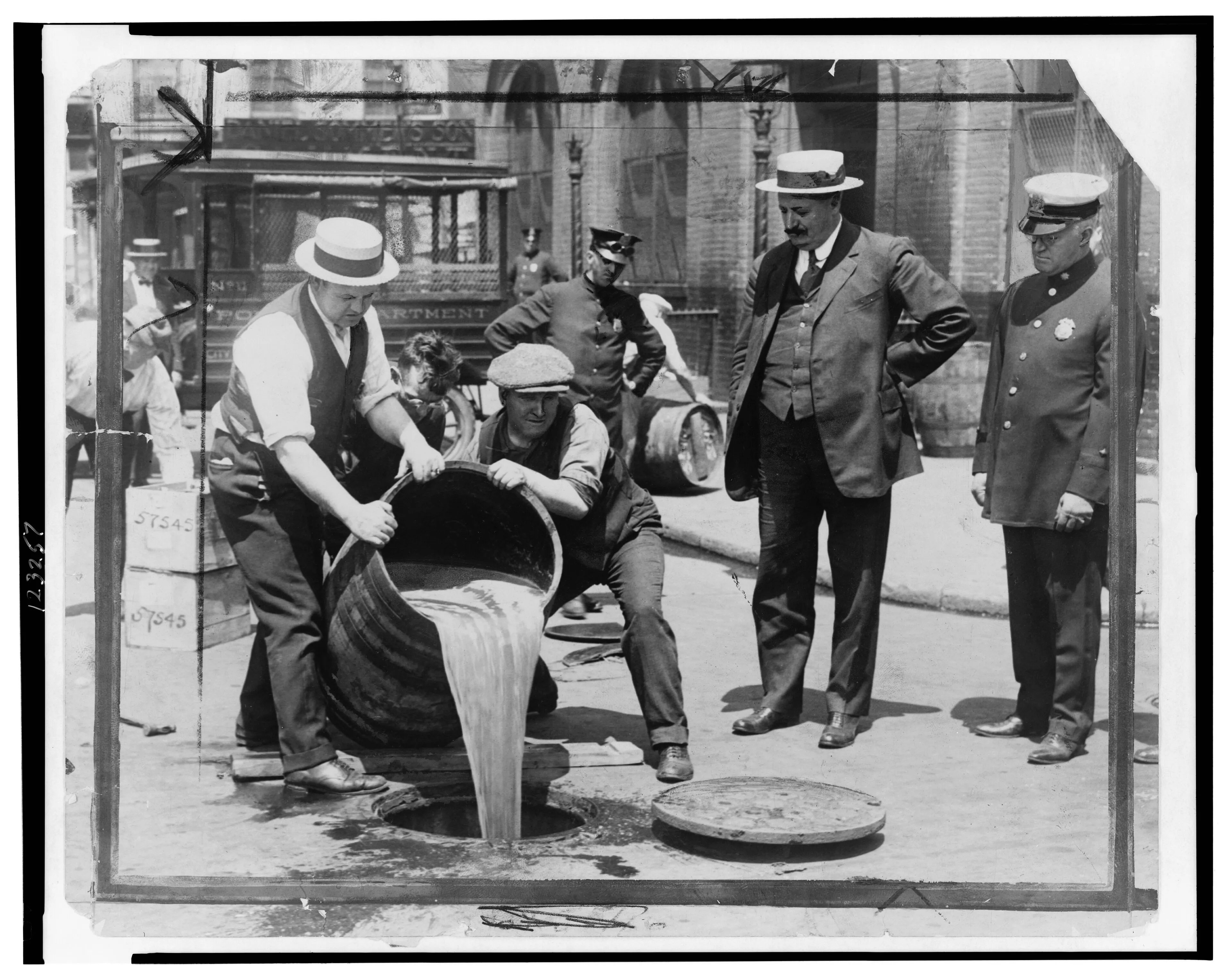
The 21st Amendment ended it on 5 December 1933 and gave the question back to the states. Its second section bars bringing liquor into a state “in violation of the laws thereof”.21 Most states license private sellers. Seventeen, plus Montgomery County in Maryland, are “control” jurisdictions in which the state itself wholesales spirits, and 13 of those also control off-premise retail.22 Under the three-tier system that grew up after repeal, brewers and distillers, wholesalers and retailers are kept separate, and producers may not own retailers or give them things of value.23
What a licence costs there
| Licence | Annual cost | Multiple of the country’s GDP per head |
|---|---|---|
| Andhra Pradesh shop, town under 50,000 (2026-27) | ₹60.5 lakh (about $63,000) | 26 times |
| Andhra Pradesh shop, city over 5 lakh (2026-27) | ₹93.5 lakh (about $97,400) | 40 times |
| California, Type 21 off-sale general | $1,009 | 1.1 per cent |
| Texas, package store | $900 ($1,800 for two years) | 1.0 per cent |
| New York City, liquor store | about $1,366 ($4,098 for three years) | 1.5 per cent |
Sources: AP orders; state fee schedules; World Bank GDP per head for 2025, ₹2.36 lakh for India and $90,027 for the United States; dollar figures at ₹96 to the dollar.24
An Andhra Pradesh shop pays 26 to 40 times the country’s income per person, every year, for the right to sell. A California liquor store pays about 1 per cent. At Andhra’s ratio, the California store would owe between $2.3m and $3.6m a year.24
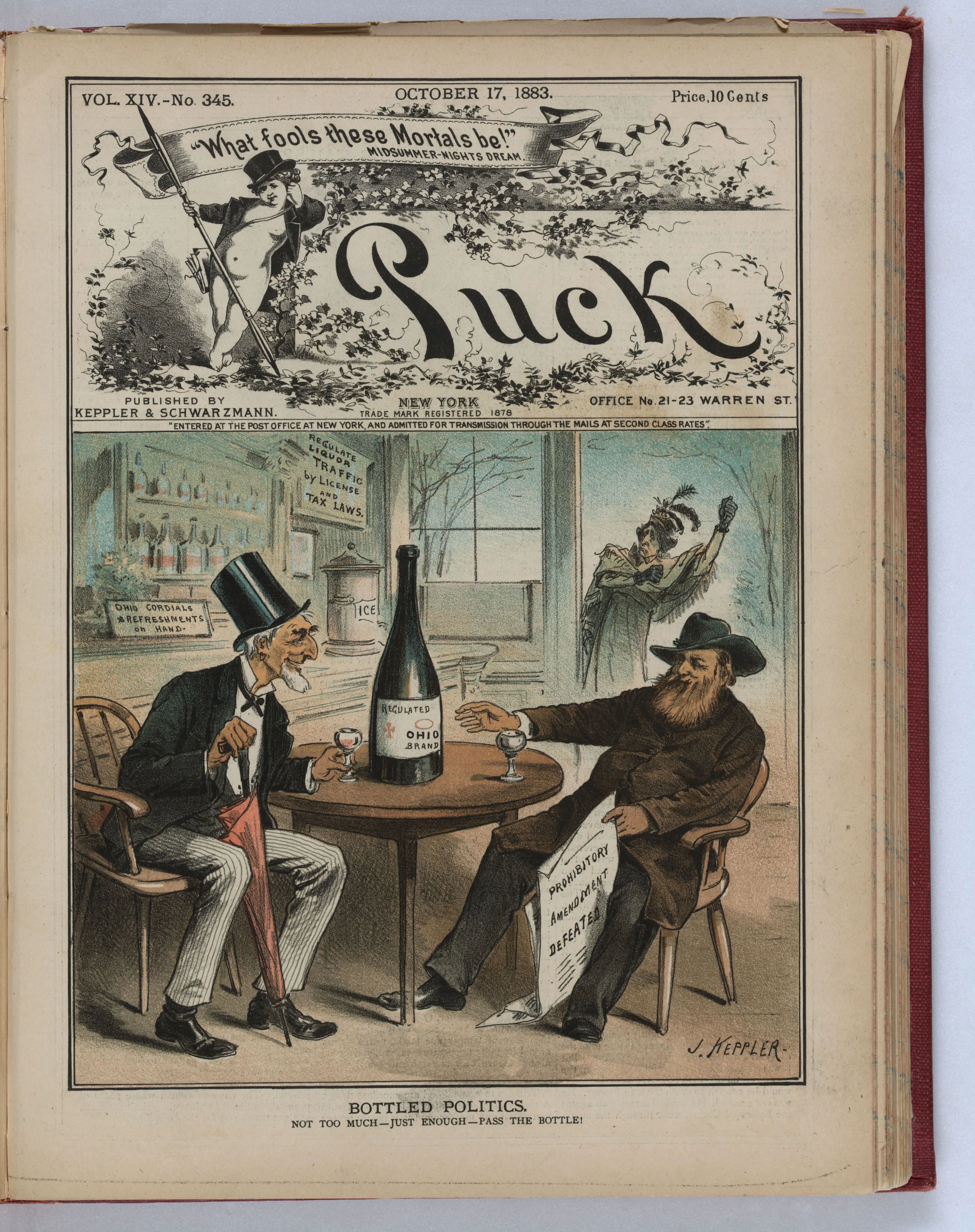
The comparison has limits, and the desk owes readers them. California also charges $19,840 to apply for a new full licence.24 Some American states ration licences by population. New Jersey allows one liquor-store licence for every 7,500 residents and has done since 1947; its liquor licences of all kinds resold for an average of $350,000 in 2017, and the most expensive for about $1.8m. Brick Township auctioned one for $575,000 in 2022.25 Florida issues new spirits licences by lottery; it drew 52 of them on 6 May 2026.26 Washington, which privatised its state liquor stores in 2012, charges spirits retailers 17 per cent of their spirits sales.27 Federal excise on spirits is $13.50 per proof gallon.28
Those are the costly corners of the American system, and even there a rationed licence is mostly paid for once and then owned. In Andhra Pradesh the licence is rented for one or two years at a time, at 26 to 40 times national income per head, and the state can add charges when it renews. This year it asked renewing shops for a further 38 per cent of their old fee, and every shop for a permit-room fee.29
Sources and notes29
Footnotes
-
Imperial Gazetteer of India, new edition, vol. IV, The Indian Empire, Administrative (Oxford, 1907), ch. VIII, Excise, pp. 254 and 256. https://archive.org/details/imperialgazettee04grea. Confidence: verified. ↩ ↩2
-
G.O.Ms.No.211, Revenue (Excise) Department, Government of Andhra Pradesh, 30 September 2024; 2026 application fee from District Gazette ATR.189/2026, Ananthapuramu. Confidence: verified. ↩ ↩2
-
Erica Wald, “Governing the Bottle: Alcohol, Race and Class in Nineteenth Century India”, Journal of Imperial and Commonwealth History 46(3), 2018, pp. 397-417, citing Bengal Regulations XXXIII of 1790, XXXIV of 1793, VI of 1800 and X of 1813 (India Office Records). The regulations themselves were not read. Confidence: reported. ↩ ↩2
-
Imperial Gazetteer, vol. IV, pp. 255-256. Confidence: verified. ↩
-
Imperial Gazetteer, vol. IV, p. 256. Confidence: verified. ↩
-
Imperial Gazetteer, vol. IV, pp. 256-257. Confidence: verified. ↩
-
Imperial Gazetteer, vol. IV, p. 257. Confidence: verified. ↩
-
Hansard, House of Commons, “East India (Abkari Department)”, 30 April 1889, Division No. 89. Figures are speakers’ claims in debate, not checked against official tables. Confidence: verified (as spoken). ↩ ↩2 ↩3
-
Imperial Gazetteer, vol. IV, p. 254. Confidence: verified. ↩ ↩2
-
Imperial Gazetteer, vol. IV, ch. VI, Table II, read from an imperfect scan; the share of net revenue is the desk’s arithmetic. Confidence: estimated. ↩
-
North Bengal University thesis chapter on temperance and nationalism; standard accounts of the Non-Cooperation movement. Confidence: reported. ↩
-
TIME, “Foreign News: Gandhi’s If”, 6 July 1931, reporting Young India. The original issue was not checked. Confidence: reported. ↩
-
David Hardiman, The Coming of the Devi: Adivasi Assertion in Western India (Oxford University Press, 1987), as described by its publisher and reviewers. Confidence: reported. ↩
-
Wikipedia, “Chief ministership of C. Rajagopalachari” and “Alcohol prohibition in Tamil Nadu”. One source dates the Salem start to 1938. Confidence: reported. ↩
-
Andhra Pradesh High Court, Jagriti vs The State and Others, AIR 1994 AP 225, 31 December 1993 (G.O.Ms. No. 966; the 1886 Abkari Act “ineffective” in Andhra since 1937), verified. The 1968 Bill’s statement of objects, as quoted by TaxTMI, reported. AP Excise Act, Act 17 of 1968, India Code record, reported. ↩ ↩2
-
Constitution of India, Article 47. Confidence: reported. ↩
-
The News Minute and Deccan Chronicle obituaries of Vardhineni Rosamma, August 2016. Some reports date Dubagunta to 1991. Confidence: reported. ↩
-
The South First, “Politics of liquor policy in Andhra Pradesh”; AP Prohibition (Amendment) Act, 1997 (Act 5 of 1997); Onmanorama/IANS, 3 October 2019; G.O.Ms.No.211. Confidence: reported (G.O. verified). ↩
-
Imperial Gazetteer, vol. IV, pp. 256-257 (verified); G.O.Ms.No.211 and District Gazettes of 10 October 2026 (verified); The South First, 12 September 2026, for the ₹93.5 lakh slab (reported). ↩
-
US House of Representatives History, “The Volstead Act”; US Senate Historical Office, “The Senate Overrides the President’s Veto of the Volstead Act”. The National Archives gives 16 January 1920 as the start. Confidence: reported. ↩
-
US Constitution, Amendment XXI, section 2 (Cornell Legal Information Institute). Confidence: verified. ↩
-
National Alcohol Beverage Control Association, Control State Directory and Info, read October 2026. Confidence: verified. ↩
-
Federal Alcohol Administration Act, 27 U.S.C. § 205(b), standard description. Confidence: reported. ↩
-
California ABC, annual and application fee schedules effective 1 January 2026 (verified); Texas Alcoholic Beverage Commission, two-year fees effective 1 September 2021 (verified); New York State Liquor Authority retail fee chart, revised 2016 (reported); World Bank, GDP per capita (current US$), 2025 (verified); rupee near 96 to the dollar in late September 2026 (reported). Multiples and dollar conversions are the desk’s arithmetic: India’s GDP per head is about ₹2.36 lakh at the World Bank’s 2025 rate of ₹87.16. Confidence: estimated. ↩ ↩2 ↩3
-
Tara Nurin, “Explainer: Why it’s so tough to get an N.J. liquor license”, WHYY, 8 May 2017; Shorebeat, “Brick sells liquor license again for $575K”, October 2022. Confidence: reported. ↩
-
Florida Department of Business and Professional Regulation, quota licence drawing, 6 May 2026. Confidence: reported. ↩
-
Revised Code of Washington 66.24.630. Confidence: verified. ↩
-
Alcohol and Tobacco Tax and Trade Bureau, Industry Circular 2023-2. Confidence: reported. ↩
-
Renewal RET of 38 per cent of the 2025-26 fee: The South First, 12 September 2026; challenge in the High Court: Deccan Chronicle, 17 September 2026. Confidence: reported. ↩
Letters
No letters on this report yet.
Letter received
Thank you. It is with the editors now and will appear here if we publish it.