AP liquor · Part 3 · 1992–2026
A pub, not a grille
An English pub's premises licence can cost £70 a year to keep. A liquor shop in Tadipatri pays ₹71.5 lakh for the counter and ₹7.5 lakh for a permit room whose published conditions, as far as the desk can find, say nothing about a chair or a fan. How Andhra Pradesh could keep its tax, drop the rents, open the trade to anyone who builds a decent place, and let any brand that pays its duty onto the shelf.
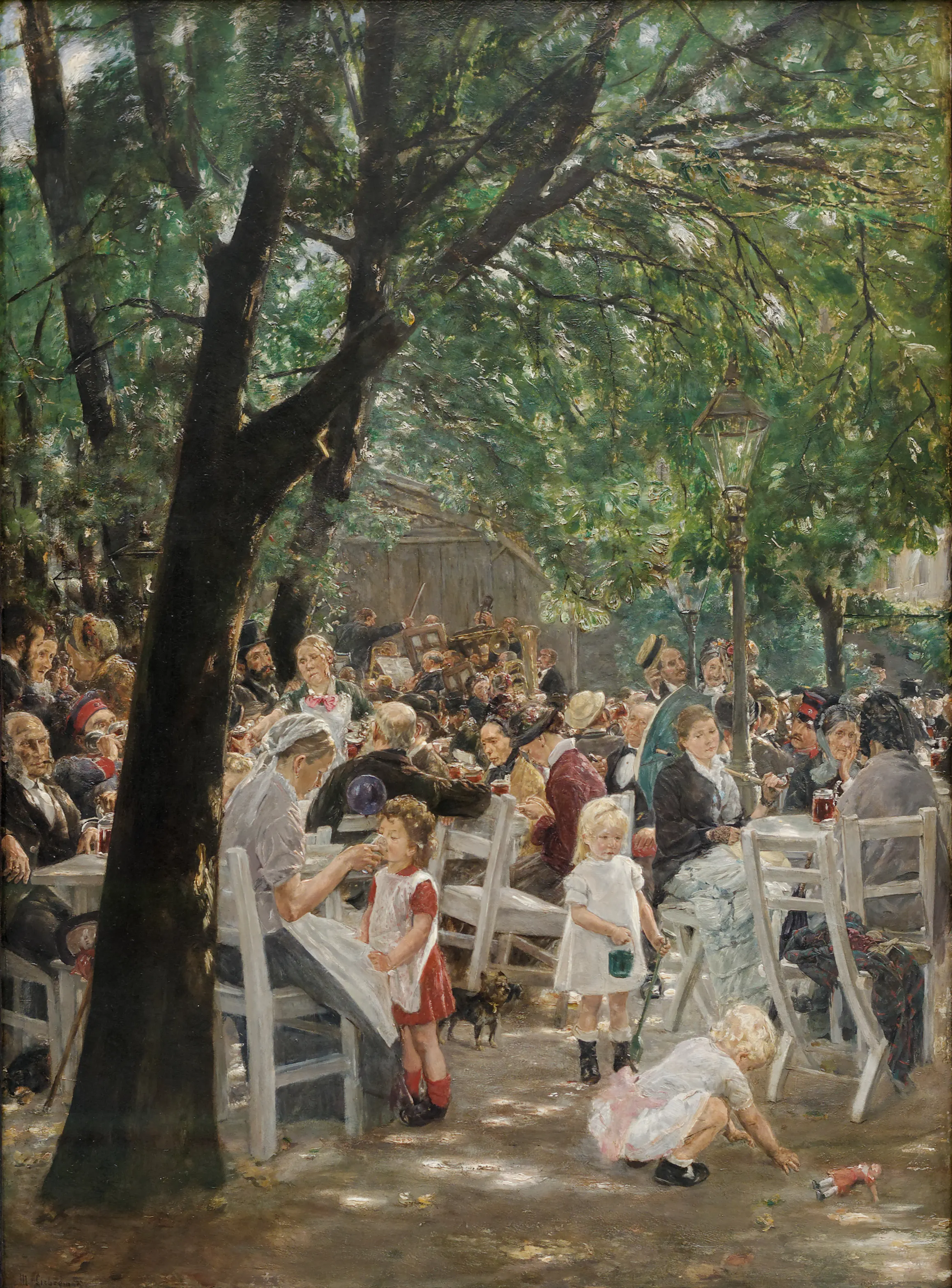
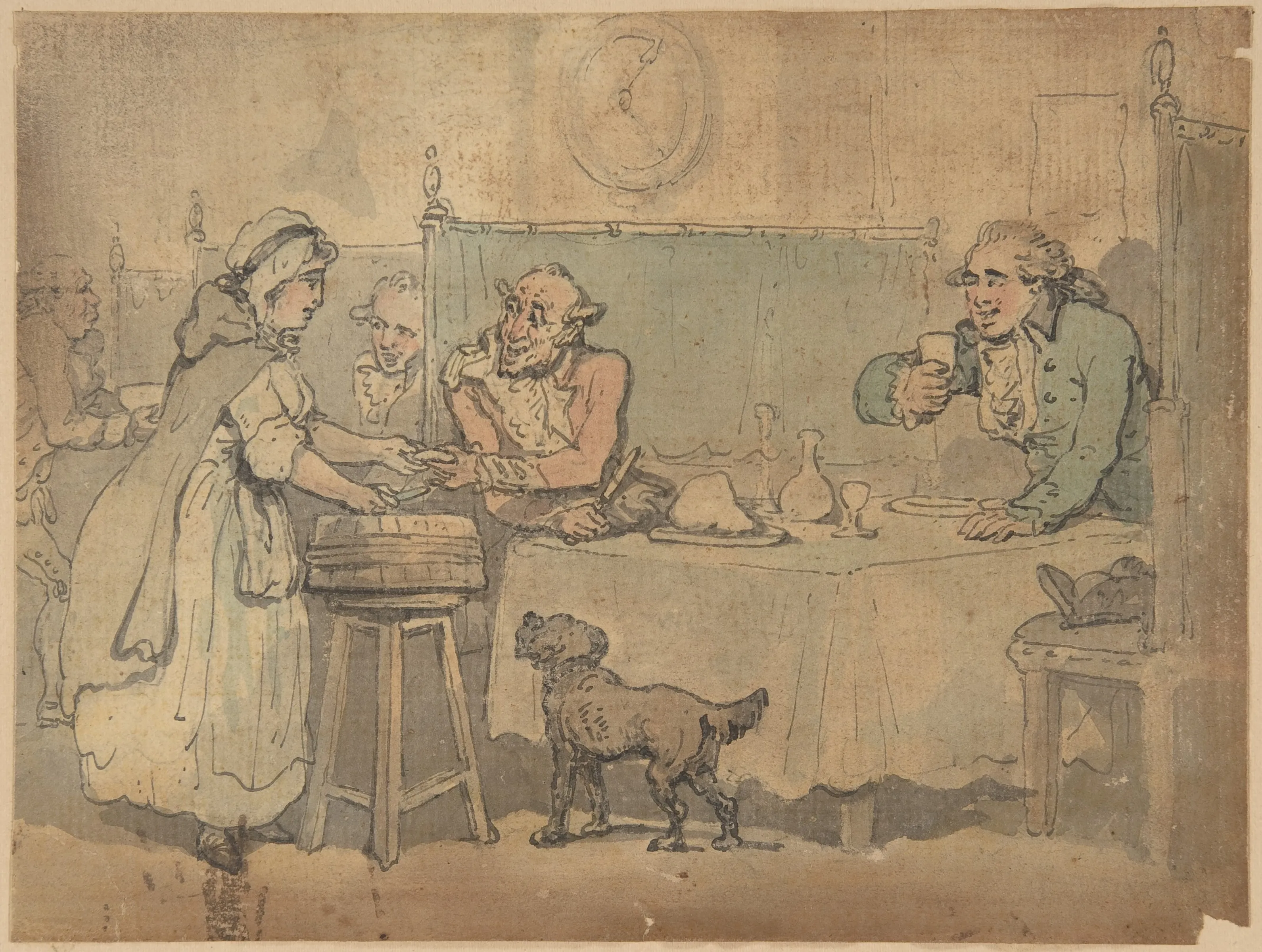
Munich Beer Garden, Max Liebermann, 1884. Drinkers seated in shade, at tables, in public.Neue Pinakothek, Munich. Public domain, via Wikimedia Commons
Under England’s Licensing Act 2003, a pub in the lowest rating band pays £100 to apply for its premises licence and £70 a year to keep it. The largest premises pay £635 and £350, with higher multiples for big places that mainly sell drink.1 The United Kingdom had 44,650 pubs in 2025.2
A liquor shop in Tadipatri, in Anantapur district, pays ₹71.5 lakh a year for the right to trade and ₹7.5 lakh a year for a permit room.3 The first report in this series described what its customers get: an iron grille onto the street, a crowd in the heat, ₹30 over the printed price of a beer, and a roadside to drink on. The second traced the system to the Raj’s auction of liquor shops. This one sets out how to change it.
The series does not argue for more drinking, or for cheap drink at any cost. It argues that adults who buy a legal product, and pay heavy tax on it, should be able to buy it at the printed price, from a shop that stocks what they want, and drink it sitting down, out of the sun.
Keep the tax, drop the rent
The World Health Organization’s view is that “an increase in excise taxes on alcoholic beverages is a proven measure to reduce harmful use of alcohol”, and that taxes should rise with inflation.4 This series accepts that. A tax on each bottle, set by its alcohol content and published, charges the drinker for what is drunk and is the same for every seller.
A licence fee of ₹71.5 lakh a year does something else. It is a charge for being allowed into the trade at all. The National Institute of Public Finance and Policy, a government-funded research institute, put it plainly in a 2024 report: “high dependence on other revenues (other than taxes) erects ‘barriers to entry’ and restricts competition in the market.”5 It quoted Karnataka’s Tax Reforms Commission of 2001: “Beyond a point, high tax rates become counterproductive and encourage evasion and widespread distribution of illicit liquor.”5
A renewing shop that owes the state about ₹1 crore for the year before it sells a bottle has to make it back from its customers. The ₹30 at the Tadipatri grille may be one way it does. Shopkeepers say their margin, promised at 20 per cent, is now about 13.5; officials say 17.5.6
What happens when the price goes too high
Andhra Pradesh has run this experiment on itself. When shops reopened after the lockdown in May 2020, the state raised prices by 25 per cent and then by another 50 per cent the next day.7 Liquor poured in from Telangana and Karnataka. By September the state’s Special Enforcement Bureau had registered 48,182 cases and arrested 59,438 people, and on its advice the government cut prices by ₹50 to ₹1,350 a bottle.8
In June 2024, 70 people died after drinking methanol-laced arrack in Kallakurichi, Tamil Nadu. The commission of inquiry, whose report was tabled on 8 September 2026, found a “cordial and illegal nexus” between the sellers and police and excise officials.9 Coverage of the report set out the prices: a drinker who needed two quarters of legal liquor paid about ₹400, while arrack sold at ₹50 to ₹60 for a 100 ml sachet, and was available from 6 am, when the state shops were shut.9 The commission blamed official collusion first; the price gap was one more reason the sachets sold.
NIPFP’s 2025 study of household spending found that taxation “becomes less effective when informal supplies of intoxicants (e.g., spurious, untaxed, contraband, smuggled, locally made alternatives) exist”.10 The WHO says the same: where there is a large illicit market, tax rises should come with efforts to control it.4
Who picks the brands
Every bottle sold legally in Andhra Pradesh passes through one buyer, the AP State Beverages Corporation, which the state set up in 1983.11 Maharashtra, Punjab, Goa and Haryana leave wholesale to private firms.11
A single buyer can be steered. A committee of the corporation found that between 2018-19 and 2023-24 the market share of the two big multinational makers fell from 53.21 per cent to 5.25 per cent, and it alleged that the computer system that set orders by sales was switched off on 15 October 2019 and replaced by manual orders.12 Those findings are now the basis of a criminal case alleging kickbacks of ₹150 to ₹600 a case; the desk found no conviction.12 The present government says “unbranded liquor” held 68 per cent of the market and that “reputed domestic and international brands have now overtaken it”.13
The pattern is not confined to Andhra Pradesh. In Tamil Nadu, reporting going back a decade describes most suppliers to the state retailer, TASMAC, as owned by politicians or their families from both main parties.14 In 2025 the Enforcement Directorate alleged a ₹1,000 crore scam at TASMAC; the Supreme Court stayed the probe, saying the agency was “crossing all limits”.15 The Competition Commission has opened an inquiry into TASMAC’s beer buying.15
Brand control and price control go together. In 2021 the Competition Commission found that the three biggest brewers had fixed beer prices in eight states, Andhra Pradesh among them, from 2009 to 2018.16
What competition does, and what it does not
Washington State is the warning. Voters ended the state’s monopoly on spirits in 2011, and from 2012 private shops took over. The number of outlets selling spirits rose about sixfold, to 1,422. Prices went up, by about 15 per cent in the first year, largely because the new law charged retailers 17 per cent of their spirits sales and distributors 10 per cent.17 More shops and more choice did not mean lower prices, because the state took its cut as a fee on top.
India has its own warnings. Karnataka has issued no new retail or bar licence since 1992. A licence that pays the state only an annual fee resells for up to ₹3.8 crore in Bengaluru.18 Maharashtra froze new licences in the early 1970s.19 When a state caps the number of sellers, the right to sell becomes a valuable asset, and politicians in a position to hand it out gain power over who gets it.
Delhi tried opening its retail trade in 2021, with discounts allowed. The policy was withdrawn in 2022 amid a CBI case, and the auditor later put the loss at about ₹2,026.91 crore.20
How America sells a beer
In much of the United States, beer sits in the cooler at the grocery store and the petrol station. Colorado let grocery stores sell full-strength beer from 1 January 2019; Oklahoma did so from October 2018 and Kansas from April 2019. Utah raised its grocery limit to 5 per cent alcohol by volume on 1 November 2019.21 Pennsylvania’s 2016 law let grocery and convenience stores with restaurant licences sell wine as well as beer.21 The beer wholesalers’ association counts 252 places selling beer for every 100,000 Americans.22
Maharashtra’s cabinet approved wine in supermarkets in January 2022 and then put it out for public consultation after protests.23 Kerala approved beer and wine parlours at 74 more tourist spots in January 2025.23
A licence for a decent place
Andhra Pradesh already charges for the room. From 1 October 2026 every shop must hold a permit-room licence, at ₹5 lakh a year in towns up to 50,000 people and ₹7.5 lakh above.3 As far as the desk can find, the conditions printed with it in the district gazettes cover the fee, the form and a CCTV camera.3 A government minister said in August 2025 that “more than 2.07 lakh law and order cases” had been registered for drinking in the open.24 The state is now charging for the room without, as far as the desk can find, saying what has to be in it.
Here is what a reform could look like.
- Open entry. Anyone who meets the standards below gets a shop licence at a fixed, modest fee. No lottery, no non-refundable ₹3 lakh tickets, and no cap on shops beyond zoning rules near schools and places of worship.
- Standards in the licence. A walk-in store with shelves and a cooler, and no grille onto the street. A seated room or covered garden, with shade or cooling, drinking water and a toilet, and an inspection before opening.
- A cheaper licence for building it. Cut the fee for any shop that meets the standard, so the money goes into the building. The state keeps its tax on every bottle.
- Open shelves. Any brand that holds a valid licence and pays its duty can be ordered by any shop. The Beverages Corporation publishes its orders by brand and distillery every month, and orders are set by sales, as the 2024 policy says they now are, with the evidence published. Over time, wholesale opens to private firms, as it already has in four states.
- One honest tax. A published duty by alcohol content, raised with inflation, in place of a stack of percentage levies and annual rents.
- The printed price, enforced. The ₹10 lakh fine for selling above MRP already exists.25 Publish every case, by district, every month.
- Beer and wine where people shop. Let grocery and convenience stores sell beer and wine under the same open licence.
What the cooling costs
The desk priced cooling for one shop’s room, with rooftop solar to offset most of its power bill, using published retail and tariff figures. All of it is estimated.26
| Item | Cost |
|---|---|
| Two 2-ton inverter air-conditioners | about ₹75,000 to ₹96,000 |
| 5 kW rooftop solar, at about ₹45,000 to ₹50,000 per kW | about ₹2.25 lakh to ₹2.5 lakh |
| One-off total | about ₹3 lakh to ₹3.5 lakh |
In Anantapur, a 5 kW rooftop system should produce roughly 7,000 to 7,500 units a year. At the commercial tariff of about ₹9 to ₹9.60 a unit at the margin, that is worth about ₹63,000 to ₹72,000 a year in power not bought. That covers roughly 60 per cent of what the two air-conditioners would draw running eight hours a day. Andhra Pradesh’s rules allow commercial rooftops to use net metering.26
The air-conditioners and panels together cost less than half of one year’s permit-room fee in Tadipatri, and less than 5 per cent of one year’s shop licence.
Sources and notes26
Footnotes
-
Licensing Act 2003 (Fees) Regulations 2005, SI 2005/79, as set out in council fee tables (Oxford, Rushcliffe, Shropshire): Band A £100 application and £70 annual; Band E £635 and £350; multipliers for Bands D and E where premises are used mainly for drinking on site. The statutory text was not loaded. Confidence: reported. ↩
-
British Beer and Pub Association data, reported by the Morning Advertiser, 6 May 2026. Confidence: reported. ↩
-
G.O.Ms.No.579 to 581, 11 September 2026, as applied in District Gazettes ATR.189/2026 (Ananthapuramu) and 1483/2026 (Alluri Sitarama Raju), 10 October 2026: shop RET ₹71,50,000; permit-room RET ₹5,00,000 or ₹7,50,000; Rules 24-A and 46. Confidence: verified. ↩ ↩2 ↩3
-
World Health Organization, “SAFER: Pricing policies”. Confidence: verified. ↩ ↩2
-
Sacchidananda Mukherjee and R. Kavita Rao, Revenue Mobilisation from Taxes on Alcoholic Beverages, NIPFP, March 2024 (draft report), quoting the Karnataka Tax Reforms Commission (2001). Confidence: verified. ↩ ↩2
-
G.O.Ms.No.211, 30 September 2024 (20 per cent), verified; ap7am, 1 January 2025 (“from 10.5% to 14%”), reported; Deccan Chronicle, 5 August 2026 (traders 13.5 per cent, officials 17.5 per cent), seen as a search extract only, reported, unconfirmed. ↩
-
The News Minute, May 2020; BloombergQuint, 5 May 2020. Confidence: reported. ↩
-
Deccan Herald and The News Minute, September 2020. Confidence: reported. ↩
-
The News Minute, “‘Cordial and illegal nexus’: Commission for Kallakurichi hooch tragedy indicts cops and govt officials”, September 2026. The price detail rests on this one report. Confidence: reported. ↩ ↩2
-
Jadhav and Mukherjee, “Price Elasticity of Demand for Alcoholic Beverages in India”, NIPFP Working Paper 431, July 2025. Confidence: verified. ↩
-
The South First, April 2025, and The News Minute, 2025, relaying the APSBCL committee’s “Report on Liquor Procurement and Market Manipulation (2019-2024)” and the SIT remand report. Allegations; the committee report was not read by the desk. Confidence: reported. ↩ ↩2
-
Government of Andhra Pradesh release via PTI, The Week, 14 July 2025. The government’s own claim. Confidence: reported. ↩
-
The News Minute, “Politicians and the business of alcohol: why prohibition remains a dicey topic in TN”, 2015-16. Confidence: reported. ↩
-
The South First, March 2025 (ED allegation); The Wire/PTI, 22 May 2025 (Supreme Court stay); DT Next and IndiaLaw, 2025 (CCI inquiry; outcome not found). Confidence: reported. ↩ ↩2
-
Competition Commission of India, Press Release No. 40/2021-22, 24 September 2021. Confidence: verified. ↩
-
Washington Office of Program Research, 2011 summary of Initiative 1183; The Columbian, 31 May 2014; Drug Store News. Confidence: reported. ↩
-
Deccan Herald, 2025, quoting the Chief Minister’s economic adviser Basavaraj Rayareddi. Confidence: reported. ↩
-
PTI via The Week, 13 July 2025: Ajit Pawar told the Assembly no new licences had been issued since 1972; other reports say 1973. Confidence: reported. ↩
-
Business Today and The Week, 25 February 2025, on the CAG report tabled that day; Deccan Herald, 2022. Cases are pending. Confidence: reported. ↩
-
Grocery Dive, 2021; Durango Herald, January 2019; Fortune, 1 November 2019; WHYY, 2022. Confidence: reported. ↩ ↩2
-
NBWA/Fintech data, reported by Brewbound, 2025. Industry figure. Confidence: reported. ↩
-
Deccan Herald, February 2022; Onmanorama, 23 January 2025. Confidence: reported. ↩ ↩2
-
The News Minute, 7 August 2025, quoting minister Kolusu Parthasarathy; the period covered was not stated. Confidence: reported. ↩
-
Rule 18-A, Shop Rules 2024 as amended, in District Gazette 1483/2026. Confidence: verified. ↩
-
Desk estimates from: retail listings for 2-ton 3-star inverter split air-conditioners (Croma, Bajaj Finserv, 2025-26, ₹37,500 to ₹48,000 each); installer quotes of ₹45,000 to ₹50,000 per kW for small commercial rooftop systems (vendor figures, unconfirmed; MNRE’s last commercial benchmark was ₹45,000 per kW in 2019); NTPC’s 250 MW Anantapur plant, about 1,590 units per kW a year, discounted to 1,400 to 1,500 for rooftops; AP LT commercial tariff slabs of ₹9.05 and ₹9.60 for 101 to 500 units (Mercom India, FY 2026-27); APERC net-metering regulation (Mercom, SolarQuarter). Confidence: estimated. ↩ ↩2
Letters
No letters on this report yet.
Letter received
Thank you. It is with the editors now and will appear here if we publish it.