H-1B · Part 2 · 2015–2026
The scapegoat
Seven in ten approved H-1B petitions are for Indians, so every charge against the programme lands on them. We took the charges one at a time: who made each, when, and what the record says. Some are true. The step from a guilty firm to a guilty nationality is where they stop being true.
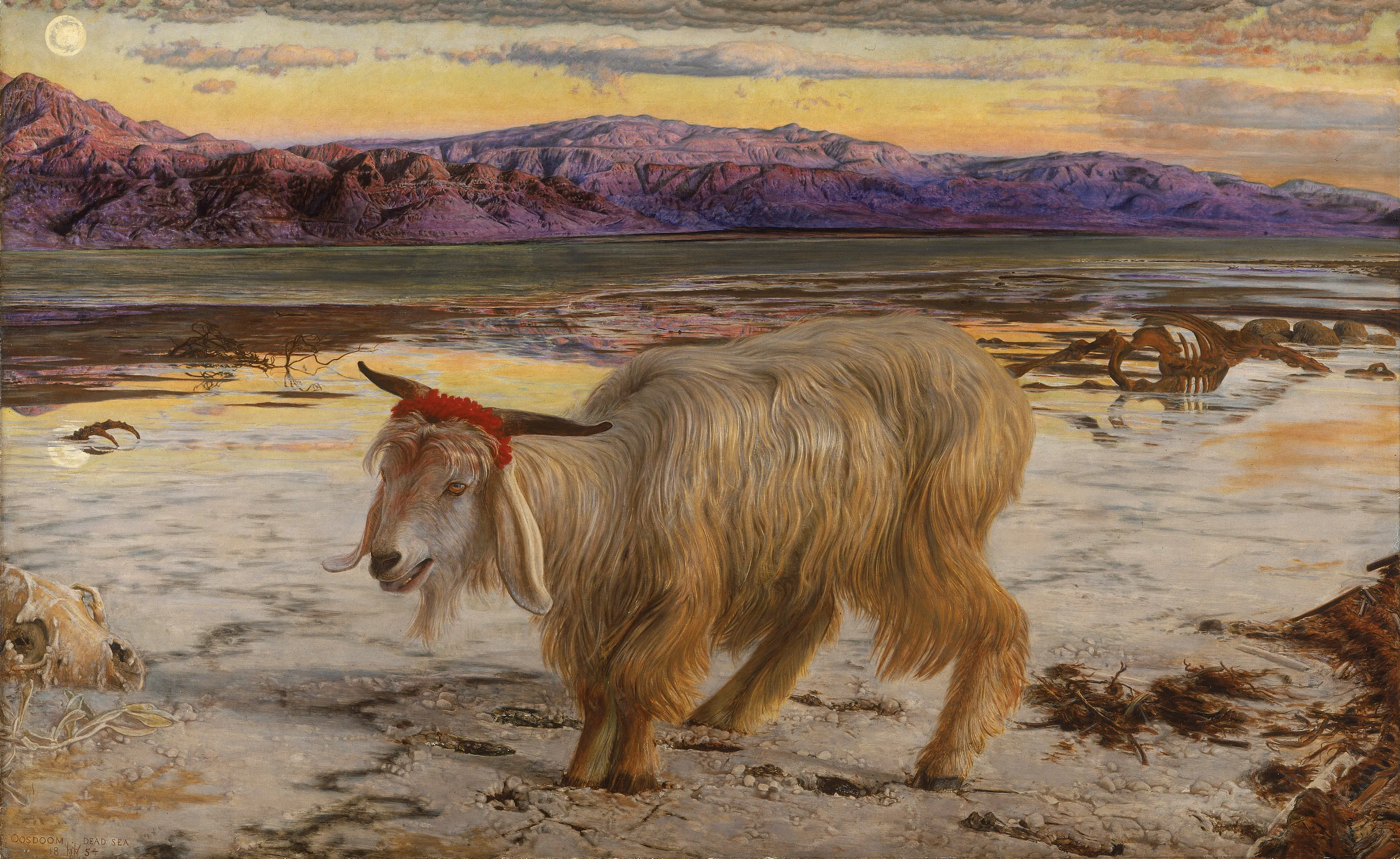
William Holman Hunt, The Scapegoat, 1854-56, used here for mood. In Leviticus the goat carries the community's sins into the wilderness; Hunt began painting it on the shore of the Dead Sea.Lady Lever Art Gallery, National Museums Liverpool. Public domain, via Wikimedia Commons
In late October 2025 the United States Department of Labor posted a 51-second video on X. Over 1950s imagery it said that about 72 per cent of H-1B approvals go to Indians, and, as the press reported it, that “Young Americans have had the American Dream stolen from them, as jobs have been replaced by foreign workers due to rampant abuse of the H-1B visa.”1
The number is right. Indians received 71.0 per cent of approved H-1B petitions in fiscal 2024 and 72.3 per cent in fiscal 2023, by the government’s own count.2 What the video added was the pairing: one nationality, set beside the word “abuse”, on an official account. Every finding of H-1B abuse in the record the desk read is against an employer or the people who ran it, and none is against a nationality.
This is the second part of three. The first covered how the visa and the green card queue were built. This one takes the charges now made against Indian H-1B workers, names who made each one, and sets it against the record, including the parts of the charges that are true.
Who decides who gets an H-1B
A worker cannot apply for an H-1B. An employer files the registration and the petition, and under the rules “a prospective petitioner may only have one registration submitted per beneficiary per fiscal year”.3 So the first question about who uses the visa is a question about companies.
The answer has changed. In fiscal 2025 the four employers with the most new H-1B approvals were Amazon (4,644), Meta (1,555), Microsoft (1,394) and Google (1,050). Tata Consultancy Services came fifth with 846. The National Foundation for American Policy, which compiled the figures from the government’s Employer Data Hub, called it “the first time these four large U.S. technology companies have held the top four spots”.4
The Indian outsourcing firms that critics usually name have been shrinking on this list for a decade. The top seven India-based companies had 4,573 new approvals in fiscal 2025, down 37 per cent in a year and 70 per cent from 15,270 in fiscal 2015. Cognizant, which is headquartered in the United States and employs most of its staff in India, fell from 2,873 to 743 in one year.4 The White House’s own figure, in September 2026, was that the largest staffing and outsourcing firms had cut their combined registrations from 24,946 to 2,055.5
Compete America, a coalition that lobbies for the visa, counts Amazon, Apple, IBM, Intel, Meta, Microsoft, Salesforce and the US Chamber of Commerce among its members, according to secondary listings.6 When President Donald Trump imposed a $100,000 charge on new petitions for workers outside the country in September 2025, the Chamber of Commerce and the Association of American Universities sued to stop it.7
Charge one: cheap labour
The charge comes from left and right. Senator Bernie Sanders wrote on X on 2 January 2025: “The main function of the H-1B visa program is not to hire ‘the best and the brightest,’ but rather to replace good-paying American jobs with low-wage indentured servants from abroad.”8 Florida’s governor, Ron DeSantis, called it “cheap labor that they’re bringing in to try to save money” on 29 October 2025.9 In early October 2026 Vice President JD Vance said: “If you’re going to bring in an accountant making $45,000 a year to replace an accountant who’s an American making $60,000 a year, that’s not you using the program to bring in a genius.”10
Part of it is true. The Government Accountability Office reported in 2011 that the programme’s wage protections were “weakened by several factors” and that it “lacks a legal provision for holding employers accountable” when workers come through a staffing company.11 The Economic Policy Institute, a labour-aligned think tank, found that 60 per cent of jobs certified for the 30 biggest H-1B employers were at the two lowest of the Labor Department’s four wage levels, below the local median for the occupation.12 The economist George Borjas, matching petition wage offers to census survey data, estimated in 2026 that “H-1B workers earn 16 percent less than comparable natives”.13
Replacement happened, too. In 2015 Disney laid off about 300 IT staff in Orlando, some of whom were told to train replacements supplied by HCL and Cognizant to keep their severance, and Southern California Edison cut about 500 IT jobs and moved the work to Infosys and Tata.14 The Labor Department looked at the Edison case and found no violation by Infosys.15 The law allowed it, and that is the strongest form of the complaint.
The rest of the record runs the other way. The median pay of all approved H-1B workers in fiscal 2024 was $120,000, and $125,000 in computer jobs; 46 per cent held a master’s degree and 8 per cent a doctorate.2 In fiscal 2025, 68,167 petitions were for H-1B workers moving to a new employer.4 The proclamation’s own “36 percent discount” for entry-level H-1B jobs gives no source in its text; the most recent academic estimate is Borjas’s 16 per cent, in a working paper.1613
The sources do not agree on the size of the gap, and the honest summary is a range. Much of it turns on the wage level the employer picks for the job, which is the employer’s choice under the government’s rules.
Charge two: Indians hire only Indians
An anonymous account on X put it in August 2025: “There is an entire indian nepotism industry in the tech and IT world…”17
There is one firm where a jury agreed. On 4 October 2024 a federal jury in California found that Cognizant had engaged in a pattern or practice of intentional discrimination against employees who were not Indian or South Asian; non-Indians had been dismissed at about 8.4 times the rate.18 The Equal Employment Opportunity Commission is investigating complaints against Tata Consultancy Services from older non-South Asian workers, which the company calls “meritless and misleading”.19 On 29 September 2026 the commission sued Sibitalent, a staffing firm in Plano, Texas, alleging it marked a job “ONLY H-1B” and dropped an American applicant.20
Other cases went the other way. In November 2018 a jury in California rejected the same kind of claim against Tata Consultancy Services, the first such case against an Indian IT firm to reach trial.21 At Infosys a former vice-president, Jill Prejean, alleged she was told not to hire people of Indian descent, and a court let her case go ahead in 2022.22 HCL America settled for $495,000 in 2026 after the commission alleged that an email chain asked recruiters to send only non-Indian candidates and that a 62-year-old applicant of Indian descent was turned away.23
The findings are about named firms in named years. None of them shows that Indian managers across American technology, as a group, hire by ethnicity. The claim takes a jury verdict against one company and applies it to 5.2 million people.
Charge three: it is all fraud
On Steve Bannon’s War Room in November 2025 the former congressman Dave Brat said the US consulate in Chennai had approved about 220,000 H-1B visas against a cap of 85,000.24 From January 2026 the Texas attorney-general, Ken Paxton, investigated companies over what the press called “ghost offices”, and in April he said he would not let “bad actors” use the programme “as a loophole for allowing foreign nationals to invade Texas”.25
There was real fraud, and it was measured. In the fiscal 2024 lottery, 408,891 of 758,994 eligible registrations were for people entered more than once, which multiplied their chances. When the government switched to one entry per person, the multiples fell to 47,314 the next year and 7,828 the year after.3 Kishore Dattapuram, who ran a staffing firm in San Jose, was sentenced to 14 months for petitions claiming jobs that did not exist.26 Infosys paid $34m in 2013 to settle allegations that it used business visitors for work that needed H-1Bs.27 The Labor Department’s inspector-general opened a nationwide probe in July 2026.28
Brat’s figure is another matter. The 85,000 cap applies to new petitions, not to visa stamps issued for renewals, transfers and re-entry, and the Hindu American Foundation, an advocacy group, said there was “no public data showing that Chennai issued 220,000 H-1B visas in a single year”.29 The government’s own count for fiscal 2024 was 283,397 approved petitions for India-born workers in every category. Nationally, 258,190 of the 399,395 approvals that year were for continuing employment, such as extensions and transfers, rather than new entrants.2 The denial rate for new petitions in fiscal 2025 was 2.8 per cent.4 Paxton’s inquiries began after viral videos by a Blaze TV host; by April 2026 they were civil demands for documents, with no finding of wrongdoing.25
Charge four: they took the graduates’ jobs
This one is in the proclamation itself. It cites unemployment of 6.1 per cent among young computer science graduates and 7.5 per cent in computer engineering.16
Both figures are real, from the New York Fed’s table of recent graduates by major, which used 2023 census data.30 The same table put art history at 3.0 per cent. The Economic Innovation Group pointed out that the samples “are quite small”: computer engineering’s 95 per cent confidence interval runs from about 4 to 11 per cent, and 90 per cent of computer science graduates were in work.31
Something did hit young workers. Economists at Stanford found that employment of 22- to 25-year-olds in the jobs most exposed to artificial intelligence fell 13 per cent relative to others, and in a follow-up said interest rates are not “a good explanation for the disproportionate decline in entry-level hiring in AI-exposed occupations”.32 No study the desk found isolates the H-1B as the cause of graduate unemployment since 2023.
Who said “Indian”
The charges above are about a programme. Some officials went further and named a nationality.
On 4 August 2025 Representative Marjorie Taylor Greene of Georgia wrote “End Indian H1-B visas replacing American jobs”, in a post that went on to call for an end to funding the war in Ukraine.34 In November she announced a bill to abolish the visa except for some medical jobs.35 Representative Brandon Gill of Texas said of Frisco that “you feel like you’re in a foreign country, and that’s a problem”, and called Hindu events “Third World religious ceremonies”.36 In Palm Bay, Florida, the city councilman Chandler Langevin wrote “Deport every Indian immediately” on 26 September 2025, and on 2 October asked for Trump to revoke “every Indian visa”. His council censured him three votes to two.37 Then there was the Labor Department’s video.
Every official the desk found naming Indians or India in a hostile frame was a Republican. The wish to cut the visa is not partisan: Sanders and Senator Dick Durbin, a Democrat, have attacked it for years, and Durbin co-wrote a reform bill with the Republican Chuck Grassley in September 2025.38
Trump’s own record moves. In a Republican debate on 10 March 2016 he said of the visa: “We shouldn’t have it. Very, very bad for workers.”39 On 28 December 2024 he told the New York Post: “I’ve always liked the visas, I have always been in favor of the visas.”40 Nine months later came the $100,000 charge. In November 2025, defending skilled visas on Fox News, he told Laura Ingraham: “You don’t have certain talents.”41
Is it a state-backed campaign?
The desk looked for evidence that a government, American or foreign, is funding or directing the campaign against Indian H-1B workers, and found none in the reports it could read.
The platform reports that do mention India describe operations aimed at India and its government. In 2024 Meta took down a network from China that posed as Sikhs and posted about Khalistan and “criticism of the Indian government”.42 Nothing found ties such networks to the H-1B fight in America.
The online campaign has been measured. The Network Contagion Research Institute counted more than 24,600 anti-Indian posts on X in 2025 with over 300 million views, and found that three accounts produced 10 per cent of all the likes and 20 per cent of all the reposts.43 The Center for the Study of Organized Hate counted about 542,000 hateful posts on X in its study of anti-South Asian hate from January 2025 to June 2026.44 Both name American influencers. The NCRI found that the spikes followed government moves: a Department of Homeland Security H-1B rule, State Department visa steps and the $100,000 charge.43
What the record supports is narrower than “state-backed groups”, and it is on the record: a federal department’s video, a congresswoman’s post, a councilman’s posts, a state attorney-general’s word “invade”, and policies whose cost falls mostly on one nationality because that nationality holds most of the visas. The Penn Wharton Budget Model estimates that the charge and a new wage-weighted lottery would cut India’s share of selections from 66.8 per cent to between 55.7 and 63.5 per cent.45
Whether this is a diversion from other failures is an argument. Tech layoffs, artificial intelligence and higher interest rates are all documented; no poll or study the desk found measures whether the H-1B fight draws blame away from them.
The people being charged
There were about 5.2 million Indian Americans in 2023. Of those aged 25 and over, 77 per cent held a degree, and their median household income was $151,200.46 Of the 582 American start-ups valued at a billion dollars or more in 2022, immigrants founded 319, and India was the top country of origin with 66.47
On crime, the nearest measure is incarceration. The Cato Institute’s estimate from the 2024 American Community Survey puts the rate for India-born adults aged 18 to 54 at 49 per 100,000, against 1,195 for people born in the United States. That is the lowest of the 20 largest countries of origin in its table.48 It is not zero, and China-born legal immigrants, at 46, come in slightly below India-born legal immigrants, at 72. No figure exists by visa type, so nobody can say what the rate is for H-1B holders.
The $100,000 charge was renewed by the White House on 18 September 2026. A federal judge in Massachusetts had already set it aside on 8 June, in a suit brought by 20 states, and on 24 July the appeals court refused to put it back.49
Sources and notes49
Footnotes
-
US Department of Labor, post on X, late October 2025, as reported by American Bazaar, 31 October 2025, and The Federal. The video was not viewed by the desk. Confidence: reported. ↩
-
USCIS, Characteristics of H-1B Specialty Occupation Workers, Fiscal Year 2024, report to Congress. Confidence: verified. ↩ ↩2 ↩3
-
USCIS, “H-1B Electronic Registration Process”, registration statistics, read 4 October 2026. Confidence: verified. ↩ ↩2
-
Stuart Anderson, National Foundation for American Policy, H-1B Petitions and Denial Rates in FY 2025 (November 2025), from the USCIS H-1B Employer Data Hub. NFAP is a pro-immigration think tank; the figures are the government’s. The FY2015 base rests on press summaries of NFAP. Confidence: verified. ↩ ↩2 ↩3 ↩4 ↩5
-
The White House, “Restriction on Entry of Certain Nonimmigrant Workers” and accompanying fact sheet, 18 September 2026. The firms are not named and the underlying data is not published. Confidence: verified (that the White House said it). ↩
-
Compete America membership as listed in secondary references (Wikipedia, SourceWatch); the coalition’s own list was not read. India’s IT industry body NASSCOM, TCS and Infosys also paid US lobbyists in 2017. Confidence: reported. ↩
-
KJZZ, 24 December 2025. Judge Beryl Howell ruled for the government on 23 December 2025; the Chamber appealed. Confidence: reported. ↩
-
Sen. Bernie Sanders, post on X, 2 January 2025. Text via search snapshot. Confidence: reported. ↩
-
Central Florida Public Media, 29 October 2025. Confidence: reported. ↩
-
Just the News, 2 October 2026. Another account places the interview aboard Air Force Two. Confidence: reported. ↩
-
US GAO, H-1B Visa Program: Reforms Are Needed to Minimize the Risks and Costs of Current Program, GAO-11-26, 14 January 2011. Confidence: verified. ↩
-
Daniel Costa and Ron Hira, “H-1B visas and prevailing wage levels”, Economic Policy Institute, 4 May 2020. Level I was 12 per cent and Level II 48 per cent. Page returned an error; figures via summaries. Confidence: reported. ↩
-
George J. Borjas, “The H-1B Wage Gap, Visa Fees, and Employer Demand”, NBER Working Paper 34793, February 2026, revised August 2026; a working paper, not yet peer-reviewed. An earlier version gave 15 per cent. Confidence: verified. ↩ ↩2
-
CNN Money, 25 January 2016 (Disney); Computerworld, 2015 (Southern California Edison). Confidence: reported. ↩
-
KPCC, 22 October 2015. Confidence: reported. ↩
-
The White House, Proclamation 10973, “Restriction on Entry of Certain Nonimmigrant Workers”, 19 September 2025. Confidence: verified. ↩ ↩2
-
Anonymous account @Anc_Aesthetics on X, August 2025, via search snapshot. Quoted as an example of the claim, not as a person. Confidence: reported. ↩
-
Bloomberg, 8 October 2024; Duane Morris client alert, October 2024. Palmer v. Cognizant. Confidence: reported. ↩
-
American Kahani, April 2025. Confidence: reported. ↩
-
EEOC, “EEOC Sues Sibitalent for H-1B Visa-Based National Origin Discrimination”, 30 September 2026. An allegation, not a finding. Confidence: verified. ↩
-
Seattle Times (Reuters), November 2018, Buchanan v. Tata Consultancy Services. Confidence: reported. ↩
-
The News Minute, October 2022. An allegation; the outcome is not known to the desk. Confidence: reported. ↩
-
HR Morning, April 2026; consent decree approved 2 April 2026. Confidence: reported. ↩
-
Business Standard, 26 November 2025. Confidence: reported. ↩
-
Newsweek, 30 April 2026; KERA News, 30 April 2026. The inquiry began with three firms in January 2026 and covered about 30 by April. Confidence: reported. ↩ ↩2
-
US Attorney’s Office, Northern District of California, 2025. Confidence: reported. ↩
-
US Immigration and Customs Enforcement, 30 October 2013. Confidence: reported. ↩
-
Cronkite News, 21 July 2026. Inspector-General Anthony D’Esposito announced the probe on 8 July 2026. Confidence: verified. ↩
-
Hindu American Foundation, 27 November 2025. An advocacy body; the point about the cap follows from the statute. Confidence: verified. ↩
-
Federal Reserve Bank of New York, “The Labor Market for Recent College Graduates”, February 2025 release, via press. Confidence: reported. ↩
-
Connor O’Brien, Economic Innovation Group, 13 August 2025. Confidence: verified. ↩
-
Brynjolfsson, Chandar and Chen, “Canaries in the Coal Mine?”, Stanford Digital Economy Lab, August 2025 (reported), and follow-up note of 9 February 2026 (verified). Confidence: reported/verified. ↩
-
CFO Dive, 2025. Confidence: reported. ↩
-
Rep. Marjorie Taylor Greene, post on X, 4 August 2025; Business Today, 5 August 2025. Confidence: reported. ↩
-
The Hill, November 2025. Confidence: reported. ↩
-
Texas Tribune, 12 May 2026, with links to the posts. Confidence: verified. ↩
-
Newsweek, October 2025. Censure vote on 16 October 2025. Confidence: verified. ↩
-
Office of Sen. Dick Durbin, “Durbin, Grassley Introduce Bipartisan H-1B, L-1 Visa Reform Bill”, 30 September 2025. Confidence: reported. ↩
-
CNN, transcript of the Republican debate in Miami, 10 March 2016. Confidence: reported. ↩
-
Fortune, 28 December 2024, quoting the New York Post. Confidence: reported. ↩
-
CNN, 11 November 2025. Confidence: reported. ↩
-
Meta, Quarterly Adversarial Threat Report, Q1 2024. Meta’s Q2-Q3 2025 report could not be loaded and has not been checked. Confidence: verified. ↩
-
Network Contagion Research Institute, From Policy Drift to Purity Grift, March 2026, via American Kahani and summaries; the report itself returned an error. Confidence: reported. ↩ ↩2
-
Center for the Study of Organized Hate, The Rising Tide of Anti-South Asian Hate in the United States, 28 September 2026, covering 1 January 2025 to 30 June 2026. The count measures posts, not how many people hold these views. Confidence: verified. ↩
-
Penn Wharton Budget Model, “Effects of the New $100,000 Fee and Wage-Weighted Lottery on the H-1B Visa”, 3 August 2026. A model estimate. Confidence: verified. ↩
-
Pew Research Center, “Indians in the U.S.” fact sheet (2023 American Community Survey), via press. Confidence: reported. ↩
-
National Foundation for American Policy, Immigrant Entrepreneurs and U.S. Billion-Dollar Companies, July 2022. Confidence: reported. ↩
-
Alex Nowrasteh and Michelangelo Landgrave, Illegal Immigrant Incarceration Rates, 2010-2024, Cato Institute briefing paper, 25 March 2026, read via the Wayback Machine. These are survey estimates of people in institutions on a given day, not offending rates; Cato notes small samples for some countries. Confidence: reported. ↩
-
The White House, 18 September 2026; CNBC, 8 June 2026; Clark Hill, July 2026. Judge Beryl Howell in Washington upheld the charge in December 2025. Confidence: reported. ↩
Letters
No letters on this report yet.
Letter received
Thank you. It is with the editors now and will appear here if we publish it.