AP liquor · Part 1 · 1968–2026
Behind the grille
A liquor shop licence in a mid-sized Andhra Pradesh town costs ₹71.5 lakh a year, plus ₹7.5 lakh for a permit room and, for a renewing shop, about ₹27 lakh more. The state has budgeted ₹30,067 crore from excise this year. In Tadipatri, the buyer gets a grille in a wall, a queue in the sun, and, in the editor's experience, ₹30 added to the printed price of a beer. An open letter to the excise minister, with the figures.
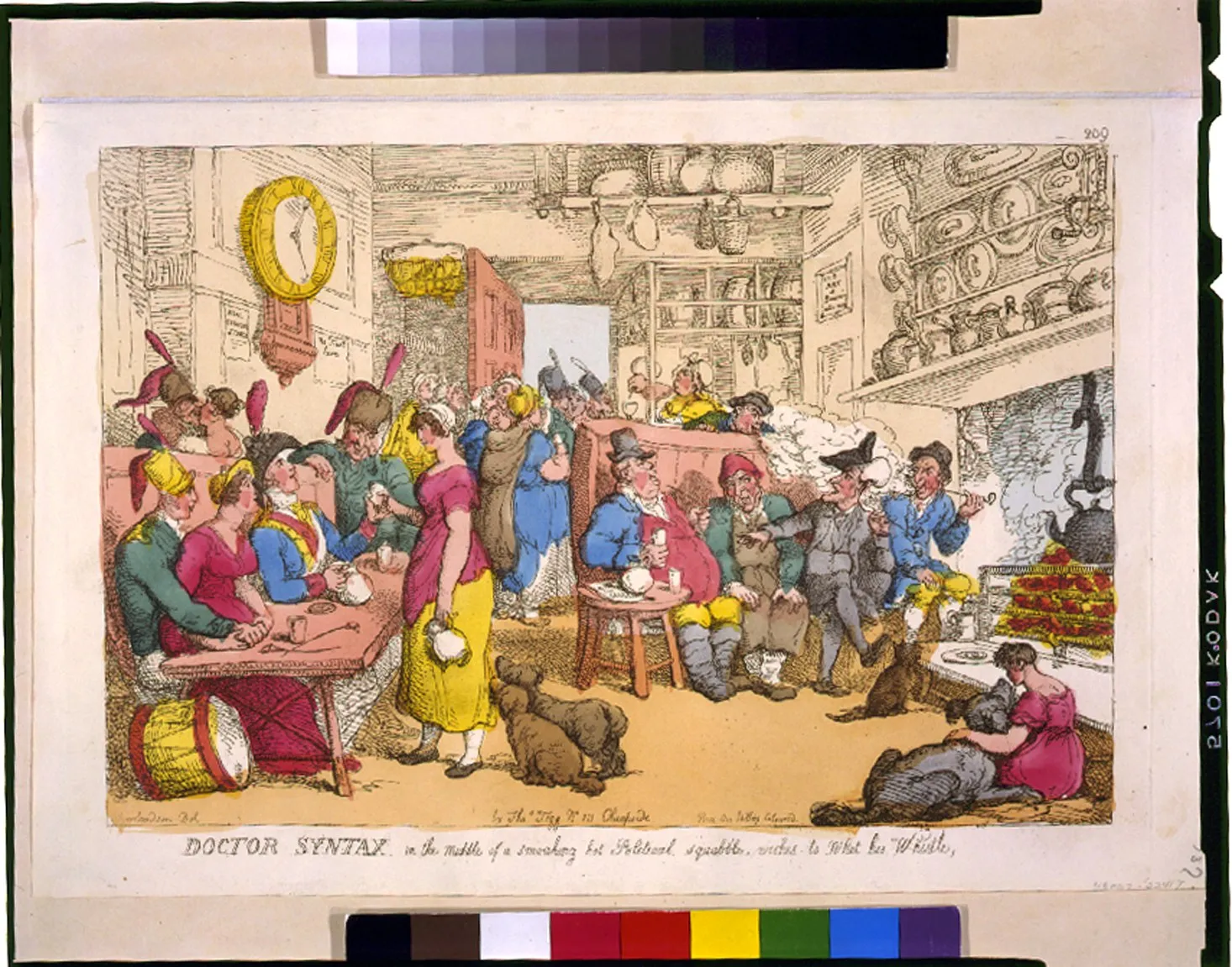
Gin Lane, William Hogarth, 1751. Used here for mood.Metropolitan Museum of Art. CC0, via Wikimedia Commons
To Kollu Ravindra, Minister for Mines, Geology and Excise, Government of Andhra Pradesh.1
In Tadipatri, in Anantapur district, the editor of this paper pays ₹330 for a beer with ₹300 printed on the label. The ₹30 is added every time, at every shop the editor has used, and has been for more than 30 months. That is 10 per cent on top of a price already loaded with tax. It is collected at a grille in a shop wall, from a crowd of men who then walk off to drink at a street corner in the sun.
That is the editor’s account, and the editor holds records of it. The rest of this report comes from your department’s own orders and gazettes, your government’s budget, and the press. It sets out what the state charges for the right to sell a bottle in Tadipatri, what it charges on the bottle, what its rules promise the buyer, and what the buyer gets.
What the state charges for the right to sell
Your government handed liquor retail back to private licensees in October 2024. The order, G.O.Ms.No.211 of 30 September 2024, fixed 3,736 shops for the state: 3,396 open to anyone and 340 reserved for toddy-tapper communities.2 It put no limit on how many shops one person may hold. “There shall be no restriction on the number of Shop licenses a person can hold,” it says.2
The fee for the licence is called Retail Excise Tax, and it is set by the population of the town. Tadipatri had 108,171 people at the 2011 census,3 which puts its shops in the second-highest band. The Anantapur gazette of 1 October 2024 lists nine shops in Tadipatri municipality, numbered AT/89 to AT/97, and three more in the rural mandal. Each was charged ₹65 lakh for 2024-25 and ₹71.5 lakh for 2025-26.4
The licences ran out on 30 September 2026. Under the new orders, G.O.Ms.No.579 to 581 of 11 September 2026, a Tadipatri shop still pays ₹71.5 lakh a year, and now also ₹7.5 lakh for a permit room, which every shop must have.5 A shop that renewed paid a further 38 per cent of its old fee, about ₹27.2 lakh, as a one-off charge.6 A renewing Tadipatri shop therefore owes the state about ₹1.06 crore for the year before it buys a single bottle of stock or pays rent or wages.7 The renewal charge is being challenged in the High Court.8
Losing also costs money. Entering the 2024 lottery cost a non-refundable ₹2 lakh per application per shop; entering the 2026 lottery costs ₹3 lakh plus ₹1,000.9 In 2024 your ministry received 89,882 applications and kept ₹1,797 crore in fees, you said, from people competing for 3,396 shops.10 In Kakinada, 3,332 applications for 155 shops brought in ₹66.64 crore. One group from Tallarevu filed 80 applications and won five. “This was a bad bargain, we cannot recoup the money we spent,” one of them told the Deccan Chronicle.11
A winner pays the first instalment the same day or the next working day, and lodges a bank guarantee within 30 days or the selection “stands cancelled”. In the counterpart agreement, the licensee accepts that on default the state may recover its dues “by distraining my/our movable and immovable properties” under the Revenue Recovery Act of 1864.12
What the state charges on the bottle
The licence fee is a charge for the right to trade. The tax on each bottle comes on top. Under the structure set in November 2023, a bottle of Indian-made liquor with a basic price up to ₹2,500 carried Additional Retail Excise Tax of 250 per cent, additional excise duty of 10 per cent and VAT of 10 per cent. Beer carried 225 per cent.13 Your government cut the number of tax heads in October 2024 and added a 2 per cent cess.14 Since then it has raised the price of spirits by ₹10 a bottle in February 2025 and again in January 2026; beer was left out of the second rise.15 Your department publishes no figure for the share of a bottle’s price that is tax. At these rates, tax is most of it.
The take is large. State excise brought in ₹19,882 crore in 2024-25, ₹23,648 crore in 2025-26 by the revised estimate, and is budgeted at ₹30,067 crore for 2026-27.16 That is between a fifth and a quarter of the state’s own tax revenue. VAT on liquor comes on top and is not broken out in the budget.16
Nor does the shopkeeper keep much of it. G.O.Ms.No.211 promised a 20 per cent margin on the issue price. A second order took the additional retail excise tax out of the base on which that margin is counted.17 Retailers complained, and the Chief Minister approved a margin of 14 per cent.18 In August 2026 traders said they were getting about 13.5 per cent and that about 40 per cent of shops were losing money; officials said the figure was 17.5 per cent.19
The law behind it
| Year | Law or order | What it did |
|---|---|---|
| 1968 | Andhra Pradesh Excise Act (Act 17 of 1968), 29 August | The parent law for licences to make and sell liquor |
| 1995 | AP Prohibition Act (Act 17 of 1995) | N. T. Rama Rao’s total prohibition, in force from 16 January 1995 |
| 1997 | AP Prohibition (Amendment) Act (Act 5 of 1997) | Lifted prohibition from 1 April 1997, except on arrack |
| 2019 | State takeover | AP State Beverages Corporation ran every shop from 1 October 2019 |
| 2024 | Ordinance No. 6 of 2024; Excise (Amendment) Bill passed 19 November | Retail back to private licensees |
| 2024 | G.O.Ms.No.210 and 211, 30 September | Shop Rules 2024 and the lottery policy |
| 2026 | G.O.Ms.No.579 to 581, 11 September | Current fees, compulsory permit rooms, ₹10 lakh fine for selling above MRP |
Sources for each row are in the notes.20
Through all of it the state has kept one thing. The AP State Beverages Corporation is the only wholesaler. Every shop buys its stock from the corporation’s depots, in trucks tracked by GPS.21 Whoever governs Andhra Pradesh decides which brands that corporation orders.
What happened to the brands last time
Between 2019 and 2024, under the YSR Congress government, the corporation’s orders moved away from national brands. A committee of the corporation, whose report became the basis of a police case, found that the market share of the two big multinational makers fell from 53.21 per cent in 2018-19 to 5.25 per cent in 2023-24. The committee named McDowell’s No. 1, Royal Stag and Bagpiper among brands that were sidelined, and Adan’s “Supreme Blend” and Leela’s “Brilliant Blend” among those it says were favoured.22
The state’s Special Investigation Team alleges a loss of more than ₹3,200 crore, and kickbacks of ₹150 to ₹600 a case paid by distilleries for orders.22 The first chargesheet, filed in July 2025, alleges that former Chief Minister Y. S. Jagan Mohan Reddy received kickbacks but does not name him as an accused. He calls the case baseless and political. A YSRCP MP, P. V. Mithun Reddy, was arrested in July 2025 and bailed after 71 days. The desk found no conviction.23
In September 2021 the Competition Commission of India found that the three biggest brewers had fixed beer prices in eight states and territories between 2009 and 2018. Andhra Pradesh was one of them.24
Who gets the shops
The warnings came before the 2024 lottery. In September 2024 the Deccan Chronicle, reporting from Anantapur, wrote that “political leaders in various assembly segments, who have experience in the liquor trade, started attempts to form syndicates and grab shops”, and that “political or faction domination is likely in most localities in the Rayalaseema region”.25 The Hans India reported that applications moved slowly “due to alleged interference of MLAs and party leaders to get tenders in favour of their followers by threatening or preventing others from filing applications”, and that the Chief Minister warned he would not tolerate anyone who interfered.26
In Tadipatri the then municipal chairman, J. C. Prabhakar Reddy of the Telugu Desam Party, spoke on video in October 2024. The Deccan Chronicle reported that he urged shop applicants to give “a 15% share for constituency development” and said he would take 20 per cent from each shop to invest in local projects.27 Oneindia Telugu reported the same video as a demand for 15 paise in the rupee from shops in each mandal and 20 paise in the rupee to him, for Tadipatri’s development, and said he wanted nothing for himself.27 No complaint, case or payment arising from it has been reported. His son, J. C. Ashmit Reddy, has been Tadipatri’s MLA since June 2024; the desk found no liquor-related allegation against him.28
The editor holds records of the ₹30 payments. This report makes no finding about where the money goes.
What your rules promise the buyer
On paper, the buyer in Tadipatri is well protected. Rule 18-A of the Shop Rules, as amended this year, makes every licensee undertake to sell at MRP. A first violation “shall attract a penalty of ₹10,00,000”; a second means cancellation and a ban on future licences.29 Rule 40-A requires every shop to display the MRP of every brand and to make a “digital display and announcement of MRP at the time of every sale transaction”. It must show a QR code for complaints and the toll-free number 14405. Rule 46 requires four CCTV cameras, on the counter, the stock, the customers and the permit room, feeding what the rules call an “AI-enabled Command Control Centre”.30
In June 2026 you said “continuous monitoring was being carried out on liquor quality, pricing, MRP violations and adherence to prescribed sale timings”.31 In February 2026 the Deputy Chief Minister, Pawan Kalyan, ordered surveillance after complaints of overcharging, including from Kakinada.32
The desk could find no published count of shops fined for selling above MRP, in Anantapur or anywhere else.33 The rules put a camera on every counter, and in the editor’s experience the ₹30 is still added.
What the buyer gets
The editor counts about three working shops in Tadipatri town, in run-down buildings, each selling through an iron grille onto the street. The 2024 gazette notified nine. Two of the town’s shops, AT/89 and AT/93, went unclaimed in the first round of 2026 and are back in the lottery on 21 October.34 Whatever the exact number trading, the editor describes them the same way: men press against the grille in the heat, pay, and take the bottle to a corner, a roadside or a field, because there is nowhere to sit.
Andhra Pradesh recorded 46.4°C at G. Singavaram in Kurnool district in May 2024.35 In August 2025 a minister of your government said “more than 2.07 lakh law and order cases were registered due to open consumption of liquor”.36 The state had licensed thousands of counters to sell drink, and far fewer places to drink it, 840 bars against 3,736 shops, and then booked the drinkers for drinking outdoors.37
The permit room was meant to fix that. It became compulsory on 1 October 2026, at ₹7.5 lakh a year in a town of Tadipatri’s size.5 The conditions printed in the district gazettes set the fee, the licence form and a CCTV camera for the room.30 The desk found nothing in them about what a drinker in a state that reaches 46 degrees would ask for: a fan or air-conditioning, a chair, shade, a toilet.
What the minister can do this month
- Publish, district by district, the number of shops fined under Rule 18-A since 1 October 2026, and the number of complaints received on 14405.
- Send excise officers, unannounced, to buy beer at every shop in Tadipatri, and act on what they are charged.
- Write minimum standards for the permit room you now charge for: shade or cooling, seating, drinking water, a toilet, and no grille.
- Publish which brands the Beverages Corporation ordered, from which distilleries, in what quantities, every month.
The third part of this series sets out a fuller reform: a cheaper licence for any shop that builds to a standard, open entry in place of the lottery, and open listing of brands. The second traces the lottery and the licence fee back to the auction of liquor shops under British rule.
The next lottery for Tadipatri’s unclaimed shops is at the District Prohibition and Excise Officer’s office in Ananthapuramu at 8 am on 21 October 2026. Each application costs ₹3,01,000.34
Sources and notes37
Footnotes
-
Kollu Ravindra (TDP), Minister for Mines, Geology and Excise since 12 June 2024; he speaks as Excise Minister in Deccan Chronicle reports of 11 February 2025, 11 June 2026 and 26 September 2026. Confidence: reported. ↩
-
Government of Andhra Pradesh, Revenue (Excise) Department, G.O.Ms.No.211, “Excise Policy for 2024-26 for disposal of Shops”, 30 September 2024 (Wayback copy). 3,396 open-category shops plus 340 reserved for Geetha Kulalu make 3,736; a later order, G.O.Ms.No.13 of 21 January 2025, reserved 335. Confidence: verified. ↩ ↩2
-
Census of India 2011, Tadipatri (urban), as given by Wikipedia and citypopulation.de. Confidence: reported. ↩
-
District Prohibition and Excise Officer, Ananthapuramu, District Gazette ATR No.45/2024, 1 October 2024: 136 shops in the district; Tadipatri Municipality AT/89 to AT/97, Tadipatri Rural AT/98 to AT/100; RET ₹65,00,000 (2024-25) and ₹71,50,000 (2025-26) each. Confidence: verified. ↩
-
G.O.Ms.No.579, 580 and 581, Revenue (Excise-II), 11 September 2026, as cited and applied in District Gazette ATR.189/2026 (Ananthapuramu, 10 October 2026) and District Gazette 1483/2026 (Alluri Sitarama Raju, 10 October 2026): licence period 1 October 2026 to 30 September 2027; RET ₹71,50,000 and permit-room RET ₹7,50,000 for Tadipatri shops; “No Shop shall be permitted to be established without obtaining the Permit Room licence” (Rule 24-A). Confidence: verified. ↩ ↩2
-
The South First, “AP liquor policy 2026-27: permit rooms made mandatory, existing shops get renewal option”, 12 September 2026; Deccan Chronicle, 12 September 2026. Renewal RET is 38 per cent of the 2025-26 RET. Confidence: reported. ↩
-
The desk’s arithmetic: ₹71.5 lakh + ₹27.2 lakh + ₹7.5 lakh = ₹1.062 crore. Confidence: estimated. ↩
-
Deccan Chronicle, “HC seeks AP response on 50% hike in liquor shop renewal fee”, 17 September 2026. Outcome not found. Confidence: reported. ↩
-
G.O.Ms.No.211 (₹2 lakh, 2024); District Gazettes ATR.189/2026 and 1483/2026 (₹3,00,000 plus ₹1,000 processing fee, 2026). Confidence: verified. ↩
-
The minister’s figures, The South First, “Putting Andhra Pradesh’s Rs 30,000 crore excise revenue in perspective”, 15 October 2024. The Excise Commissioner gave about 85,000 applications and ₹1,700 crore on 12 October 2024 (The Hans India). Confidence: reported. ↩
-
Deccan Chronicle, “Many burn their fingers, lose money as liquor shops allotted via lottery system”, 15 October 2024. Confidence: reported. ↩
-
Shop Rules conditions and counterpart agreement (Form A-6) as printed in District Gazette 1483/2026, 10 October 2026. Confidence: verified. ↩
-
Deccan Chronicle, “AP rationalises liquor price by levying taxes”, 19 November 2023. Confidence: reported. ↩
-
Deccan Chronicle, “AP Govt notifies new liquor policy, allows private retailers”, 1 October 2024. Single source. Confidence: reported. ↩
-
Deccan Chronicle, 11 February 2025 and 13 January 2026 (G.O.Ms.No.22). Confidence: reported. ↩
-
PRS Legislative Research, Andhra Pradesh Budget Analysis 2026-27, tables of state excise and own tax revenue (₹89,435 crore, ₹98,025 crore and ₹1,25,846 crore). State excise is 22.2, 24.1 and 23.9 per cent of own tax revenue by the desk’s arithmetic. Confidence: verified (figures); estimated (shares). ↩ ↩2
-
G.O.Ms.No.211 (20 per cent on issue price), verified; G.O.Ms.No.229, 15 October 2024 (“no retailer margin shall be allowed on Additional Retail Excise Tax”), as summarised by TeamLease RegTech, reported. ↩
-
ap7am, “AP Government announces increased margin for liquor retailers”, 1 January 2025 (“from 10.5% to 14%”). Confidence: reported. ↩
-
Deccan Chronicle, 5 August 2026, seen as a search extract only. Confidence: reported, unconfirmed. ↩
-
AP Excise Act: India Code record, Act 17 of 1968, 29 August 1968 (reported). Prohibition: The South First, “Politics of liquor policy in Andhra Pradesh” (reported). Act 5 of 1997: CaseMine record, assent 28 March 1997 (reported). 2019: Onmanorama/IANS, 3 October 2019 (reported). Ordinance No. 6 of 2024: cited in G.O.Ms.No.211 (verified); Bill: Deccan Chronicle, 19 November 2024 (reported). G.O.Ms.No.210 and 211 (verified). 2026 orders: note 5 (verified). ↩
-
G.O.Ms.No.211 and District Gazette 1483/2026. Confidence: verified. ↩
-
The South First, “‘Rs 3,200 crore kickbacks to YSRCP leaders, distilleries’: What SIT report in Andhra liquor scam says”, April 2025, relaying the APSBCL committee’s “Report on Liquor Procurement and Market Manipulation (2019-2024)”; The News Minute, 2025. These are allegations; the committee report was not read by the desk. Confidence: reported. ↩ ↩2
-
Deccan Herald (PTI), July 2025; Telugu360, September 2025; The News Minute (IANS), 11 June 2026. The chargesheet coverage gives ₹3,500 crore; the Enforcement Directorate cites a money trail of ₹1,048.45 crore. Confidence: reported. ↩
-
Competition Commission of India, Press Release No. 40/2021-22, 24 September 2021: price co-ordination “in the States of Andhra Pradesh, Karnataka, Maharashtra, Odisha, Rajasthan, West Bengal, National Capital Territory of Delhi and the Union Territory of Puducherry”. The penalty, about ₹873 crore in all, is national. Confidence: verified. ↩
-
Deccan Chronicle, “Political tug of war for liquor shops”, 19 September 2024. Confidence: reported. ↩
-
The Hans India, “Liquor tenders surge post CM’s warning to MLAs”, 12 October 2024. The warning is the reporter’s paraphrase. Confidence: reported. ↩
-
Deccan Chronicle, “JC Prabhakar seeks 15% share for development from liquor shops”, 14 October 2024; Oneindia Telugu, 13 October 2024. The two outlets describe the same video differently; the desk has not seen it. Confidence: reported. ↩ ↩2
-
Wikipedia, “J. C. Ashmit Reddy”; desk searches of press coverage to 12 October 2026. Confidence: reported. ↩
-
Rule 18-A, as printed in District Gazettes ATR.189/2026 and 1483/2026. Confidence: verified. ↩
-
Rules 24-A, 40-A and 46, District Gazette 1483/2026, 10 October 2026. Confidence: verified. ↩ ↩2
-
Deccan Chronicle, “Crackdown on non-duty paid liquor boosts revenue, says Kollu Ravindra”, 11 June 2026. Confidence: reported. ↩
-
Ambrosia India, February 2026. Trade site, single source. Confidence: reported. ↩
-
Desk searches of the excise portal and press to 12 October 2026. Confidence: unknown. ↩
-
District Gazette ATR.189/2026, Ananthapuramu, 10 October 2026: AT/89, AT/93 and AT/100 re-notified; draw at 8 am on 21 October 2026 at the DPEO office. The count of shops trading is the editor’s observation. Confidence: verified (gazette); editor’s account (count). ↩ ↩2
-
Deccan Chronicle, May 2024, citing a state official; IMD gave 46.2°C at Jangamaheswarapuram. Confidence: reported. ↩
-
The News Minute, “Andhra government allows bars to remain open from 10 am to 11 pm”, 7 August 2025, quoting minister Kolusu Parthasarathy. The period the figure covers was not stated. Confidence: reported. ↩
-
AP Bar Policy 2025-28, G.O.Ms.No.275: 840 bars plus a 10 per cent reservation, as reported by The South First, 18 August 2025. Confidence: reported. ↩
Letters
No letters on this report yet.
Letter received
Thank you. It is with the editors now and will appear here if we publish it.