India's oldest ground · 1.5 million years ago–5000 BCE
Older than your civilisation
Stone tools 1.5 million years old near Chennai, a hearth older than the Toba eruption in Andhra, rice in the Ganga plain 8,000 years ago. A tour of India's oldest ground, from Tamil Nadu to Haryana, as the Indian teams who dug it reported it.
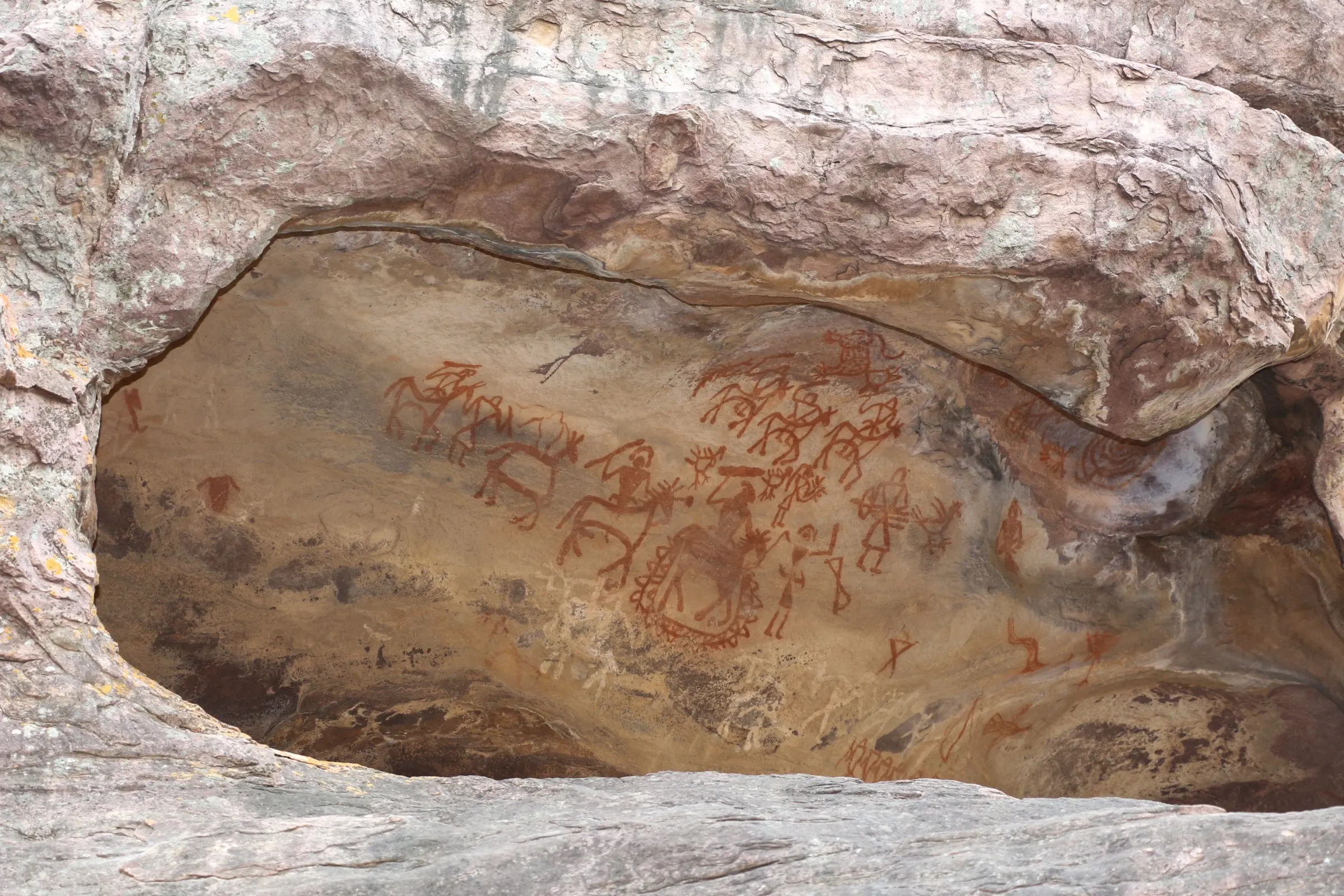
Rock Shelter 8 at Bhimbetka, Madhya Pradesh. People lived in these shelters from the Stone Age onward.
The story most readers learned at school starts Indian history in the Indus cities, about 4,500 years ago, and those cities now lie mostly in Pakistan. The ground of India itself holds a record hundreds of times older. Indian archaeologists and Indian laboratories have dated much of it, from a riverbank near Chennai to the plains of Haryana. Here it is, south to north, in their own findings.
Tamil Nadu: 1.5 million years
Attirampakkam lies on the Kortallayar river, about 60 kilometres north-west of Chennai. In 2011 a team led by Shanti Pappu of the Sharma Centre for Heritage Education in Chennai published in Science the results of a trench more than nine metres deep. It held 3,528 Acheulian stone tools, handaxes, cleavers and flakes, in laminated clays. Burial dating of the quartzite tools themselves, with French laboratories, gave “a pooled average age of 1.51 ± 0.07 Ma”, about one and a half million years. The earliest levels were “no younger than 1.07 million years ago”.1
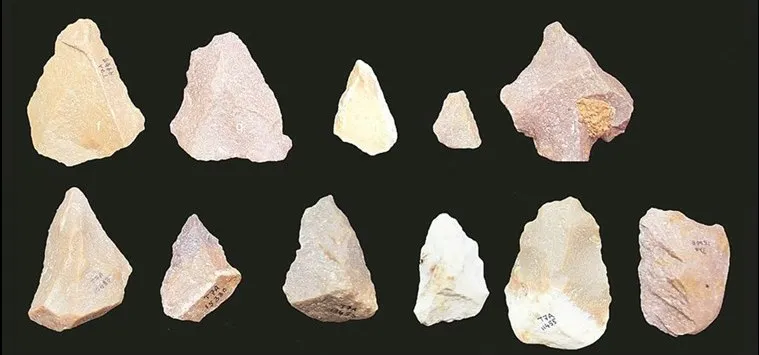
The same team went back to the site with the Physical Research Laboratory in Ahmedabad, whose luminescence laboratory dated sediment from the later layers. In 2018 they reported in Nature that the handaxe culture gave way to a new, lighter toolkit at Attirampakkam “at 385 ± 64 thousand years ago (ka), much earlier than conventionally presumed for South Asia”, contemporary with the same change in Africa and Europe.2 The dating was done in India, by Indian scientists.
Karnataka and Andhra: workshops and a volcano
In the Hunsgi and Baichbal valleys of Karnataka, K. Paddayya of Deccan College excavated hundreds of Acheulian localities from the 1970s. At Isampur he found a quarry and workshop where every stage of making a handaxe is preserved. Preliminary dating of two teeth from the site came to more than 1.2 million years.3
About 74,000 years ago the Toba volcano in Sumatra erupted, one of the largest eruptions known, and spread ash across India. At Jwalapuram in Andhra Pradesh, Ravi Korisettar of Karnatak University and his colleagues found stone tools below the ash and above it. “Broad continuity of Middle Paleolithic technology across the YTT event suggests that hominins persisted regionally across this major eruptive event,” they wrote in Science in 2007.4 A rock shelter nearby holds India’s longest sequence of microliths, the small blades of later hunters, running from about 35,000 years ago, with beads, worked bone and part of a human skull.5
On the red teri dunes of the Tamil Nadu coast near Thoothukudi, a team from the Physical Research Laboratory, the Wadia Institute and Manonmaniam Sundaranar University dated the sands. The microlithic sites on them, they concluded, show that people “existed in the region during 11.4 ± 0.9 ka”, more than 11,000 years ago.6
Central India: the Narmada and the Son
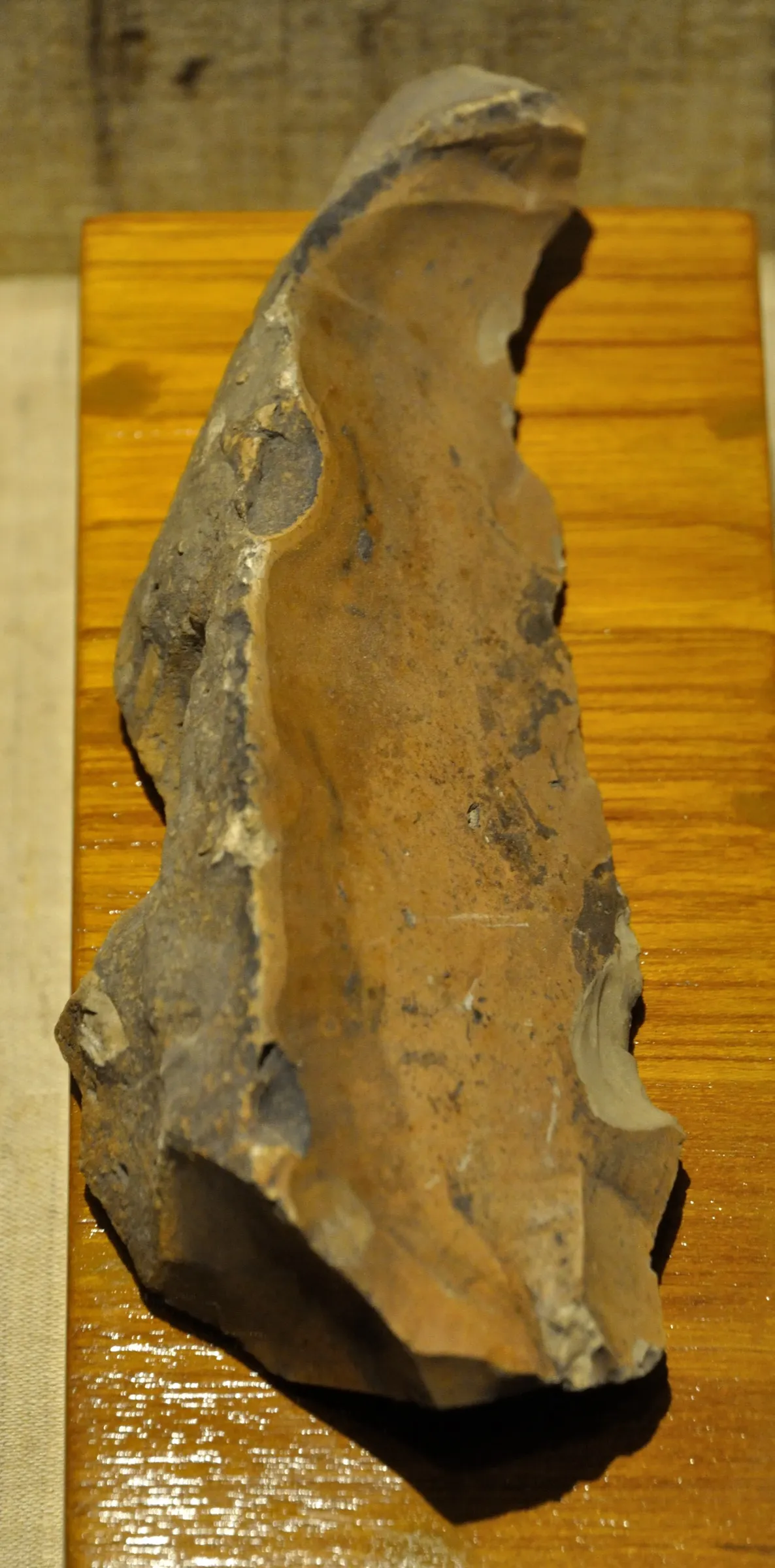
On 5 December 1982 Arun Sonakia of the Geological Survey of India found part of a human skull in the gravels of the Narmada, the Reva of the Puranas, at Hathnora in Madhya Pradesh. It lay with handaxes and the bones of stegodon, horse and pig. Sonakia named it Homo erectus narmadensis.7 It is still the only widely accepted human fossil from India’s Ice Age. Its age is argued; V.N. Misra of Deccan College put it at around 200,000 years.8
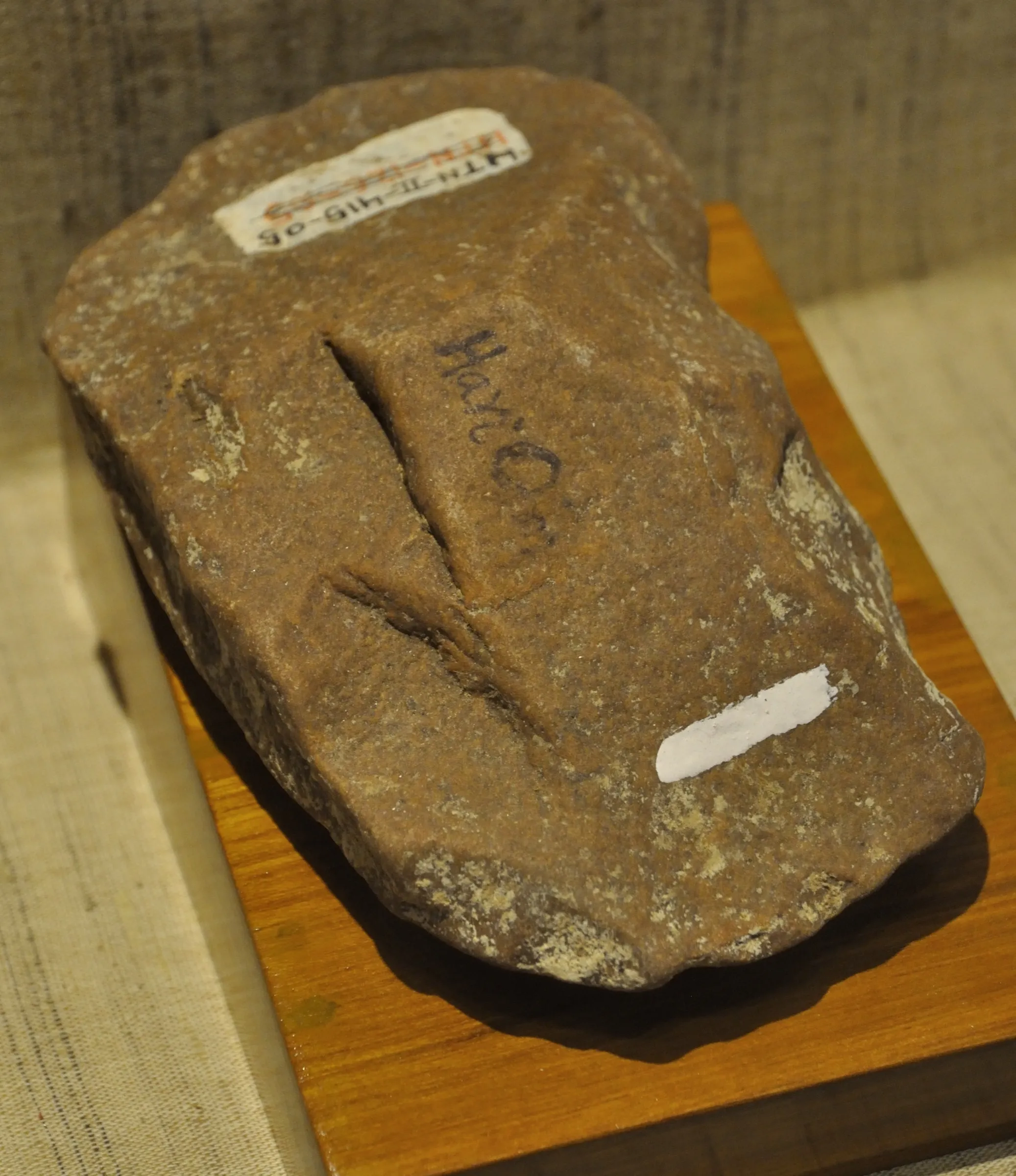
In the Son valley to the east, the Sona of Sanskrit texts, Allahabad University teams led by G.R. Sharma surveyed from 1977. At Baghor in 1980 they found a natural triangular stone with concentric rings set on a rubble platform in an Upper Palaeolithic layer, dated to about 11,870 radiocarbon years. Local Kol and Baiga people still worship such stones as the goddess. “The Baghor structure probably represented the earliest shrine in India,” Misra wrote, “and suggests a remarkably long continuity of mother goddess worship.”9 At Dhaba, in the same valley, a team including J.N. Pal, M.C. Gupta and D.P. Mishra of Allahabad University and A.K. Dubey of Banaras Hindu University found a toolmaking tradition that ran straight through the Toba eruption, “bracketed between ages of 79.6 ± 3.2 and 65.2 ± 3.1 ka”.10
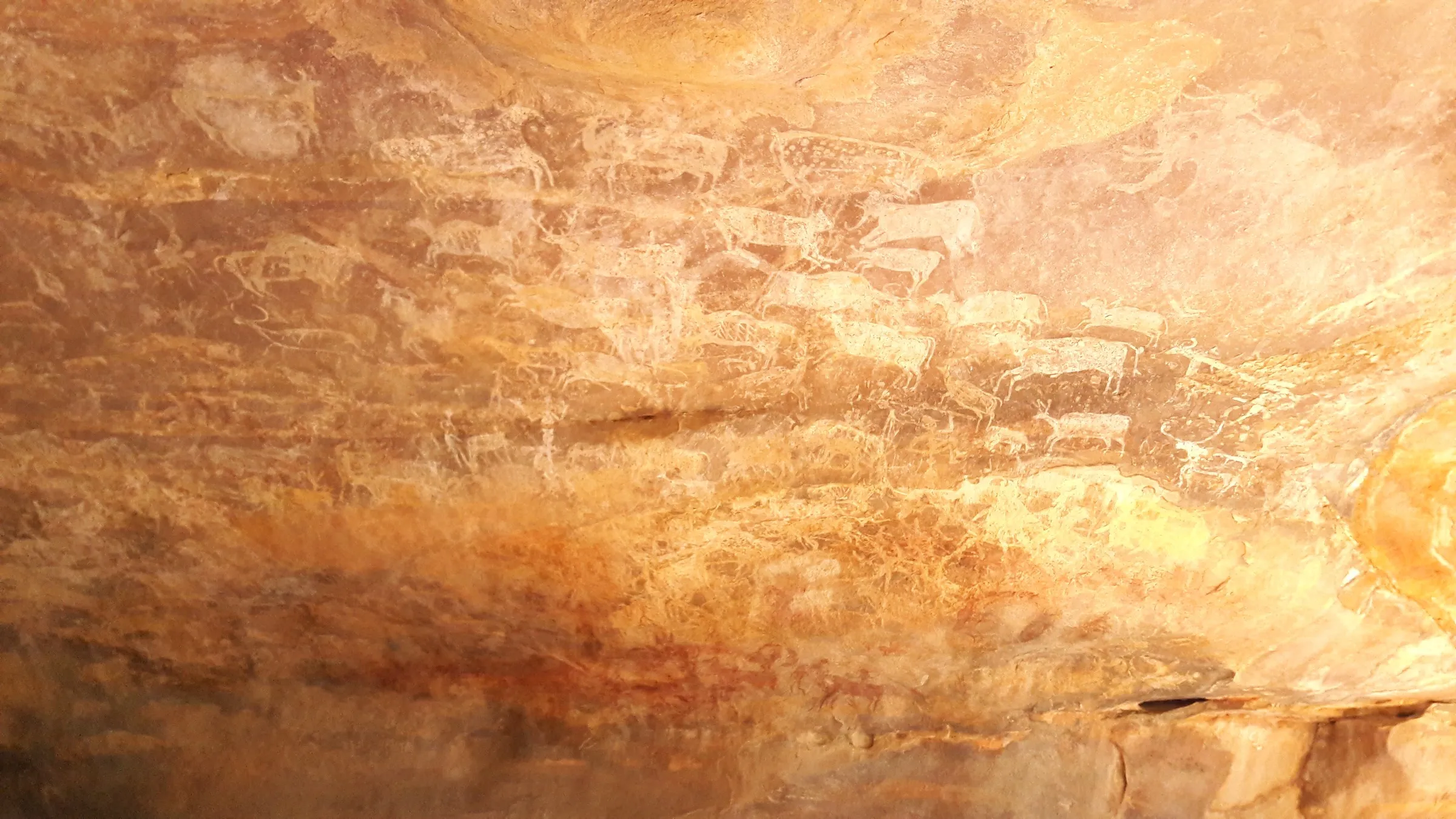
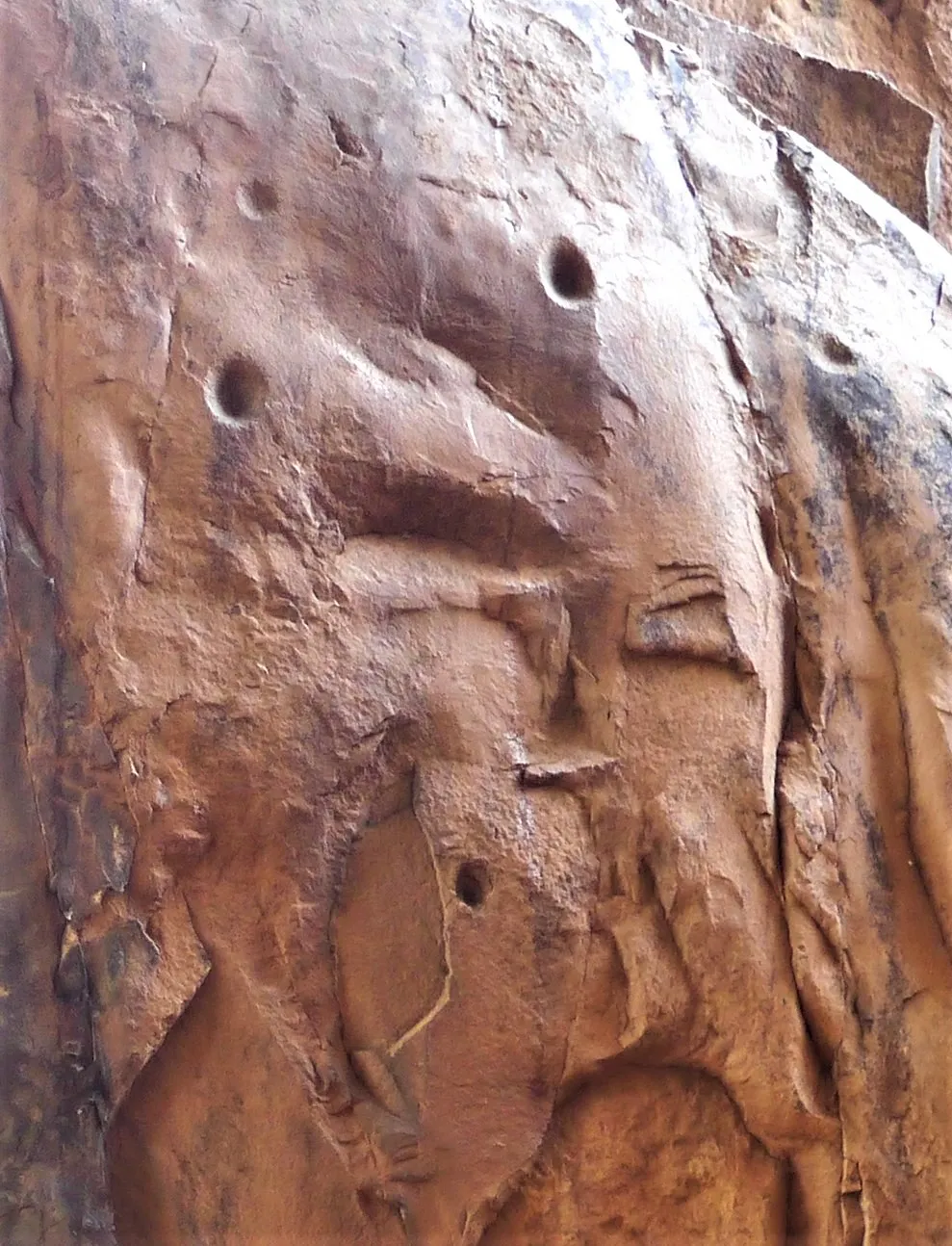
Bhimbetka, in the Vindhya hills, was found by V.S. Wakankar of Vikram University in 1957 and dug by him and by Misra in the 1970s. The Government of India’s nomination to UNESCO says that in one shelter, III F-23, “continued occupation is demonstrable from 100,000 BP (Late Acheulian) to 1000 AD”. The earliest of its paintings are put at about 10,000 years old.11 In its Auditorium Cave, cup-shaped hollows were ground into the rock. Giriraj Kumar of Dayalbagh, Agra, argues they are among the oldest art in the world; a 2023 luminescence study of a rock flake that fell from above the lowest of them gave an age of about 46,000 to 71,000 years, so the hollows are older still.12
The Ganga plain: the first cemeteries and the first rice
North of Prayagraj, beside old oxbow lakes in Pratapgarh district, Allahabad University dug three Mesolithic sites: Sarai Nahar Rai from 1972, Mahadaha in the late 1970s and Damdama in the mid-1980s. Together, J.N. Pal and the American anthropologist John Lukacs wrote, they “have produced the largest collection of Mesolithic human skeletons in Asia”, with hearths, microliths, bone tools and burials wearing jewellery of bone and antler.13 Two dates on human bone from Damdama came to 8,865 and 8,640 radiocarbon years, roughly 8000 to 7600 BCE. At Lekhahia, a rock shelter in Mirzapur with 17 burials, two dates came to 8,370 and 8,000 radiocarbon years.14
At Lahuradewa, in Sant Kabir Nagar district, the Uttar Pradesh Directorate of Archaeology under Rakesh Tewari dug with Lucknow University and the Birbal Sahni Institute of Palaeosciences from 2002. A clot of rice husk from the lowest level was dated to about 6400 BCE.15 In the lake beside the site, Birbal Sahni Institute scientists traced wild rice from the start of the Holocene, about 10,000 years ago, “followed by initiation of rice domestication (cultivation) beginning at ~8.35 ka BP”. New dates from the Physical Research Laboratory in 2022, they wrote, “reaffirm older chronological framework”.16
The west: dunes and hunters
At Didwana in Rajasthan, V.N. Misra and S.N. Rajaguru of Deccan College, with Hema Raghavan, excavated a dune called 16R that holds the whole Stone Age in one section, from handaxes to microliths. Its lowest handaxe levels were dated to about 390,000 years.17 At Bagor, on the Kothari river, Misra dug a Mesolithic camp of stone-paved floors and huts from 1967; its first phase is dated from about 5000 BCE, and he and the zoologist P.K. Thomas read some of its sheep and goat bones as domestic.18 At Langhnaj in Gujarat, H.D. Sankalia of Deccan College excavated India’s first Mesolithic site in the 1940s.19
The best-dated early site in the west is Loteshwar, in Mehsana district, Gujarat. A Maharaja Sayajirao University of Baroda team under P. Ajithprasad re-excavated it in 2009. “The Mesolithic deposits have been AMS dated to 7168-4703 cal. BC,” they wrote, with bones of blackbuck, gazelle, wild boar, nilgai, onager and deer.20
Haryana and the Sarasvati
The seasonal Ghaggar of Haryana and Rajasthan, called the Hakra in Pakistan, has been identified with the Sarasvati of the Rigveda since C.F. Oldham proposed it in 1874. Its southern neighbour, the Chautang, is usually taken as the Drishadvati; the Rigveda and Manu place the sacred land of Brahmavarta between the two.21 Indian scientists at the Physical Research Laboratory and IIT Bombay reported in 2019 that the Ghaggar “was perennial”, fed from the Himalaya, from 80,000 to 20,000 years ago and again from 9,000 to 4,500 years ago, which “likely facilitated development of the early Harappan settlements”.22
On this river, at Bhirrana in Fatehabad district, L.S. Rao of the Archaeological Survey of India excavated pit dwellings beneath the Harappan town from 2003 to 2006. A team from IIT Kharagpur, Deccan College, the Physical Research Laboratory, the Birbal Sahni Institute and the ASI wrote in 2016 that the settlement “has been inferred to be the oldest (>9 ka BP) in the Indian sub-continent”, and that its first phase “is older than 8 ka BP”.23 At Kunal, nearby, Haryana’s Department of Archaeology describes a “pre-Harappan site which is 8000 years old (C14 dates 5700-6000 B.C)”.24
Mehrgarh, on the western edge
At Mehrgarh in Balochistan, on the subcontinent’s western edge, the French excavators found a farming village whose cemetery held eleven molars from nine adults, drilled while the people were alive. Published in Nature in 2006 as 7,500 to 9,000 years old, it is the oldest known tradition of drilling living teeth. A 2025 study by some of the same scientists re-dated the cemetery to about 5200 to 4900 BCE.25
The oldest of all these dates comes from Tamil Nadu: 1.51 million years, from tools found at Attirampakkam, a short drive from Chennai.1
Sources and notes25
Footnotes
-
Shanti Pappu et al., “Early Pleistocene presence of Acheulian hominins in South India”, Science 331 (25 March 2011), pp. 1596-1599. https://www.science.org/doi/10.1126/science.1200183. Critics have asked whether burial ages date the tools’ final deposition; the team dated the artefacts themselves. Confidence: verified (abstract). ↩ ↩2
-
Kumar Akhilesh, Shanti Pappu, A.K. Singhvi et al., “Early Middle Palaeolithic culture in India around 385-172 ka reframes Out of Africa models”, Nature 554 (2018), pp. 97-101. The authors do not claim which human species made the tools. Confidence: verified (abstract). ↩
-
K. Paddayya et al., “Recent findings on the Acheulian of the Hunsgi and Baichbal valleys, Karnataka”, Current Science 83:5 (2002), pp. 641-647. The authors called the dates preliminary. Confidence: reported. ↩
-
Michael Petraglia, Ravi Korisettar et al., “Middle Paleolithic assemblages from the Indian subcontinent before and after the Toba super-eruption”, Science 317 (2007), pp. 114-116. Paul Mellars and colleagues (PNAS, 2013) argue modern humans arrived after Toba. Confidence: verified (abstract). ↩
-
Chris Clarkson, Michael Petraglia, Ravi Korisettar et al., “The oldest and longest enduring microlithic sequence in India”, Antiquity 83 (2009), pp. 326-348. Confidence: verified (abstract). ↩
-
R. Jayangondaperumal, M.K. Murari, P. Sivasubramanian, N. Chandrasekar and A.K. Singhvi, “Luminescence dating of fluvial and coastal red sediments in the SE Coast, India”, Quaternary Research 77 (2012), pp. 468-481. The dates are on the dunes, not the tools. Confidence: verified (abstract). ↩
-
Arun Sonakia, “The skull-cap of early man and associated mammalian fauna from Narmada valley alluvium”, Records of the Geological Survey of India 113 (1984). Confidence: reported. ↩
-
V.N. Misra, “Prehistoric human colonization of India”, Journal of Biosciences 26:4 (2001), pp. 491-531. Other estimates range from 50,000 to 600,000 years. Confidence: verified (Misra). ↩
-
J.M. Kenoyer, J.D. Clark, J.N. Pal and G.R. Sharma, “An Upper Palaeolithic shrine in India?”, Antiquity 57 (1983), pp. 88-94; Misra (2001). Confidence: reported (date); verified (Misra). ↩
-
Chris Clarkson et al., “Human occupation of northern India spans the Toba super-eruption ~74,000 years ago”, Nature Communications 11 (2020), 961. https://pmc.ncbi.nlm.nih.gov/articles/PMC7042215/. Confidence: verified. ↩
-
Government of India, nomination of the Rock Shelters of Bhimbetka to the World Heritage List, with the ICOMOS evaluation; inscribed 2003. https://whc.unesco.org/uploads/nominations/925.pdf. The 100,000-year figure rests on the order of layers and tool types, not a measured date. Confidence: verified. ↩
-
G.S. Polymeris, I. Liritzis, R.G. Bednarik, Giriraj Kumar et al., Quaternary Geochronology 78 (2023), 101472, on Daraki-Chattan and the cupule tradition. Other rock-art specialists regard the Lower Palaeolithic attribution as unproven. Confidence: verified (abstract). ↩
-
J.R. Lukacs and J.N. Pal, “Skeletal variation among Mesolithic people of the Ganga plains”, Asian Perspectives 42:2 (2003), pp. 329-351. https://os.pennds.org/archaeobib_filestore/pdf_articles/AP/2003_42_2_LukacsPal.pdf. Confidence: verified. ↩
-
Lukacs and Pal (2003) for Damdama; Lukacs et al. (1996) for Lekhahia, as cited in secondary accounts. Dates on tooth enamel from Damdama are about 3,000 years younger. Confidence: verified (Damdama); reported (Lekhahia). ↩
-
R. Tewari et al., “Second preliminary report of the excavations at Lahuradewa”, Pragdhara 16 (2006), pp. 35-68; AMS date ERL-6904, 7532 radiocarbon years, about 6442-6376 cal BCE. Confidence: reported. ↩
-
N. Patel et al., Journal of the Palaeontological Society of India 67:1 (2022). https://palaeontologicalsociety.in/vol67_1/10.%20JPSI-IBSV-Patel-Agnihotri.pdf. Confidence: verified. ↩
-
H. Raghavan, S.N. Rajaguru and V.N. Misra, “Radiometric dating of a Quaternary dune section, Didwana, Rajasthan”, Man and Environment 13 (1989), pp. 19-22; Misra (2001). Confidence: verified (Misra); reported (individual dates). ↩
-
V.N. Misra, “Bagor: a late Mesolithic settlement in north-west India”, World Archaeology 5:1 (1973), pp. 92-110. Confidence: reported. ↩
-
Misra (2001). Radiocarbon dates from Langhnaj came out late, around 2000 BCE, and the excavators suspected contamination. Confidence: reported. ↩
-
C. Gadekar, J.J. García-Granero, M. Madella and P. Ajithprasad, “Microlithic variation and the Mesolithic occupations of western India”, PLOS ONE 17:5 (2022), e0267654. https://journals.plos.org/plosone/article?id=10.1371/journal.pone.0267654. Confidence: verified. ↩
-
C.F. Oldham, “The Saraswati and the lost river of the Indian desert”, Journal of the Royal Asiatic Society 25 (1893), pp. 49-76; Rigveda 3.23.4. Confidence: reported. ↩
-
A. Chatterjee, J.S. Ray, A.D. Shukla and K. Pande, “On the existence of a perennial river in the Harappan heartland”, Scientific Reports 9 (2019). Other studies (Giosan et al., PNAS, 2012; Singh et al., Nature Communications, 2017) find the river lost its Himalayan water earlier, before about 8,000 years ago. Confidence: verified (abstract). ↩
-
A. Sarkar et al., Scientific Reports 6: 26555 (2016). https://pmc.ncbi.nlm.nih.gov/articles/PMC4879637/. Confidence: verified. ↩
-
Department of Archaeology and Museums, Haryana, list of excavated sites. https://www.archaeology.haryana.gov.in/sites/default/files/site-docs/Excavation-sites-A-and-M-website.pdf. Other summaries put Kunal’s deposit at about 3600-3000 BCE. Confidence: verified (statement). ↩
-
A. Coppa et al., “Early Neolithic tradition of dentistry”, Nature 440 (2006), pp. 755-756; B. Mutin et al., Scientific Reports 15: 11345 (2025). Confidence: verified (abstracts). ↩
Letters
No letters on this report yet.
Letter received
Thank you. It is with the editors now and will appear here if we publish it.