Water v paper · 200 BCE–2027
Wipe and pray
India settled the question with a jar of water some 2,000 years ago. The West tried a sponge on a stick, a goose, a mail-order catalogue and medicated sheets, and settled on a roll of paper that costs it forests, fights in supermarkets and a 130-tonne lump under Whitechapel.
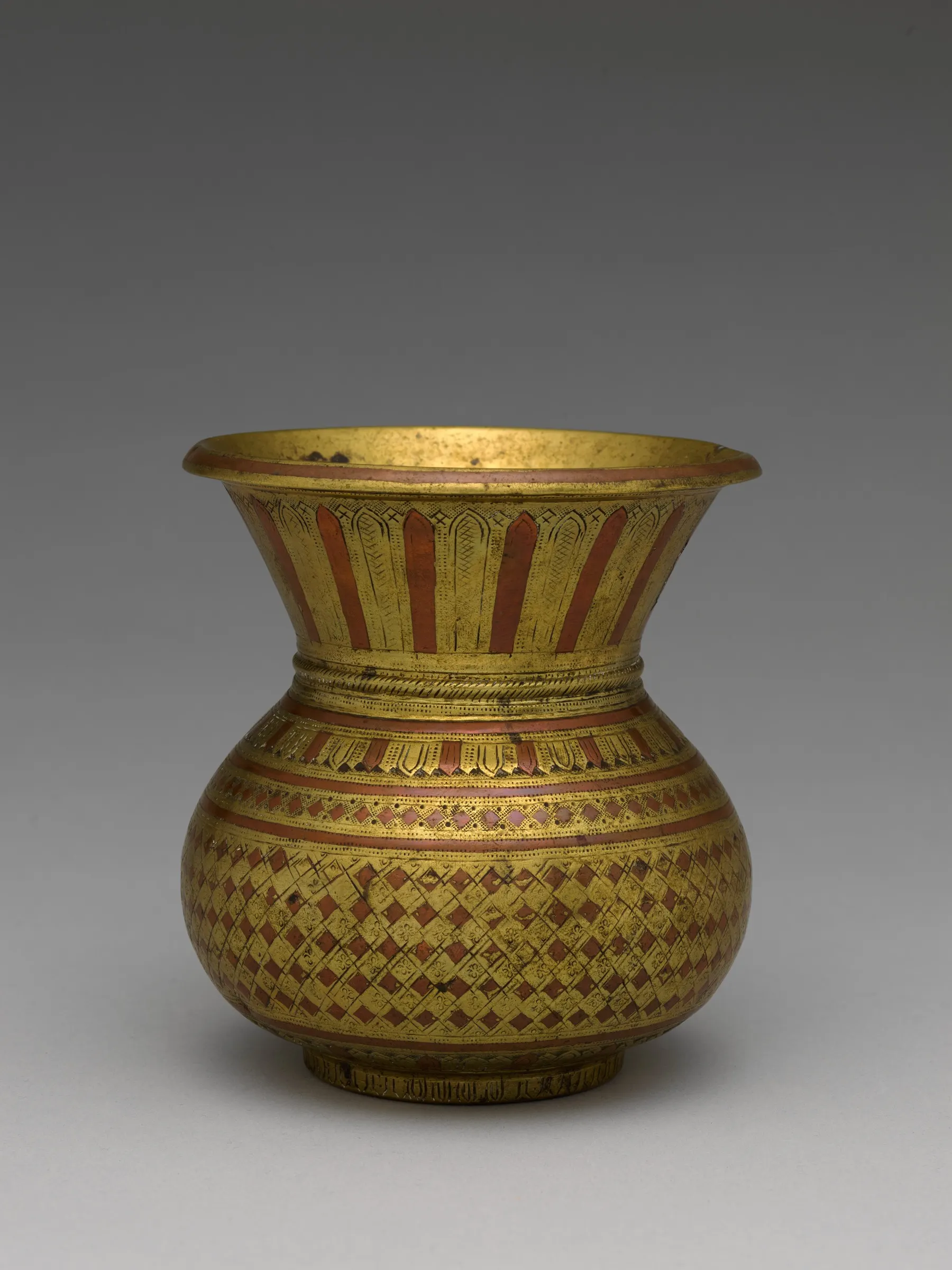
A lota, the Indian water pot, in brass and copper, 19th century. It is 14 centimetres tall.
विण्मूत्रोत्सर्गशुद्ध्यर्थं मृद्वार्यादेयमर्थवत् ।
viṇmūtrotsargaśuddhyarthaṃ mṛdvāryādeyam arthavat |
“For the cleansing of the ejectors of urine and faeces, earth and water should be used, as much as may be necessary.”1
In the 1530s François Rabelais, the great comic writer of the French Renaissance, had his giant Gargantua test everything a man might wipe himself with. He tried velvet, a lady’s neckerchief, a cat, sage, nettles, hay, straw, wool and paper, and came back with a verse on the last of these:
“Who his foul tail with paper wipes, / Shall at his ballocks leave some chips.”
Gargantua’s verdict, in Thomas Urquhart’s translation of 1653, was that “of all torcheculs, arsewisps, bumfodders, tail-napkins, bunghole cleansers, and wipe-breeches, there is none in the world comparable to the neck of a goose, that is well downed, if you hold her head betwixt your legs.”2 Water was not on his list.
India’s rule: until it is clean
The Indian rule was written down about 2,000 years ago and is a test, not a ritual. After the toilet, says the Manusmriti, use earth and water “as much as may be necessary”. Medhatithi, its commentator in Kashmir a thousand years ago, explained that meant “as much water and earth as may be necessary for the total removal of smells and stains”.1 The Vishnu Smriti says the same: clean yourself “with water and earth (previously) fetched for the purpose, so as to remove the smell and the filth”.3
Foreigners noticed the jar. Yijing, the Chinese monk who lived in India from 673 to 685, set down the Indian lavatory rules for his countrymen, noting that “such rules as above were never introduced into China”, and that in India “if one does not wash and purify oneself, the people of the five divisions of India will laugh at one”.4 An Arabic account of China and India written in 851 put it more bluntly: “The Chinese wipe themselves with Paper, whereas the Indians wash.”5 In 1689 the English chaplain John Ovington watched the merchants of Surat: “When they are called upon by the Necessities of Nature, they always carry in their Hands a small Jarr of Water, which they use to wash themselves clean with.”6
The Portuguese in Goa took up the habit. In the 1580s the Dutchman Jan Huyghen van Linschoten found their women washing after every visit to the toilet, “were it a hundred times a day and night”, a custom “they have learned and received of the Indian Heathens”.7 Around 1820 the French missionary Abbé Dubois reported that “the European habit of using paper is looked upon by all Hindus, without exception, as an utter abomination”, and that some refused to believe Europeans really did it.8
The pedigree of paper
Paper got there first in China. About 589 the scholar Yan Zhitui wrote that he would not use for the toilet any paper bearing “quotations or commentaries from the Five Classics or the names of sages”, which tells you other paper was already being used.9 By 1393 the Ming court at Nanjing was getting through 720,000 sheets a year, each about two feet by three, with another 15,000 softer, perfumed sheets for the emperor’s family.9
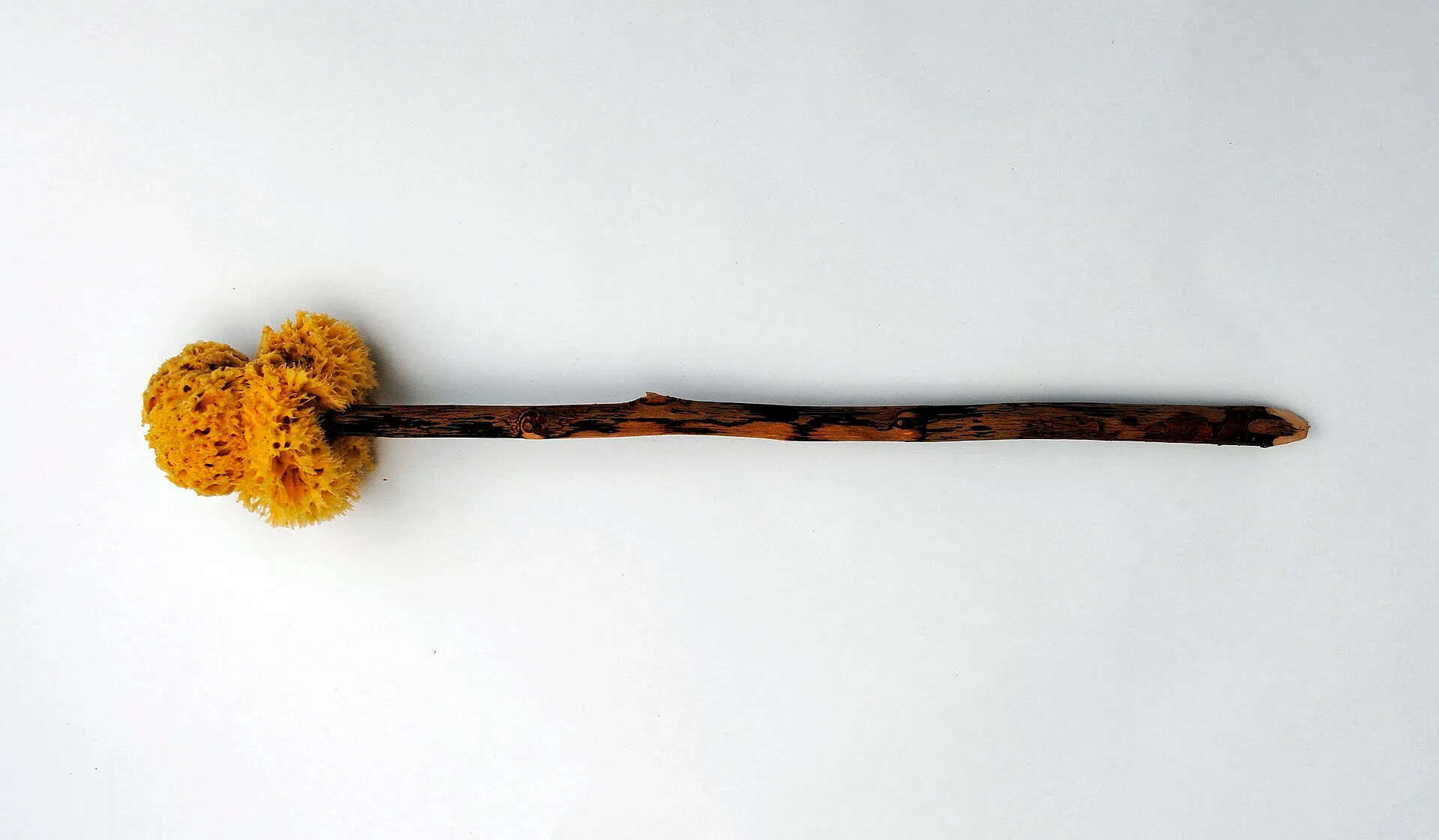
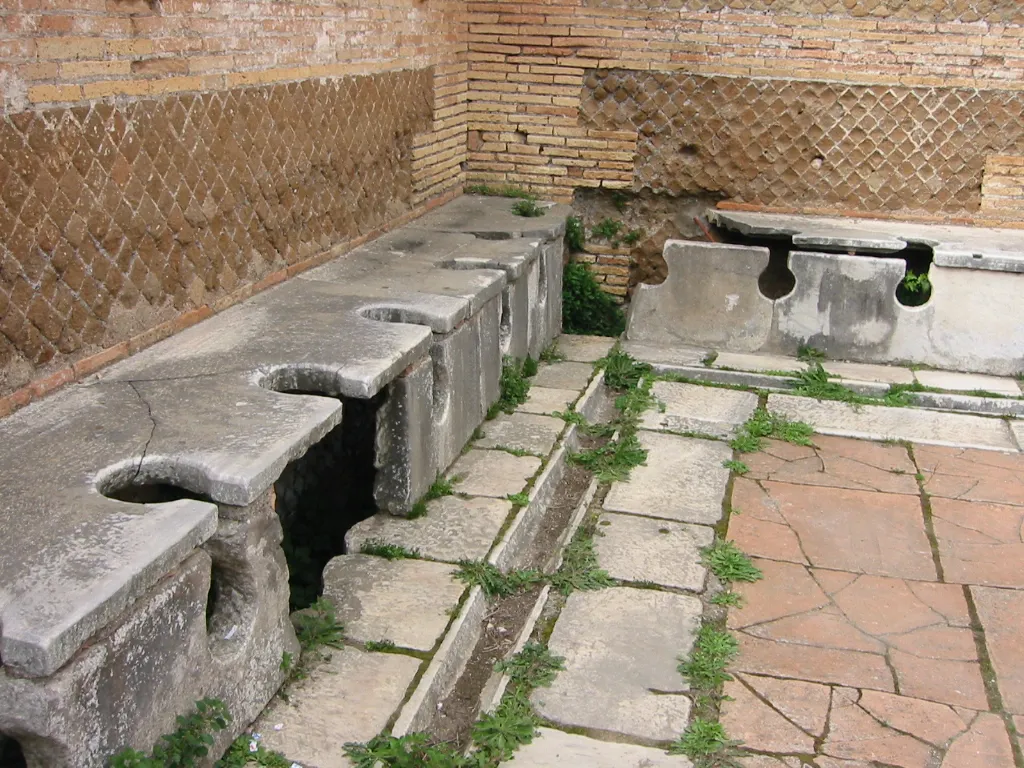
Rome had a sponge on a stick. In the first century the philosopher Seneca told of a German prisoner who killed himself in the latrine of a gladiators’ school: “he seized the stick of wood, tipped with a sponge, which was devoted to the vilest uses, and stuffed it, just as it was, down his throat”.10
America sells paper as medicine
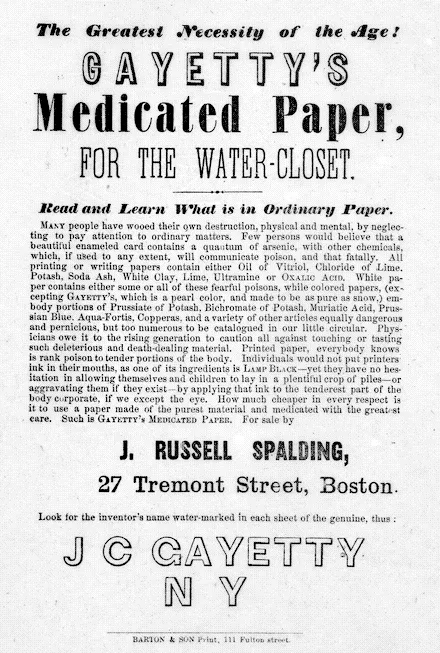
On 9 December 1857 a New Yorker named Joseph Gayetty began selling “medicated paper”: sheets of Manila hemp soaked in aloe and watermarked with his name, sold as a remedy for piles.11 His advertisement of 1859 called it “The greatest necessity of the age!”12 The West’s first commercial toilet paper, in other words, was sold to treat what wiping does to people.
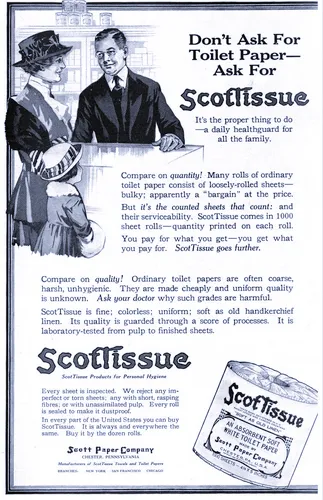
In 1890 the Scott Paper Company of Philadelphia began selling perforated paper on a roll. The Scott brothers were, according to the CBC’s history of the trade, “too embarrassed to put their own name on their own product”, and from about 1903 they advertised it as a guard against dysentery, typhoid and cholera.13 Rural Americans, meanwhile, used the pages of the Sears catalogue. As late as 1935 the Northern Tissue company advertised its paper, the CBC reports, as “splinter free”.13
What is in the roll
In 2023 researchers at the University of Florida tested toilet paper from the Americas, Africa and western Europe for PFAS, the “forever chemicals”. They found them, and concluded that “toilet paper should be considered as a potentially major source of PFAS entering wastewater treatment systems”. By their estimate it supplied about 4 per cent of one common PFAS in sewage in the United States and Canada, 35 per cent in Sweden and up to 89 per cent in France.14 Recycled toilet paper picks up bisphenol A from the till receipts pulped with it: a German study of 2004 found 3.2 to 46.1 milligrams per kilogram.15
The skin notices too. In 2010 doctors at the Mayo Clinic described four adults with “severe perianal and perineal allergic contact dermatitis” from the preservative in moist toilet paper; all four cleared up when they stopped using it.16 The same year Canadian family doctors reported a woman with four years of vulvar irritation that ended when she switched to cheap unbleached paper. They suspected the formaldehyde in “thick, absorptive, strong, bleached, and expensive brands”.17
Forests down the pan
Americans, says the Natural Resources Defense Council, “make up just over 4 percent of the world’s population” but “account for over 20 percent of global tissue consumption”. More than a million acres of Canada’s boreal forest are logged every year, “in part” to supply it, in what the council’s 2019 report called the “tree-to-toilet pipeline”.18 In 2022 it gave Procter & Gamble, Kimberly-Clark and Georgia-Pacific “F” scores for Charmin, Cottonelle and Quilted Northern. “Turning them into toilet paper is a climate crime,” said Jennifer Skene, its forest campaigner.19
The average American gets through 141 rolls a year. Italians, whose homes have had to include a bidet since a health ministry decree of 1975, use 70.20
When the shelves emptied
In March 2020, as Covid reached Australia, Sydney emptied its supermarkets of toilet paper. On 4 March police were called to a “disturbance” at a Woolworths in Parramatta, where, a worker said, “a knife was pulled and the people started running around”.21 On 7 March two women at a Woolworths in Chullora were charged with affray after a fight over a trolley full of toilet rolls. “It isn’t the Thunderdome, it isn’t Mad Max, we don’t need to do that,” said Acting Inspector Andrew New.22
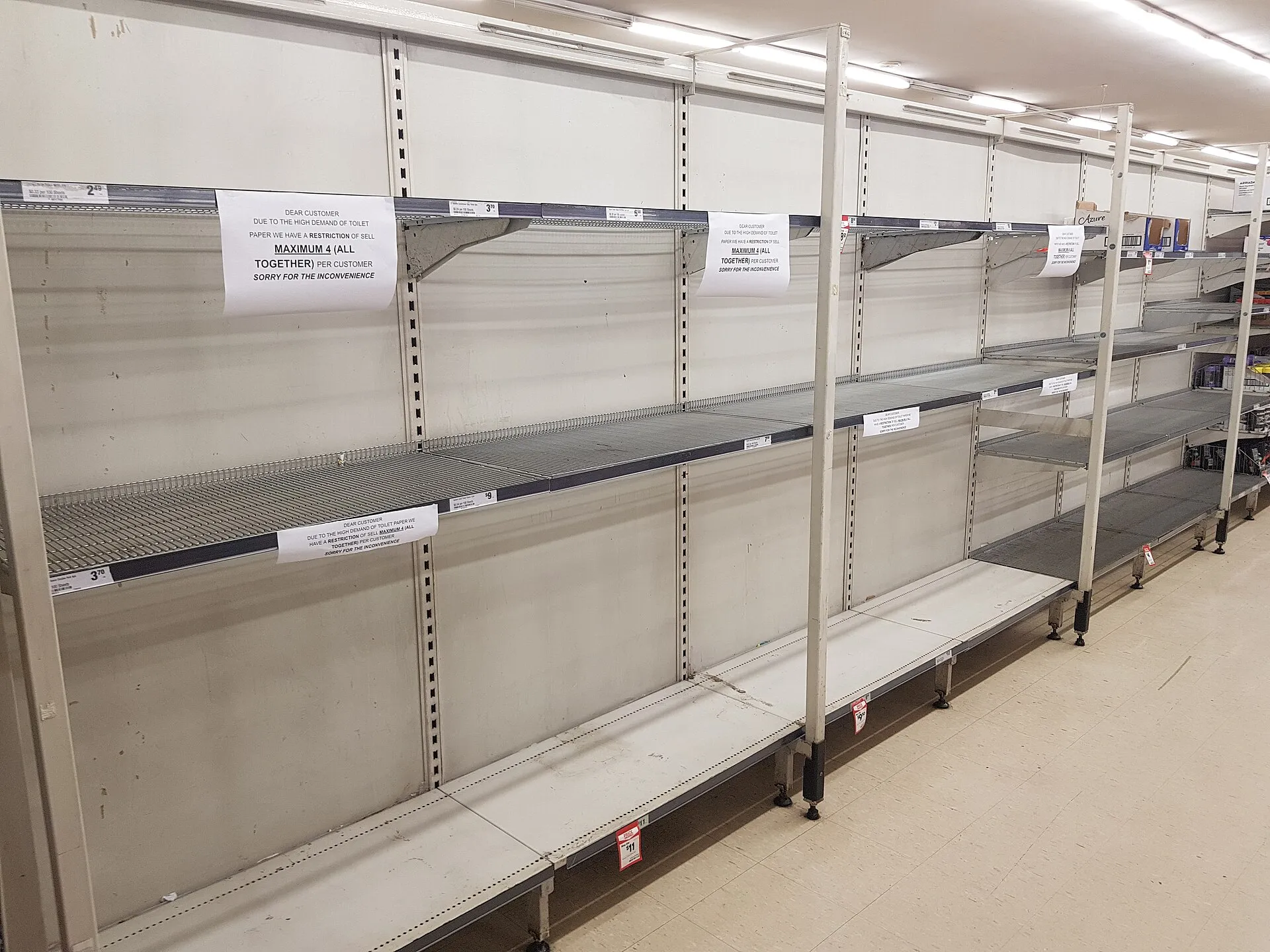
Americans discovered the bidet. Tushy, a bidet company, said its sales went “from double to triple to more like 10 times” normal; Wirecutter said traffic to its bidet guide was up “something like 5,000 percent”.23
The wet wipe
Britain’s answer to dry paper was to wet it, add plastic and flush it. In September 2017 Thames Water found a fatberg under Whitechapel, in east London, that weighed about 130 tonnes and stretched for 250 metres. “It’s basically like trying to break up concrete,” said Matt Rimmer of Thames Water.24 The company says 3.8 billion wet wipes are flushed into its sewers every year, and rags of one kind or another caused 52 per cent of its blockages in 2026.25 England’s ban on wet wipes containing plastic takes effect on 19 May 2027.26
Who washes
Japan has gone the Indian way with electronics. At the end of March 2026, 82.5 per cent of Japanese households had a warm-water washing toilet seat. Only 76.2 per cent had a car.27
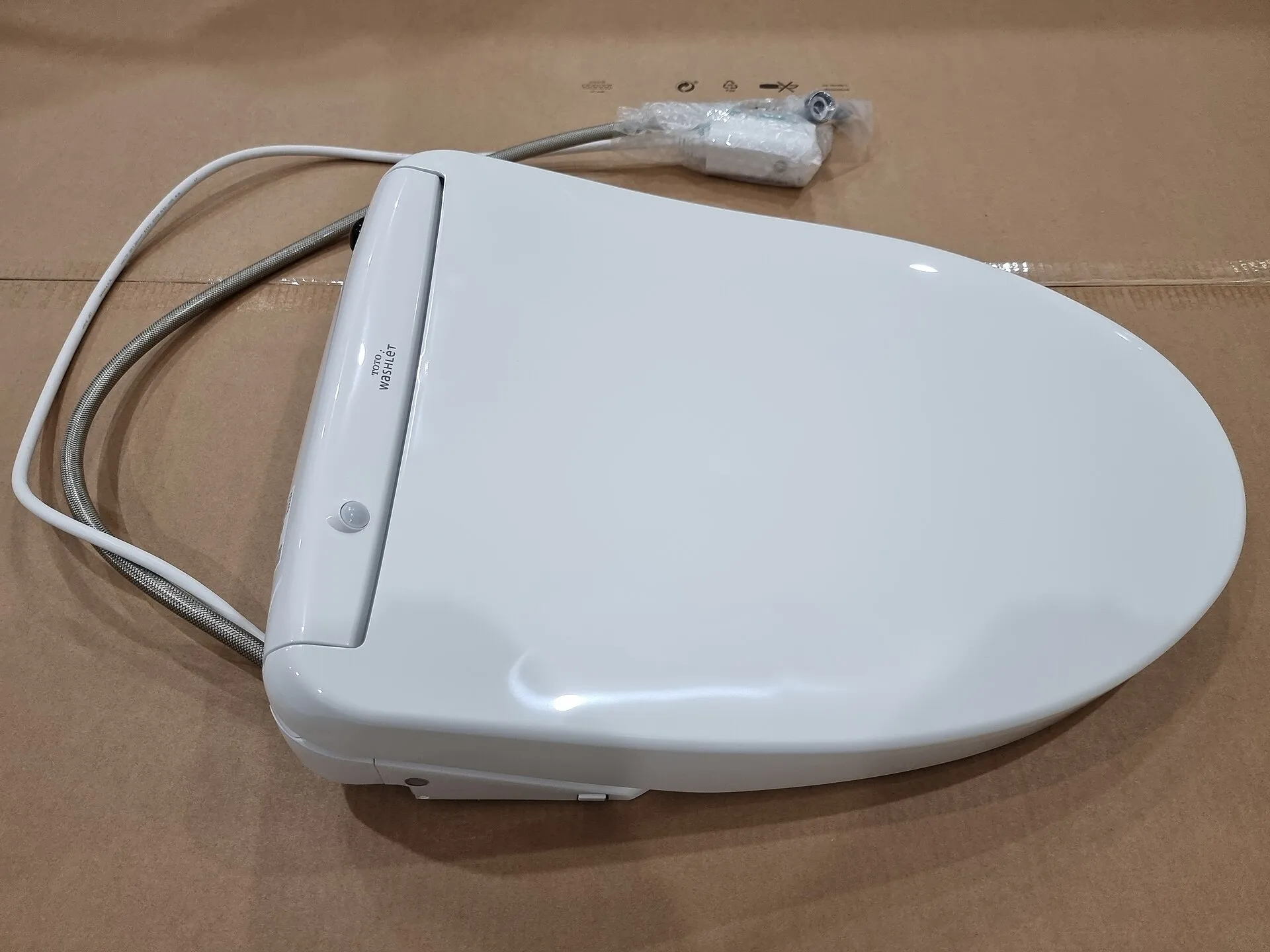
Yijing, writing for Chinese monks who preferred their old ways, had one more piece of advice: “Even if you do not believe these points, you had better try what has been directed. After five or six days you may know the faults of not washing yourselves. In winter you may use warm water.”4
Sources and notes27
Footnotes
-
Manusmriti 5.132 (Jha’s numbering; 5.134 in Bühler), trans. Ganganatha Jha, with Medhatithi’s commentary. https://www.wisdomlib.org/hinduism/book/manusmriti-with-the-commentary-of-medhatithi/d/doc200517.html. Confidence: verified (translation); the Devanagari is transcribed from the verified transliteration. ↩ ↩2
-
François Rabelais, Gargantua (1534 or 1535), book 1, ch. 13, trans. Thomas Urquhart (1653). https://www.gutenberg.org/ebooks/1200. The French has oyson, a gosling. Confidence: verified. ↩
-
Vishnu Smriti 60.24, trans. J. Jolly, Sacred Books of the East 7 (1880). https://archive.org/details/institutesofvish00joll. Confidence: verified. ↩
-
Yijing (I-tsing), A Record of the Buddhist Religion as Practised in India, trans. J. Takakusu (1896), ch. XVIII, pp. 91-94. https://archive.org/details/arecordbuddhist00takagoog. Confidence: verified. ↩ ↩2
-
Ancient Accounts of India and China, by Two Mohammedan Travellers, trans. Eusebius Renaudot (1733), pp. 36-37. https://archive.org/details/ancientaccountso00sira. Confidence: verified. ↩
-
John Ovington, A Voyage to Suratt, in the Year 1689 (1696), pp. 294-295. https://archive.org/details/AVoyageToSurattInTheYear1689. Confidence: verified. ↩
-
The Voyage of John Huyghen van Linschoten, ed. A.C. Burnell and P.A. Tiele, vol. I (Hakluyt Society, 1885), ch. 31. https://archive.org/details/voyagejohnhuygh01tielgoog. Confidence: verified. ↩
-
J.A. Dubois, Hindu Manners, Customs and Ceremonies, trans. H.K. Beauchamp (1899), pp. 241-242. https://archive.org/details/hindumannerscust00dubo_0. Confidence: verified. ↩
-
Joseph Needham and Tsien Tsuen-Hsuin, Science and Civilisation in China, vol. 5 pt 1, Paper and Printing (1985), p. 123, as quoted in secondary accounts. Confidence: reported. ↩ ↩2
-
Seneca, Epistulae morales 70.20, trans. R.M. Gummere (Loeb). https://en.wikisource.org/wiki/Moral_letters_to_Lucilius/Letter_70. Confidence: verified. ↩
-
Joseph Gayetty, medicated paper, first marketed 9 December 1857; details from secondary accounts. Confidence: reported. ↩
-
Gayetty’s Medicated Paper advertisement, 1859, Wikimedia Commons. https://commons.wikimedia.org/wiki/File:GayettysMedicatedPaperAdvertisement.jpg. Confidence: verified. ↩
-
Terry O’Reilly, “Now Splinter Free: How Marketing Broke Taboos”, Under the Influence, CBC Radio, 8 June 2017. https://www.cbc.ca/radio/undertheinfluence/now-splinter-free-how-marketing-broke-taboos-1.4149558. No copy of the Northern Tissue advertisement was found. Seth Wheeler of Albany held earlier US patents for perforated rolls (1871, 1883). Confidence: reported. ↩ ↩2
-
J.T. Thompson, B.-T. Chen, J.A. Bowden and T.G. Townsend, “Per- and Polyfluoroalkyl Substances in Toilet Paper and the Impact on Wastewater Systems”, Environmental Science & Technology Letters 10:3 (2023), 234-239. The country shares are from the American Chemical Society’s release. Confidence: verified (abstract); reported (shares). ↩
-
M. Gehring et al., “Bisphenol A contamination of wastepaper, cellulose and recycled paper products”, Waste Management and the Environment II (WIT Press, 2004). Three samples. Confidence: verified (abstract). ↩
-
K.H. Gardner et al., “The hazards of moist toilet paper”, Archives of Dermatology 146:8 (2010), 886-890. Confidence: verified (abstract). ↩
-
J.A. Majerovich, A. Canty and B. Miedema, “Chronic vulvar irritation: could toilet paper be the culprit?”, Canadian Family Physician 56:4 (2010), 350-352. One case. https://pmc.ncbi.nlm.nih.gov/articles/PMC2860827/. Confidence: verified. ↩
-
Natural Resources Defense Council and Stand.earth, The Issue with Tissue (February 2019). https://www.nrdc.org/sites/default/files/issue-tissue-how-americans-are-flushing-forests-down-toilet-report.pdf. Confidence: verified. ↩
-
NRDC press release, 14 September 2022. Confidence: reported. ↩
-
Statista, “The U.S. Leads the World in Toilet Paper Consumption” (2018), as reproduced in The Issue with Tissue; Italian health ministry decree of 5 July 1975, as cited in secondary sources. Confidence: reported. ↩
-
Mothership, March 2020, citing New South Wales Police. https://mothership.sg/2020/03/knife-australia-toilet-paper-argument/. No arrest was reported. Confidence: reported. ↩
-
The Guardian, 7 March 2020. https://www.theguardian.com/australia-news/2020/mar/07/it-isnt-mad-max-police-warning-after-shoppers-brawl-over-toilet-paper-in-sydney. Confidence: verified. ↩
-
Kate Knibbs, Wired, 17 March 2020. https://www.wired.com/story/toilet-paper-shortage-bidet-sales-boom/. The figures are the companies’ own. Confidence: verified. ↩
-
The Guardian, 12 September 2017. https://www.theguardian.com/environment/2017/sep/12/total-monster-concrete-fatberg-blocks-london-sewage-system. Confidence: verified. ↩
-
Thames Water, October 2026. https://www.thameswater.co.uk/news/2026/oct/unblocktober-you-could-build-10-big-bens-with-the-wet-wipes-flushed-every-year. Confidence: verified. ↩
-
UK government, “Plastic wet wipes ban”, guidance updated 17 December 2025. https://www.gov.uk/guidance/plastic-wet-wipes-ban. Confidence: verified. ↩
-
Cabinet Office of Japan, Consumer Confidence Survey, 2026 results, households of two or more people. https://www.esri.cao.go.jp/jp/stat/shouhi/kekkanogaiyou2026.pdf. Confidence: verified. ↩
Letters
No letters on this report yet.
Letter received
Thank you. It is with the editors now and will appear here if we publish it.