Read the world · Part 2 · 1972–2026
Eyes up
Twenty of 24 radiologists missed a gorilla placed in a lung scan, and 12 of them had looked straight at it. The US Army's influence manual, the Marines' Combat Hunter course and research on pilots' mistakes all deal with the same problem: how to notice what is in front of you, and what normal looks like before something changes. Part 2 sets out the methods and the drills.
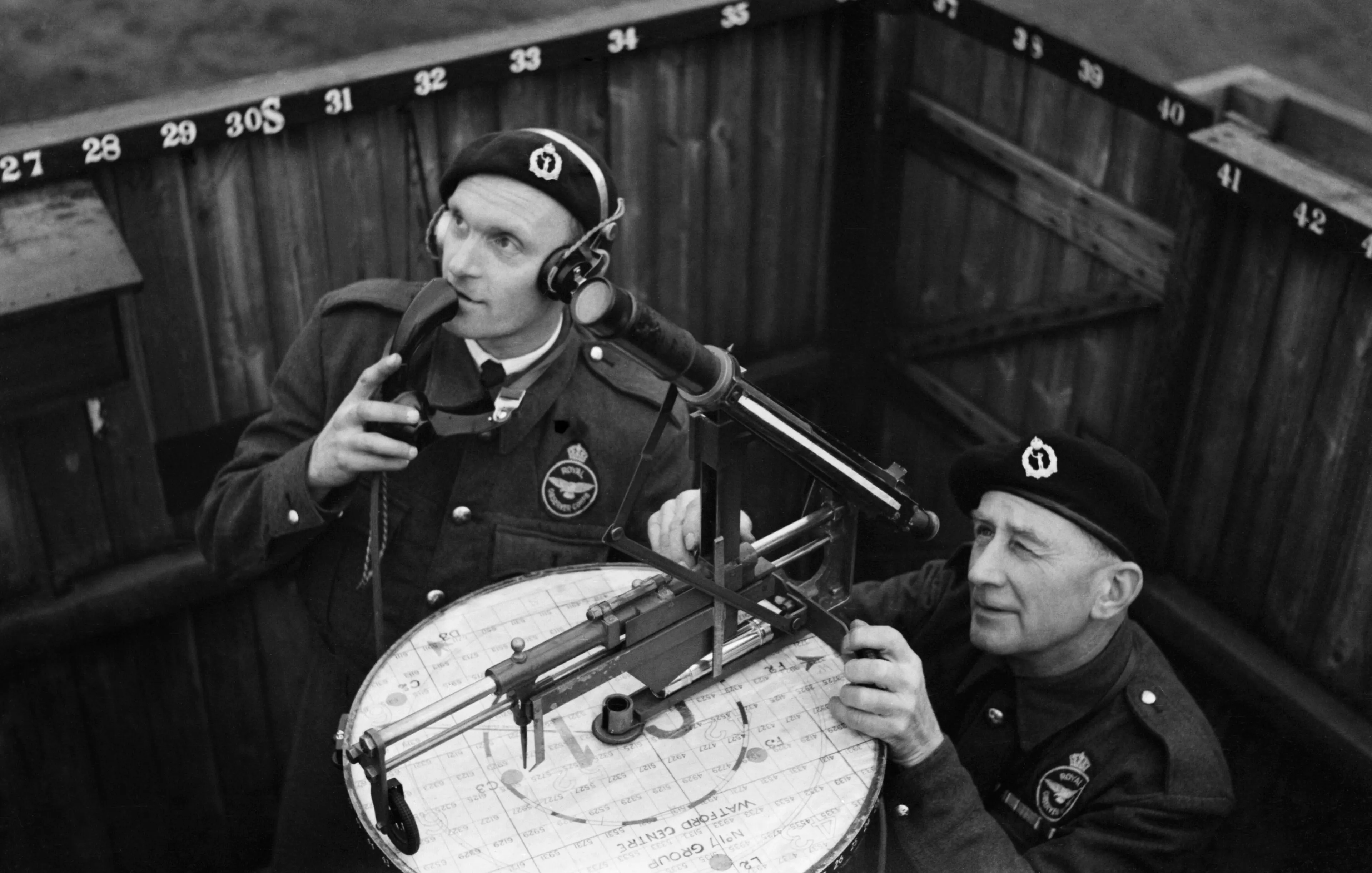
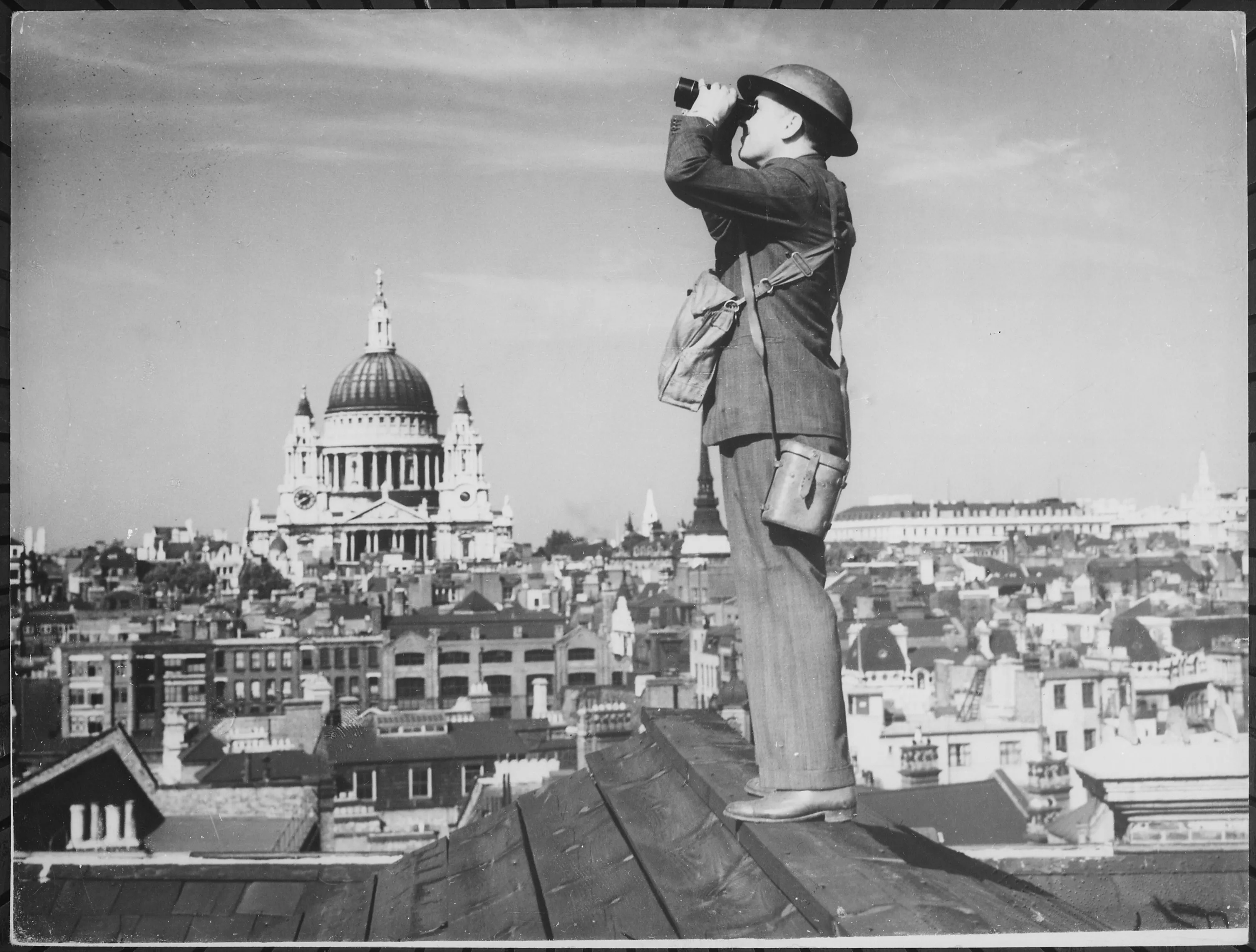
A Royal Observer Corps post at Kings Langley, Hertfordshire, during the Second World War. P.C. "Lofty" Austin reports to the Corps Centre on a chest telephone while E.C. "Smudge" Smith works the plotting instrument.Royal Air Force official photograph, © IWM (CH 8215). Public domain
In 2013 three psychologists, Trafton Drew, Melissa Võ and Jeremy Wolfe, asked 24 radiologists to search a set of lung CT scans for nodules. Into the last case they had inserted a picture of a gorilla 48 times the size of the average nodule. Twenty of the 24 did not report it. The researchers tracked the radiologists’ eye movements, and 12 of the 20 who missed the gorilla had looked directly at the spot where it was, for an average of 547 milliseconds. These were experts searching in their own field. The authors concluded that “even expert searchers, operating in their domain of expertise, are vulnerable to inattentional blindness.”1
The experiment borrowed its gorilla from a famous one. In 1999 Daniel Simons and Christopher Chabris gave observers a counting task while they watched a short video, and partway through either a woman with an umbrella or a person in a gorilla suit walked across the scene. Across all their conditions, 56 per cent of the observers shown the gorilla missed it. A harder counting task made it worse: 45 per cent noticed the unexpected event when the count was hard, against 64 per cent when it was easy. In one version the gorilla stopped, faced the camera and thumped its chest for nine seconds, and only half of the 12 people who saw it noticed. The paper’s conclusion was that “we perceive and remember only those objects and details that receive focused attention.”2
This is the second part of a series that takes apart the US Army’s 2007 manual on psychological operations, FM 3-05.301. Part 1 covered reading a group of people. This part covers the step that comes before it: seeing what is in front of you at all, learning what normal looks like, and working out where the power in a situation sits. The manual was written for soldiers working among foreign populations. Everything below about offices, streets and news feeds is this paper’s adaptation, borrowing its logic and the research on attention.
What awareness means
The standard definition comes from Mica Endsley, whose research has covered pilots, air traffic controllers, power plant operators and medicine. She first gave it in 1988 and set it out in full in 1995: situation awareness is “the perception of the elements in the environment within a volume of time and space, the comprehension of their meaning and the projection of their status in the near future”.3
That gives three levels. The first is noticing what is there. The second is understanding what it means, which she compared to “having a high level of reading comprehension as compared to just reading words.” The third is working out what happens next. “In almost every field I have studied”, Endsley wrote, “experienced operators rely on future projections heavily. It is the mark of a skilled expert.”3
Most failures happen at the first level. In 1996 Debra Jones and Endsley went through reports to NASA’s Aviation Safety Reporting System that mentioned situational awareness and sorted the awareness errors by level. Of the errors identified, 76.3 per cent were failures to perceive, 20.3 per cent failures to understand and 3.4 per cent failures to project. The largest single cause, 35 per cent of all the errors, was a situation where “all the needed information was present, but was not attended to by the operator”. It was most often associated with distraction by other tasks. Another 8.4 per cent were things that had been noticed and then forgotten, often where there were distractions or interruptions.4
The data come from aviation, but the pattern matches the gorilla studies. Misreading a warning sign was far less common than never registering it, often because attention was on another task.
How the Army maps a place
Before the manual’s planners try to change anything, they describe the place they are working in. The manual splits the “information environment” into three dimensions: the physical, meaning “terrain, weather, geography, and infrastructure”; the informational, meaning “information and its quality, flow, and distribution”; and the cognitive, the “attitudes, beliefs, and perceptions that influence decision making”.5
It then gives a checklist of what to look at: the political system, leadership and legal system; the security forces; the economy, from production to consumption; society, down to groups and subgroups, education, “Perceptions, behavior, values, beliefs.”, “History, religion.” and “Language, ethnicity, culture.”; the information networks; infrastructure and technology; and the physical environment. The planner “identifies the limitations and opportunities the environment offers” and “ascertains how each characteristic impacts the other.”5
The result goes on a map overlay in short, plain sentences. The manual’s example includes “Belief that local security forces are ineffectual.”, “Disputes resolved through community elders, not police or judicial system.”, “Population generally distrustful of foreigners.” and “Texting increasing in popularity as cellular networks develop.” The manual says “there is no set format” for it, because what matters varies with the place and the mission. When the planners lack intelligence, they work from “historical or statistical data”, form assumptions from it, and send out requests for information that “confirm or deny these suppositions.”6
Two habits in that procedure transfer directly. The first is writing the picture down in short sentences, because a sentence such as “disputes are settled by the elders, not the police” can be checked and proved wrong, and a vague impression cannot. The second is labelling assumptions as assumptions until something confirms them. The same scan works for a new job, a new neighbourhood or a family you are marrying into: who decides, who settles disputes, where information comes from and how it travels, what people believe about outsiders.
The map also goes out of date. “Many of the events that influence TA behavior or indicate PSYOP success or failure are unanticipated and outside the control of PSYOP,” the manual says (TA is its abbreviation for target audience). Its examples include a fatwa declaring the coalition an “ally of God”, two soldiers “accused of manhandling” a local man, and a factory shutdown “causing widespread unemployment”. When something like that happens, “the TAA must be reviewed because conditions and the resulting vulnerabilities have changed.”7
The best source of correction, in the manual’s view, is the people in front of you. “The most important part of face-to-face communication is the immediate feedback that can be obtained from the TA,” it says, and soldiers who watch that feedback “may realize the true meaning of the message” that they “may have overlooked due to a lack of political awareness or cultural differences.”8
The manual also expects to be watched. It warns against a leaflet that falsely tells enemy forces their escape route is mined, because they could film themselves on the route holding the leaflet, which “would embarrass the government of the United States and damage any credibility that the United States had built up”.9 Anyone running a campaign has to assume the audience is reading the campaign too.
Learn what normal looks like
The clearest teaching on baselines comes from the US Marine Corps. In the autumn of 2006 Gen. James Mattis, then commanding I Marine Expeditionary Force, asked the Marine Corps for a programme to “instill a hunter-like mindset in Marines” and train them for “increased situational awareness”. The Marine Corps built it in the first seven months of 2007 and ran the first Combat Hunter course that autumn, on three pillars: “enhanced observation, combat tracking, and combat profiling”.10 A military news report from 2009 describes Marines on the course who “tried to catalog hundreds of details to form a baseline of knowledge of the area”.10
Two former Marines who teach the method, Patrick Van Horne and Jason Riley, set it out for civilians in their 2014 book Left of Bang. “Bang” is the attack itself, in the middle of a timeline; being “left of bang” means having seen one of the warning signs that has to come earlier. Their rule is short: “Identifying threats means establishing a baseline and looking for anomalies. A baseline is what is normal for an environment, situation, or individual.”11
The useful part is their definition of an anomaly, which runs in both directions. Anomalies above the baseline are things that are happening that do not normally happen, or things that are present that are not normally present. Anomalies below it are things that are not happening that normally would, or things that are missing that are normally there.11 The second kind is easy to miss, because there is no object to catch the eye.
The psychologist Gary Klein collected a case of the second kind from a firefighter. In Daniel Kahneman’s retelling, a crew was hosing down a kitchen fire when the commander heard himself shout “Let’s get out of here!” without knowing why. The floor collapsed almost as soon as they were out. Afterwards he realised the fire had been “unusually quiet” and his ears “unusually hot”. The heart of the fire was in the basement under them.12 Experience had given him a sense of how a kitchen fire should sound, and this one was too quiet.
The CIA analyst Richards Heuer made the same point for desk work. “Note the absence of evidence as well as its presence,” he wrote, citing the Sherlock Holmes story in which the clue was that the dog did not bark in the night. His example was India’s nuclear tests of 1998: American intelligence had reported “no indication the Indians would test in the near term”, which, Heuer wrote, failed “to distinguish an unproven hypothesis from a disproved hypothesis.”13
Left of Bang sorts what to watch into six domains: body language, involuntary bodily responses (“biometric cues”), how people use space between them, patterns of movement in a place, symbols people display, and “Atmospherics: Collective attitudes that create distinct moods within an environment.”14 It insists on clusters of cues that “communicate the same message” rather than single signs, and it offers a “Combat Rule of Three”: “When you observe three anomalies or indicators, you must make a decision. Do not wait for more information.” That rule is a teaching device. The research for this series found no peer-reviewed study that validates it, and the book is written by people who sell the training.14
The body-language domain needs the most caution. As Part 1 of this series set out, people judging lies do little better than a coin toss, at 54 per cent, and the US airport programme that trained officers in behavioural signs of deception spent about $900m before the Government Accountability Office reported an absence of scientifically validated evidence for using behavioural indicators to spot threats.15 A baseline is for noticing that something has changed in a place or in a person you know. It is not a way to read a stranger’s mind from a gesture.
Observe your cat
Jeff Cooper, an American firearms instructor, wrote a short booklet in 1972, Principles of Personal Defense, revised in 1989. Its first principle is alertness, and his two rules for it are “Know what is behind you, and pay particular attention to anything out of place.” He lists what needs explaining: “Anyone who appears to be triggered out of watchfulness and into action by your appearance must be explained. Anyone observing you carefully must be explained. Anyone whose behavior seems to be geared to yours must be explained.”16
His model is the household cat. “It is difficult to surprise him. Why? … He is not preoccupied with irrelevancies.” And he gives a drill: keep a chart, and mark an X every time someone comes up behind you without your noticing. “A month with no Xs establishes the formation of correct habits.”16
Cooper is better known for a colour code (White, Yellow, Orange, Red) that is widely said to come from this booklet. The 1989 edition does not mention it. The definitions that circulate come from his later newsletter, Cooper’s Commentaries, and in them White means “unprepared and unready”, while Yellow means “you bring yourself to the understanding that your life may be in danger and that you may have to do something about it.”17 Cooper is reported to have written that the code “is not a means of assessing danger”, and to have rejected adding levels to it. The “Condition Black” that others later added is not his.17 It describes the state of mind of the person watching. It is not a scale of how dangerous a place is.
Your expectations do some of the looking
Awareness has a second enemy besides distraction: what you already believe. Heuer, whose Psychology of Intelligence Analysis the CIA published in 1999, put it plainly: “We tend to perceive what we expect to perceive.” It follows that “it takes more information, and more unambiguous information, to recognize an unexpected phenomenon than an expected one”, and that “mind-sets tend to be quick to form but resistant to change.”18 The CIA’s 2009 tradecraft primer added that “seasoned analysts may be more susceptible to these mind-set problems as a result of their expertise and past success”.19
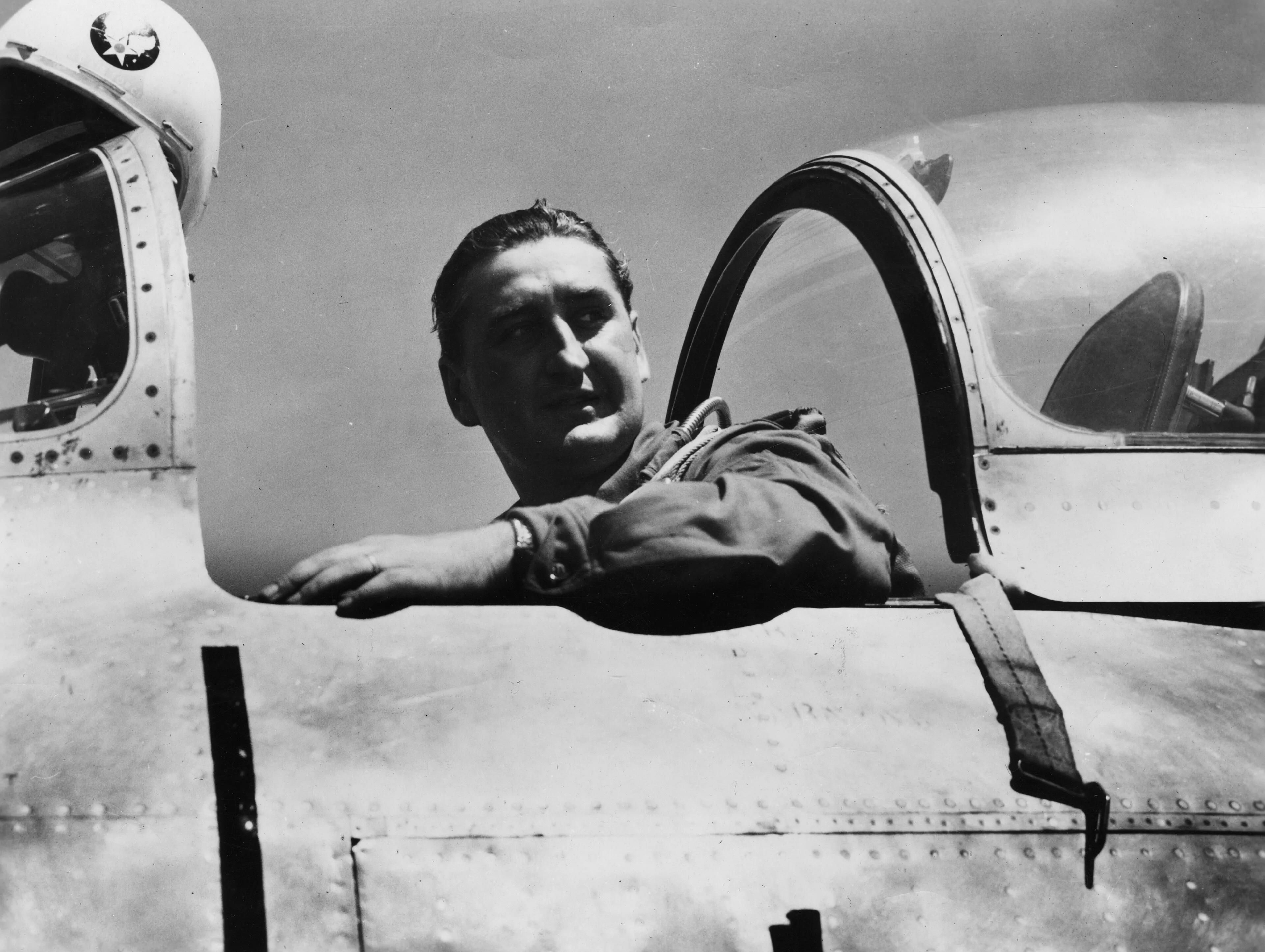
John Boyd, an American fighter pilot of the Korean War era and later a military theorist, drew the same idea as a diagram. Boyd’s “OODA loop” (observe, orient, decide, act) is usually taught as a race: cycle through the four steps faster than your opponent. The only sketch of it he drew, in a 1995 briefing, puts orientation at the centre, made up of “Cultural Traditions”, “Genetic Heritage”, “Previous Experience”, “New Information” and “Analyses & Synthesis”. His caption reads: “Note how orientation shapes observation, shapes decision, shapes action, and in turn is shaped by the feedback and other phenomena coming into our sensing or observing window.”20 In Boyd’s drawing, what you already believe decides what you notice in the first place.
Chet Richards, who worked with Boyd, links orientation to the fighter pilot’s habit of “maintaining ‘situation awareness’”.20 It also explains the radiologists. They were trained to look for nodules, and a gorilla was outside what they expected to find on a lung scan.
Signals people send on purpose
Some anomalies are behaviours a person chooses. Gavin de Becker listed seven of them in his 1997 book The Gift of Fear: Survival Signals That Protect Us from Violence. In paraphrase, they are: forced teaming, an invented “we” where there is no shared problem; charm and niceness used to disarm; too many details, because a liar who feels doubted over-explains; typecasting, a small insult you will want to disprove; loan sharking, help you did not ask for that leaves you in debt; the unsolicited promise, an assurance nobody requested; and refusing to accept the word “no”.21 None of them proves bad intent alone. They are worth noticing because each one is an attempt to steer you, and in conversation with a stranger they stand out against the baseline of ordinary small talk.
De Becker also wrote about trusting intuition. Part 1 covered when instinct is reliable: in a setting that gives valid cues, for a person who has had the chance to learn them.22 Klein’s firefighter qualified on both counts. A gut feeling about a stranger in an unfamiliar city does not.
Where the power sits
Once the picture is drawn, the planner has to decide which part of it matters. The manual borrows a tool from military planning for this, centre of gravity analysis, and defines the centre of gravity as “a military force, organization, or other entity’s source of power to act”.23
The method runs in four steps. First list the critical capabilities, what the other side can do: “A CC is a threat function rather than a tangible object”. Then find the centre of gravity, the “primary source of power to act”, by visualising the opponent “as a system of functional components”. Then list the critical requirements, the things it needs, which are “usually tangible elements”; a requirement counts only “if its absence or loss disables the threat’s CC”. Last, find the critical vulnerabilities, which “may be tangible structures or equipment, or an intangible perception, populace belief, or susceptibility.”23 The manual adds a caution aimed at the planner’s own habits: “U.S. systems and capabilities are not a mirror image of those of the threat.”23
The useful part for a civilian is the manual’s list of things people mistake for a centre of gravity. It includes “The will of the people”, “Leadership/key personality (this is a potential CR)”, “Resources (by themselves, resources are not COGs; this is another potential CR)”, “Time (this is a potential CR)” and the media, which may “influence the will of the people and key leaders, which is only a requirement.”24 Its test is a pair of verbs. “‘Does’ identifies the source, agent, or thing that carries out a particular task”, and that is the source of power. “‘Uses’ identifies a factor that the source, agent, or thing uses to perform a particular task”, and that is only a requirement. Its own table puts it bluntly: “Leadership is critical, but leadership by itself cannot conduct attacks.” “Weapons are not actors and cannot do anything by themselves.”24
In the manual’s worked example against an insurgency, the requirement most open to influence turns out to be “populace cooperation”, which rests on things such as “retribution by insurgents”, “monetary rewards paid by insurgents”, “distrust of foreigners” and the “perception of the government as a puppet regime”.25
Applied at work, the does/uses test changes the question from “who is in charge?” to “who actually does the thing?” A manager who signs off a decision uses the team that produces it; the team that produces it is where the capability lives. The same test applies to a news story. A newspaper or a channel uses its sources. Asking who supplied the facts, and who did the reporting, shows where a story’s power to persuade comes from.
The manual ranks possible targets on six scores, one of which is recognisability: whether anyone can see a change once it happens. Its lowest score is for a target where “impact indicators are near impossible to collect.”26 The same rule applies to anything you decide to watch. If you would not be able to tell whether it had changed, it is the wrong thing to watch.

A list of signs is only as good as the assumptions behind it. In 1981 Soviet intelligence began a programme, known as RYAN, to watch for signs that the United States was preparing a surprise nuclear attack. According to a CIA history, the KGB’s London station was told to monitor the prices paid for blood at urban donor banks, on the theory that prices would rise as blood banks stockpiled before a war. British donor banks do not pay for blood. The contributions are voluntary.27
Sources and notes27
Footnotes
-
Trafton Drew, Melissa L.-H. Võ and Jeremy M. Wolfe, “The invisible gorilla strikes again: sustained inattentional blindness in expert observers”, Psychological Science 24:9 (2013), 1848-1853. https://pmc.ncbi.nlm.nih.gov/articles/PMC3964612/. Confidence: verified. ↩
-
Daniel J. Simons and Christopher F. Chabris, “Gorillas in our midst: sustained inattentional blindness for dynamic events”, Perception 28:9 (1999), 1059-1074. http://www.chabris.com/Simons1999.pdf. Results are for 192 of 228 observers; 46 per cent missed the unexpected event of either kind. Confidence: verified. ↩
-
Mica R. Endsley, “Theoretical underpinnings of situation awareness: a critical review”, in Endsley and Garland (eds), Situation Awareness Analysis and Measurement (2000). https://maritimesafetyinnovationlab.org/wp-content/uploads/2018/11/Endsley-Theory-of-Situational-Awareness.pdf. The full theory is in Endsley, “Toward a theory of situation awareness in dynamic systems”, Human Factors 37:1 (1995), 32-64, which was not read. Confidence: verified. ↩ ↩2
-
Debra G. Jones and Mica R. Endsley, “Sources of situation awareness errors in aviation”, Aviation, Space and Environmental Medicine 67:6 (1996), 507-512 (abstract), https://pubmed.ncbi.nlm.nih.gov/8827130/; the 35 and 8.4 per cent figures are Endsley’s own report of the same study in Endsley (2000), cited at note 3. Confidence: verified (abstract and Endsley’s account; the full 1996 paper was not read). ↩
-
Headquarters, Department of the Army, FM 3-05.301: Psychological Operations Process Tactics, Techniques, and Procedures (30 August 2007), paras 1-22 and 1-24, pp. 1-11 to 1-12. The checklist headings are paraphrased except where quoted. The manual has circulated publicly since Public Intelligence posted it on 8 June 2012. https://publicintelligence.net/restricted-u-s-army-psyops-manual/. Confidence: verified. ↩ ↩2
-
FM 3-05.301, paras 1-23 and 1-25, and Figure 1-4, pp. 1-12 to 1-13. Confidence: verified. ↩
-
FM 3-05.301, paras 7-5 and 7-6, p. 7-3. Confidence: verified. ↩
-
FM 3-05.301, para 6-35, p. 6-10. Confidence: verified. ↩
-
FM 3-05.301, para 1-42, p. 1-26. The escape-route example is paraphrased. Confidence: verified. ↩
-
Patrick Van Horne and Jason A. Riley, Left of Bang (Black Irish Entertainment, 2014); Patrick Van Horne, “The Evolution of Combat Hunter”, CP Journal, 15 November 2011, https://www.cp-journal.com/p/the-evolution-of-combat-hunter; Lance Cpl. Jerrick J. Griffin, “Combat Hunter teaches Marines to stalk enemies”, DVIDS, 12 June 2009, https://www.dvidshub.net/news/34964/combat-hunter-teaches-marines-stalk-enemies. Confidence: verified. ↩ ↩2
-
Van Horne and Riley, Left of Bang (2014). https://archive.org/details/left-of-bang-how-the-marine-corps-situational-awareness-program-can-save-your-life. The definitions of anomalies above and below the baseline are paraphrased closely from the book. Confidence: verified. ↩ ↩2
-
Daniel Kahneman, Thinking, Fast and Slow (2011), retelling a case from Gary Klein, Sources of Power (1998). Klein’s own text was not read; summaries of it give the same outline, with the lieutenant ordering his men out and the fire hotter and quieter than expected. Confidence: verified (as Kahneman’s retelling); reported (Klein’s original). ↩
-
Richards J. Heuer Jr., Psychology of Intelligence Analysis (CIA Center for the Study of Intelligence, 1999), ch. 8, quoting Admiral Jeremiah’s review of the 1998 tests. https://www.cia.gov/resources/csi/static/Pyschology-of-Intelligence-Analysis.pdf. Confidence: verified. ↩
-
Van Horne and Riley, Left of Bang (2014). The domain list is paraphrased except for “Atmospherics”. No peer-reviewed validation of the six domains or the Rule of Three was found; Van Horne’s firm, CP Journal, sells training in the method. Confidence: verified (book’s content); unknown (validity). ↩ ↩2
-
Charles F. Bond Jr and Bella M. DePaulo, “Accuracy of deception judgments”, Personality and Social Psychology Review 10:3 (2006), 214-234, https://pubmed.ncbi.nlm.nih.gov/16859438/; US Government Accountability Office, GAO-14-159, November 2013, https://www.gao.gov/assets/gao-14-159.pdf. Confidence: verified. ↩
-
Jeff Cooper, Principles of Personal Defense (Paladin Press, revised edition 1989; first edition 1972). Confidence: verified. ↩ ↩2
-
Definitions attributed to Cooper’s Commentaries 13:7 (July 2005), as given in “Jeff Cooper”, Wikipedia; the “not a means of assessing danger” line is attributed to Cooper’s Commentaries 6:9 and the rejection of extra levels to 11:12, as quoted by the Sensible Self Defense blog, 17 May 2024. The Commentaries were not read. Confidence: reported. ↩ ↩2
-
Heuer, Psychology of Intelligence Analysis (1999), ch. 2. Confidence: verified. ↩
-
US Government, A Tradecraft Primer: Structured Analytic Techniques for Improving Intelligence Analysis (March 2009). https://www.cia.gov/resources/csi/static/Tradecraft-Primer-apr09.pdf. Confidence: verified. ↩
-
John R. Boyd, “The Essence of Winning and Losing” (1995-96), ed. Chet Richards and Chuck Spinney (2012), https://slightlyeastofnew.com/wp-content/uploads/2010/03/essence_of_winning_losing.pdf; Chet Richards, “Boyd’s OODA Loop (It’s Not What You Think)”, 7 May 2018, https://slightlyeastofnew.com/wp-content/uploads/2018/05/boyds-real-ooda-loopx.pdf. Accounts of Boyd’s Korean War service differ, so no mission record is given here. Confidence: verified (Boyd’s sketch); reported (Richards’ reading). ↩ ↩2
-
Gavin de Becker, The Gift of Fear (Little, Brown, 1997). The book was not read; the list of seven signals is consistent across secondary accounts and is given here in paraphrase. Confidence: reported. ↩
-
Daniel Kahneman and Gary Klein, “Conditions for intuitive expertise: a failure to disagree”, American Psychologist 64:6 (2009), 515-526. https://doi.org/10.1037/a0016755. Confidence: verified. ↩
-
FM 3-05.301, paras 1-26 to 1-32, pp. 1-13 to 1-17. CC, COG and CR stand for critical capability, centre of gravity and critical requirement. Confidence: verified. ↩ ↩2 ↩3
-
FM 3-05.301, paras 1-29 and 1-30, pp. 1-14 to 1-15, and Table 1-1, pp. 1-16 to 1-17. Confidence: verified. ↩ ↩2
-
FM 3-05.301, p. 1-18. The insurgency is one of the manual’s training examples. Confidence: verified. ↩
-
FM 3-05.301, paras 1-36 to 1-38, pp. 1-22 to 1-24 (the CARVER method). Confidence: verified. ↩
-
Benjamin B. Fischer, A Cold War Conundrum: The 1983 Soviet War Scare (CIA Center for the Study of Intelligence, 1997). https://www.cia.gov/resources/csi/static/Cold-War-Conundrum.pdf. The text read carries no date; 1997 is the date in the Google Books catalogue record for the CIA monograph. Confidence: verified (content); reported (year). ↩
Letters
No letters on this report yet.
Letter received
Thank you. It is with the editors now and will appear here if we publish it.