Read the world · Part 1 · 1957–2026
Read the room
The US Army trains its influence soldiers to study a group of strangers before saying a word to them: who does what, who they listen to, what they fear and want, and what would make them change. The method was written for foreign villages. It works in a meeting, a family and a new job, and it starts this series.
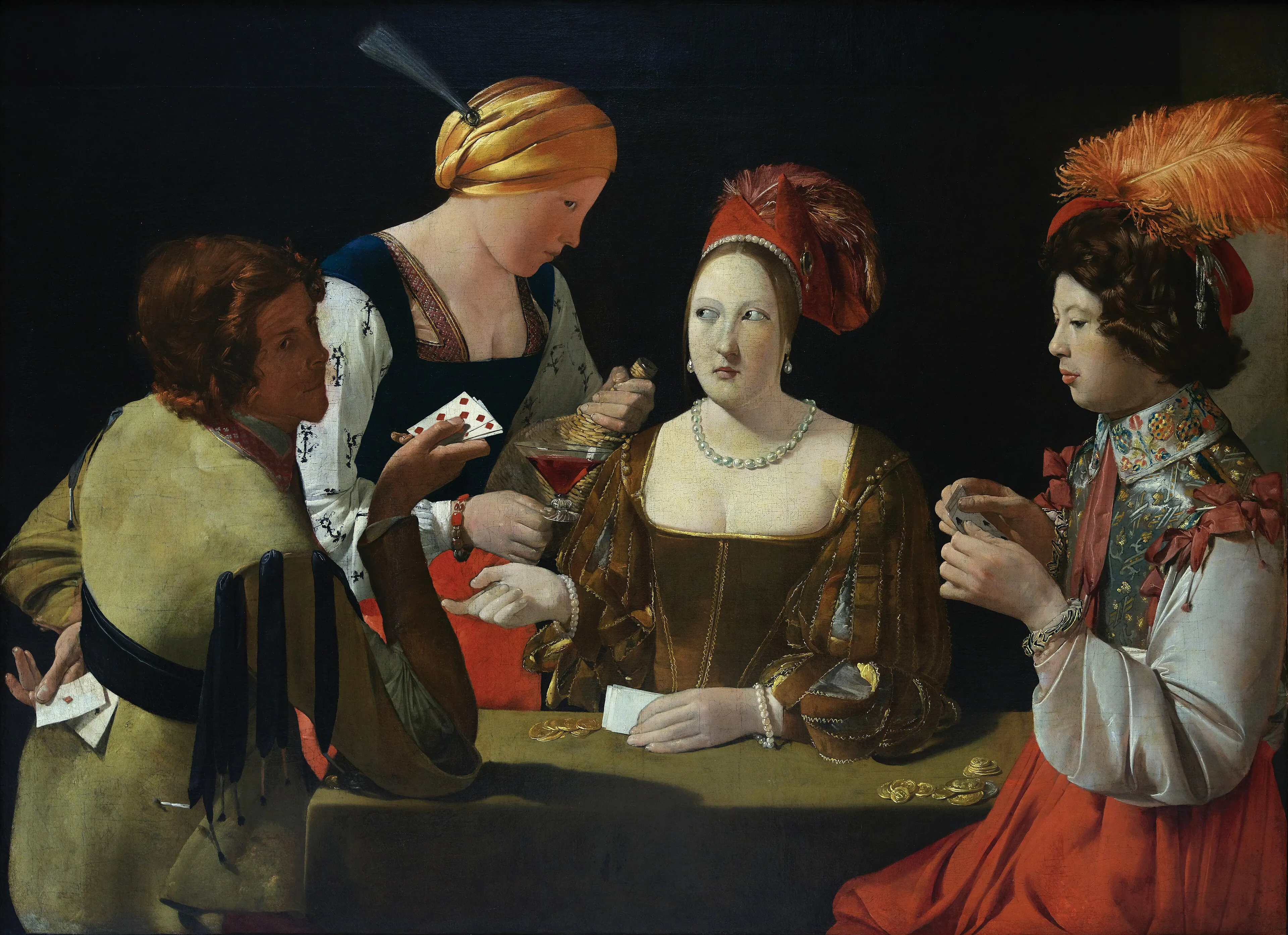
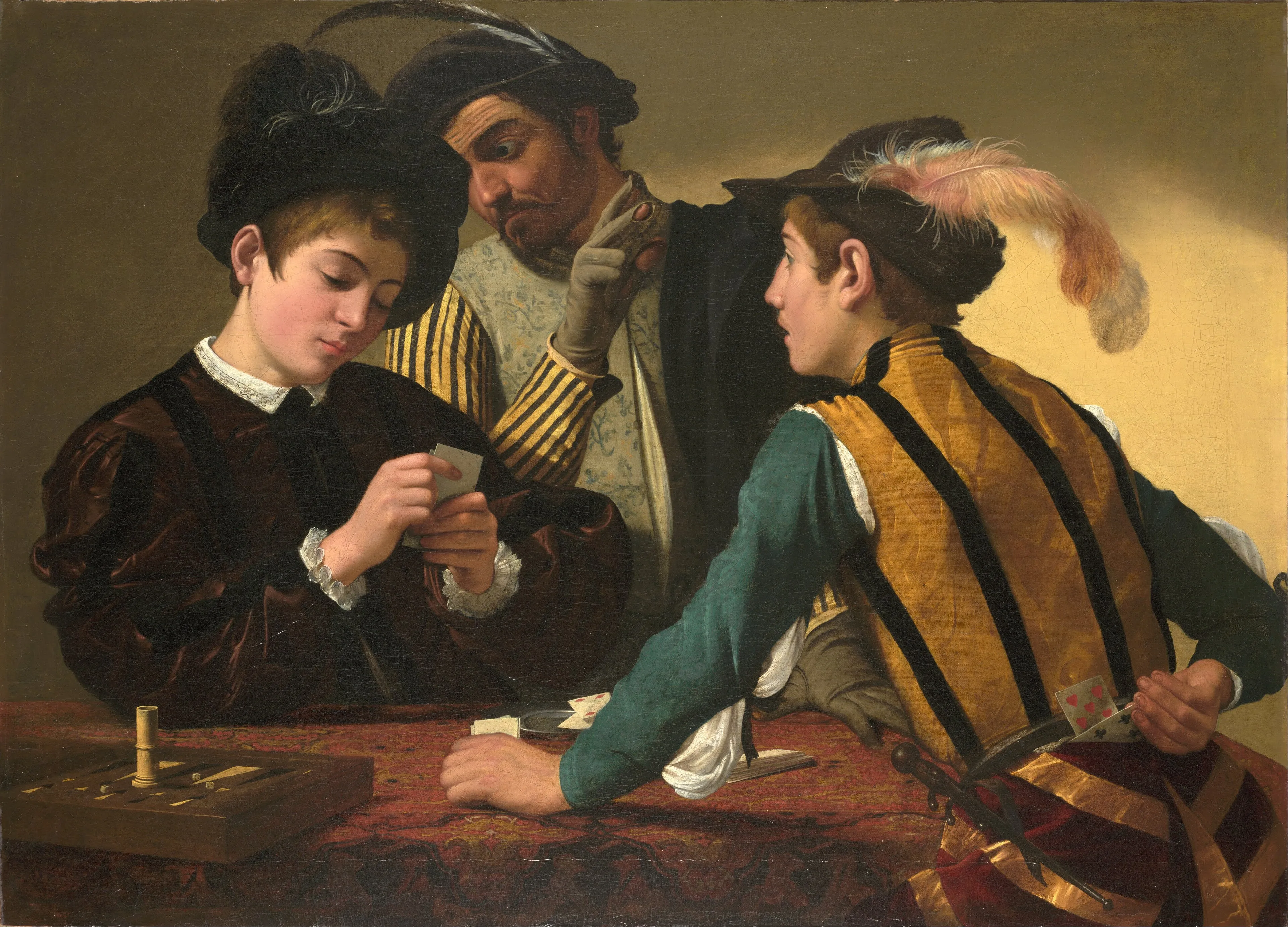
The Cheat with the Ace of Diamonds, Georges de La Tour, about 1635. Everyone at the table is reading someone except the young man with the money.Musée du Louvre. Public domain, via Wikimedia Commons
When an American psychological operations soldier has to work through an interpreter, the Army’s manual suggests taking two. “One interpreter is used in an active role and the other pays attention to the body language and side conversations of the others present. Many times, the PSYOP Soldier gains important side information that assists in negotiations from listening to what others are saying among themselves outside the main discussion.”1
The manual is FM 3-05.301, Psychological Operations Process: Tactics, Techniques, and Procedures, published by the US Army in August 2007. Its cover restricts it to “U.S. Government agencies and their contractors only” and orders readers to destroy it “by any method that will prevent disclosure of contents”. It has circulated publicly since 2012, when the website Public Intelligence posted it.2 It is a training manual for soldiers whose job is to change what foreign groups do: surrender, report a bomb-maker, vote, stay off a road. It describes itself as “a guide, and not a regulation”.3
This series takes the manual apart for civilians. The first five parts borrow its methods for everyday life: reading people, keeping your eyes open, making a case, spotting manipulation and measuring change. The next seven turn the same methods on real campaigns run on whole populations, in plagues, wars, currency crises and the statistics governments publish. Every part ends with a practice plan, because these are skills, and a skill is something you do repeatedly until it sticks. The manual’s own word for the first step is target audience analysis, and it calls it “the single most important task”.4
Who is in the room
The manual starts by sorting people by what they do. “Primary actors” are “the ‘doers’”, the people engaging in the behaviour you care about. “Secondary actors are those individuals or groups that have the ability to directly or indirectly influence the behavior of the primary actors. Secondary actors are often leaders and key communicators.”5
Key communicators matter most. The manual defines one as “an individual to whom the target audience turns most often for an analysis or interpretation of information or events”: “teachers, principals, religious figures, town elders, or prominent businessmen”.6 In a meeting, that is the person others look at before they answer, or whose reply to an email everyone waits for. It is often not the most senior person present. If you want to know how a team will take a decision, find out who they will ask about it afterwards.
Leaders are a separate case. “Leaders can make very effective TAs, as they can potentially affect the thoughts and actions of those they lead. However, they are not easily susceptible to persuasion… When leaders can be persuaded, the impact can be tremendous.”5
Organisations, the manual says, are the easiest groups to read, because their members share a purpose, see each other “as associates or coworkers” and get their information from the same places. Broad categories are the hardest: “Blue-collar factory workers between the ages of 21 and 35” may have nothing in common “except in the broadest sense”.5 “Millennials” or “the client” is not an audience. The three people on the client’s side who will sign the contract are.
Why people do what they do
The manual’s next step is to understand the behaviour before trying to change it. “All behavior serves a purpose. Therefore, any given behavior is based upon a continual cost benefit analysis. As long as the TA believes that the benefits sufficiently exceed the costs, it will engage in a behavior.”7 It names five purposes:
| Purpose | The manual’s definition |
|---|---|
| Escape or avoidance | “used to get out of doing something or away from something unpleasant” |
| Access to tangibles | “used to obtain something desirable”, often when it is “denied or taken away” |
| Justice or revenge | “used to punish others or pay back for perceived wrongs” |
| Power or control | “to gain or maintain control of others; to dominate, be in charge of, or control their environment” |
| Acceptance or affiliation | “belonging or gaining acceptance from a group; used to impress members of a peer group” |
When a colleague blocks a project, a teenager slams a door or a client goes silent, the list gives you five guesses to test before you decide what is going on. The manual adds two rules from behavioural psychology: “Behavior that is reinforced will be repeated”, and “short-term pleasurable activities usually outweigh long-term consequences.”8 A meeting that rewards whoever talks loudest will produce more loud talking. And “a reinforcer for one TA may do nothing for another, or even have the opposite effect”:8 public praise delights some people and mortifies others.
The nine questions
For what drives a group, the manual uses what it calls psychographics, “internal psychological factors” that “provoke an emotional response”. Its list of questions is the most useful checklist in the book:9
What do they fear? What do they hate? What angers them? What do they love? What do they find shameful or embarrassing? What are they dissatisfied with (“What are its gripes?”)? What are the cultural norms (“How is the TA expected to act?”)? What do they value? What are their frustrations (“What does the TA want that it cannot get?”)?
Before a negotiation, a difficult conversation or a first week in a new job, write the answers down for the people involved. Where you do not know, write “don’t know”. The manual is strict on this. Every condition on its analysis sheet “should cite a specific source”, and “logical assumptions can be made as they can be very beneficial for the analysis, but should be annotated as such.”10 Mark which answers you saw and which you guessed. It also reminds its soldiers that “conditions will change”, so the sheet has to be “updated regularly”.10
How open are they, and how do they hear things?
Susceptibility, in the manual, “is the likelihood the TA will be open to persuasion”, and it turns on perceived risk, perceived reward and fit with existing values. “Immediate risks and rewards are stronger than long-term risks and rewards. Example: Very few people are willing to walk a tightrope (immediate risk), but many people smoke (long-term risk).”11
When an audience is closed, the manual does not recommend a louder message. “The lower the susceptibility, the more conditions will need to be modified for behavior change to occur.”11 If your team will not adopt a new process, you may get further by removing the cost (the extra form, the lost evening) than by making a better slide about its benefits.
Then accessibility: “How is the TA receiving information currently? What are the most credible media and familiar formats to the TA?” The manual’s own planning example notes a population where “face-to-face communication is considered most credible”.12 Some people trust a document, some a conversation, some only what a colleague tells them over lunch.
A worked example: the Red Tribe
The manual’s appendix walks through a full analysis of an invented group, “Red Tribe Males Age 18+ in Nashburg”, who are boycotting an election. The obvious approach would be to explain why voting matters. The analysis finds the real barrier elsewhere: “acting against the will of tribal leaders is NOT consistent with values and beliefs.” Several of the tribe’s traditional moral stories are about “the young not obeying/listening to the tribal elders, and getting into trouble.” So the recommendation is to work on the elders: “the Red Tribe leadership’s support is crucial to influencing this TA to vote.”13 The analysis also notes that this audience prefers face-to-face contact, “as it feels it can see through the words and truly judge the message by the appearance of the communicator.”13
The same pattern turns up in offices and families. The people whose behaviour you want to change are often doing exactly what someone they respect expects of them.
What the research says about reading people
Reading a room is easy to oversell. The best evidence on lie detection comes from a 2006 review of studies covering 24,483 judges by Charles Bond and Bella DePaulo: people “achieve an average of 54% correct lie-truth judgments”, against 50 per cent for a coin toss. They caught 47 per cent of lies and judged 61 per cent of truths honest, so the main error is believing people. They did better listening than watching: “people are more accurate in judging audible than visible lies.”14
Expensive attempts to do better have failed. From 2007 the US Transportation Security Administration trained about 3,000 officers to spot “94 signs of stress, fear, and deception” in airport passengers, citing the psychologist Paul Ekman’s work on facial expressions. After about $900m, the Government Accountability Office reviewed more than 400 studies and found that “the human ability to accurately identify deceptive behavior based on behavioral indicators is the same as or slightly better than chance.”15
The most quoted figure about body language is also misused. The psychologist Albert Mehrabian’s formula, that liking is 7 per cent words, 38 per cent tone and 55 per cent face, came from studies of single spoken words. His own website says: “Unless a communicator is talking about their feelings or attitudes, these equations are not applicable.”16
What does hold up is less dramatic. Carl Rogers and Richard Farson’s 1957 paper “Active Listening” told managers to “listen for total meaning”, because a message has “the content of the message and the feeling or attitude underlying this content.” Their example is a worker who says “I’ve finished that lathe setup” and one who says “Well, I’m finally finished with that damned lathe setup”. The content is the same and the meaning differs, and a good foreman answers the second with “Glad to have it over with, huh?”17
On groups, Anita Woolley and colleagues tested 699 people in small teams in 2010 and found that a group’s performance across tasks was “not strongly correlated with the average or maximum individual intelligence of group members”. It was linked to members’ social sensitivity, measured by a test of reading emotions from photographs of eyes, and to “the equality in distribution of conversational turn-taking”.18 Later work disputes how strong the effect is, but the practical point survives: notice who never gets to speak. Amy Edmondson’s study of 51 manufacturing teams in 1999 found that “team psychological safety”, “a shared belief held by members of a team that the team is safe for interpersonal risk taking”, was associated with how much teams learned.19 Google’s internal study of 180 of its own teams put psychological safety first of the five things that mattered.20
On instinct, the psychologists Daniel Kahneman and Gary Klein, who started out on opposite sides of the argument, agreed in 2009 on two conditions for trusting a gut feeling: “the environment must provide adequately valid cues”, and “people must have an opportunity to learn the relevant cues.” They added a warning: “Subjective experience is not a reliable indicator of judgment accuracy.”21 A nurse’s instinct on a ward she has worked for ten years is worth listening to. Your instinct about a stranger at a party is a guess.
Manners the manual insists on
Some of the best advice in the manual is about behaviour, and it reads like a guide to being taken seriously anywhere. Interpreters may “attempt to ‘save face’ by purposely concealing their lack of understanding”, so make it safe to ask. “Neither the PSYOP Soldier nor interpreter should correct the other in front of an interviewee or class”, and differences should be “settled away from the subject or audience.” “If the class asks few questions, it may mean the instruction is ‘over the heads’ of the audience.” And “the PSYOP Soldier should never say more in one sentence than he can easily repeat word for word immediately after saying it.”22
On mirroring, the trick of copying someone’s posture and voice to build rapport, the manual is cautious: it “must be subtle and appear natural, and may not be appropriate in every culture or situation.”23

The manual’s rule for building rapport through an interpreter fits any room: “the subjects or audiences should be treated as mature, important human beings who are capable and worthy.”24
Sources and notes24
Footnotes
-
Headquarters, Department of the Army, FM 3-05.301: Psychological Operations Process Tactics, Techniques, and Procedures (30 August 2007), appendix E, para E-10, pp. E-2 to E-3. Confidence: verified. ↩
-
FM 3-05.301, cover. Public Intelligence, “Restricted U.S. Army Psychological Operations Process Tactics, Techniques, and Procedures Manual”, 8 June 2012. https://publicintelligence.net/restricted-u-s-army-psyops-manual/. The manual carries a distribution restriction, not a security classification. It supersedes a 2003 edition. Confidence: verified. ↩
-
FM 3-05.301, preface, p. vii. Confidence: verified. ↩
-
FM 3-05.301, introduction, p. ix. Confidence: verified. ↩
-
FM 3-05.301, paras 2-17 to 2-23, pp. 2-4 to 2-5. Confidence: verified. ↩ ↩2 ↩3
-
FM 3-05.301, glossary; para 2-23, p. 2-5. Confidence: verified. ↩
-
FM 3-05.301, para 2-34, p. 2-9; para 2-53, p. 2-14. Confidence: verified. ↩
-
FM 3-05.301, para 2-46, p. 2-13; para 2-49, p. 2-14. Confidence: verified. ↩ ↩2
-
FM 3-05.301, paras 2-66 and 2-67, pp. 2-17 to 2-18. Confidence: verified. ↩
-
FM 3-05.301, paras 2-44 and 2-45, p. 2-12. Confidence: verified. ↩ ↩2
-
FM 3-05.301, paras 2-73 to 2-77, pp. 2-20 to 2-21. Confidence: verified. ↩ ↩2
-
FM 3-05.301, para 2-78, pp. 2-21 to 2-22; figure 1-4, p. 1-13. Confidence: verified. ↩
-
FM 3-05.301, appendix B, figure B-6, pp. B-11 to B-15. Nashburg and the Red Tribe are the manual’s fictional training examples. Confidence: verified. ↩ ↩2
-
Charles F. Bond Jr and Bella M. DePaulo, “Accuracy of deception judgments”, Personality and Social Psychology Review 10:3 (2006), 214-234. https://pubmed.ncbi.nlm.nih.gov/16859438/. Confidence: verified (abstract). ↩
-
US Government Accountability Office, Aviation Security: TSA Should Limit Future Funding for Behavior Detection Activities, GAO-14-159 (November 2013). https://www.gao.gov/assets/gao-14-159.pdf. Confidence: verified. ↩
-
Albert Mehrabian, “Silent Messages”, author’s website. http://www.kaaj.com/psych/smorder.html. Confidence: verified. ↩
-
Carl R. Rogers and Richard E. Farson, “Active Listening” (University of Chicago Industrial Relations Center, 1957), as reprinted. http://www.ask-force.org/web/Discourse/Rogers-Farson-ActiveListening-1957.pdf. Confidence: verified. ↩
-
Anita Williams Woolley, Christopher F. Chabris, Alex Pentland, Nada Hashmi and Thomas W. Malone, “Evidence for a collective intelligence factor in the performance of human groups”, Science 330 (29 October 2010), 686-688. https://doi.org/10.1126/science.1193147. Marcus Credé and Garett Howardson (Journal of Applied Psychology, 2017) found the support “generally weak”; a 2021 meta-analysis by Riedl, Woolley and others in PNAS supports it. Confidence: verified. ↩
-
Amy C. Edmondson, “Psychological Safety and Learning Behavior in Work Teams”, Administrative Science Quarterly 44:2 (1999), 350-383. https://doi.org/10.2307/2666999. The quotation has a dash in the original, replaced here by a comma. Confidence: verified (abstract). ↩
-
Google re:Work, “Guide: Understand team effectiveness”. https://rework.withgoogle.com/intl/en/guides/understand-team-effectiveness. Charles Duhigg, “What Google Learned From Its Quest to Build the Perfect Team”, New York Times Magazine, 25 February 2016. Google’s study was internal and not peer-reviewed. Confidence: verified. ↩
-
Daniel Kahneman and Gary Klein, “Conditions for intuitive expertise: a failure to disagree”, American Psychologist 64:6 (2009), 515-526. https://doi.org/10.1037/a0016755. Confidence: verified. ↩
-
FM 3-05.301, appendix E, paras E-19, E-26, E-29 and E-32, pp. E-4 to E-6. Confidence: verified. ↩
-
FM 3-05.301, para 6-36, p. 6-11. Confidence: verified. ↩
-
FM 3-05.301, appendix E, para E-27, p. E-5. Confidence: verified. ↩
Letters
No letters on this report yet.
Letter received
Thank you. It is with the editors now and will appear here if we publish it.